
We read your photo as:
Hydrogen chloride gas dissolved in water conducts electric current because it ionizes to form mobile hydrogen ions (H^+) and chloride ions (Cl^-). These ions are free to move and
ScanSolve AI Answer
-
Hydrogen chloride gas dissolved in water conducts electric current because it ionizes to form mobile hydrogen ions () and chloride ions (). These ions are free to move and carry charge. In methylbenzene, hydrogen chloride does not ionize; it remains as covalent molecules, so there are no mobile ions to conduct electricity.
a) It is necessary to heat the wet sand before heating the iron filings to ensure that all the air is expelled from the apparatus by the steam generated. This prevents the hot iron from reacting with oxygen in the air, which would form iron oxides other than the desired product from the reaction with steam.
b) (ii)
c) (iii) A precaution necessary during the reaction is to ensure that all the air has been expelled from the apparatus before collecting or igniting the hydrogen gas produced. Hydrogen is highly flammable and forms an explosive mixture with air. Also, stop heating the iron filings before stopping the steam supply to prevent suck-back of water into the hot tube.
a) The method used to separate the mixture is fractional distillation.
b) Liquid K will be collected first. Liquid K has a boiling point of , which is lower than liquid H's boiling point of . In fractional distillation, the component with the lower boiling point vaporizes more readily and is collected first.
c) Two industrial applications of fractional distillation are:
- Separation of crude oil into various fractions (e.g., petrol, diesel, kerosene).
- Separation of liquid air into its constituent gases (e.g., nitrogen, oxygen, argon).
a)
- P: The ion has an electron arrangement of 2.8.8, meaning it has 18 electrons. Since it has a charge, the neutral atom P must have had 2 more electrons. Therefore, the electron arrangement of neutral P is 2.8.8.2.
- Q: The ion has an electron arrangement of 2.8.8, meaning it has 18 electrons. Since it has a charge, the neutral atom Q must have had 3 fewer electrons. Therefore, the electron arrangement of neutral Q is 2.8.5.
Still stuck on this one?
Ask a follow-up, and the answer starts from this question.
More Physics Questions
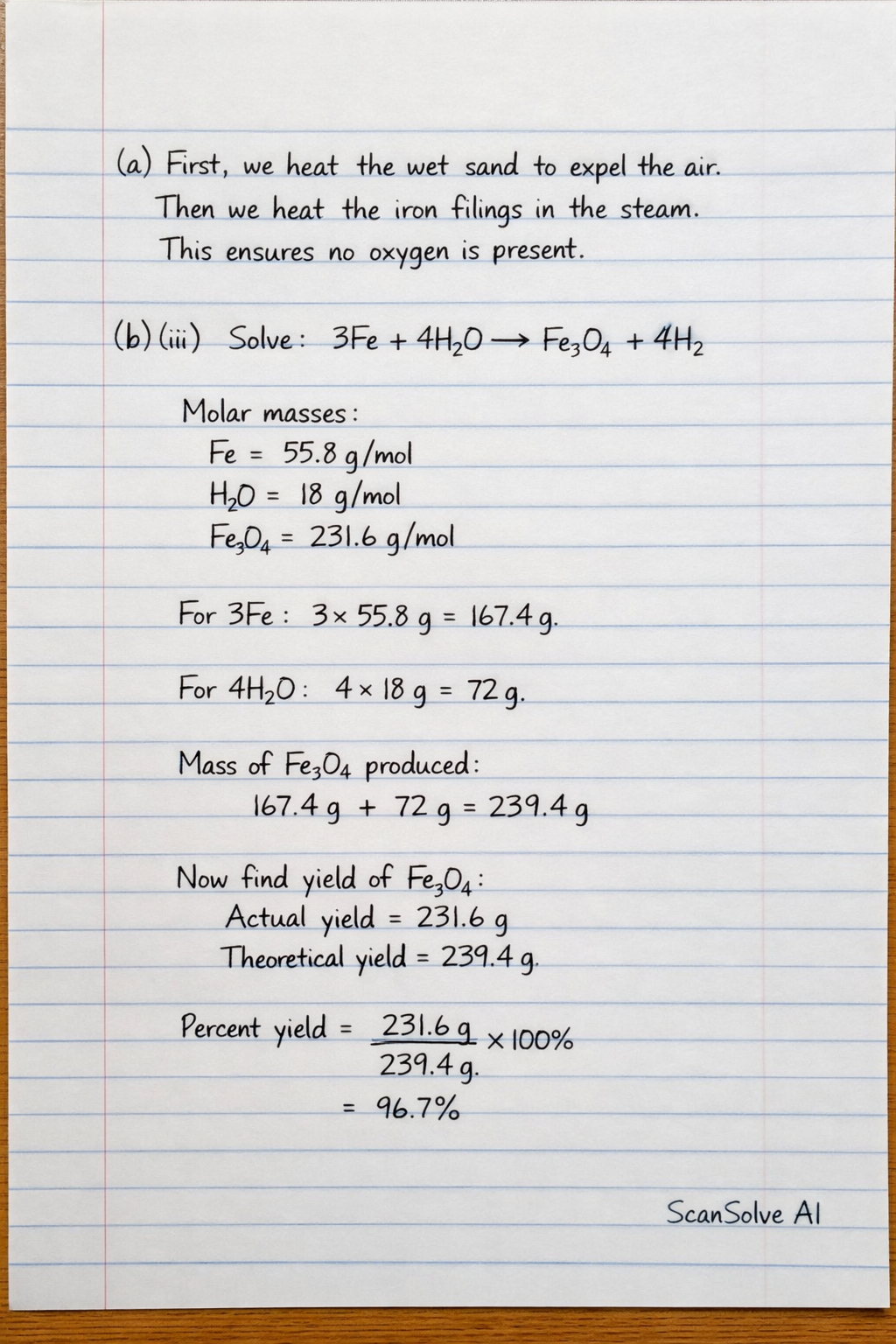
Handwritten Step-by-Step Solution
Get this as a handwritten image on WhatsApp — like a tutor wrote it for you.
Try on WhatsApp