

This physics problem tests your understanding of fundamental physical laws and their applications. The step-by-step solution below breaks down the problem using relevant equations and physical reasoning.
ScanSolve AI Answer
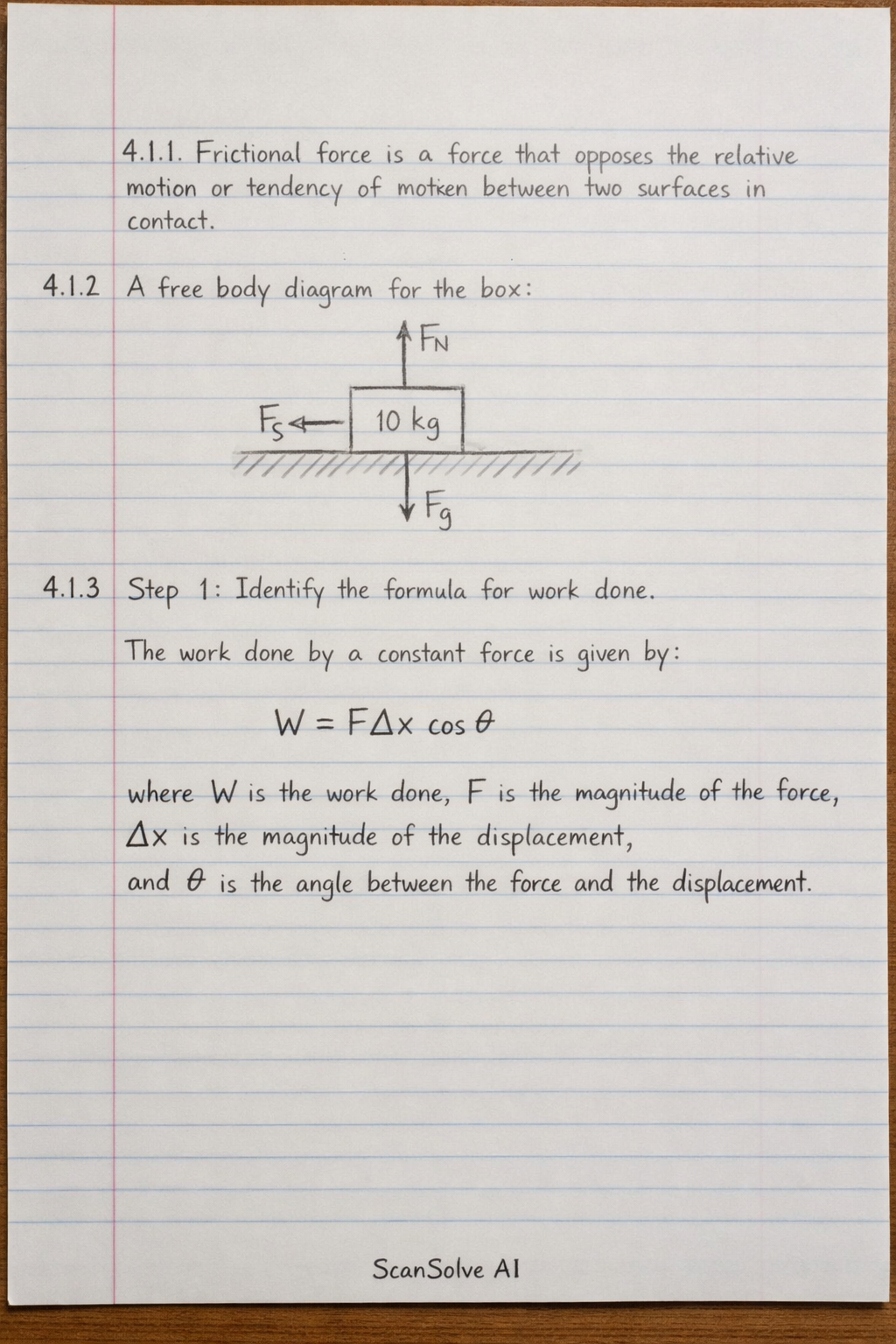
4.1.1 Frictional force is a force that opposes the relative motion or tendency of motion between two surfaces in contact. 4.1.2 A free body diagram for the box: % Box (-0.5,-0.5) rectangle (0.5,0.5); at (0,0) 10 kg; % Surface (-2,-0.5) -- (2,-0.5); in -1.8,-1.6,...,1.8 (,-0.5) -- (+0.2,-0.7); % Forces % Normal Force [->, thick] (0,0.5) -- (0,1.5) node[above] F_N; % Gravitational Force [->, thick] (0,-0.5) -- (0,-1.5) node[below] F_g; % Frictional Force (opposite to motion, which is to the right) [->, thick] (0,0) -- (-1,0) node[left] F_f; 4.1.3 Step 1: Identify the formula for work done. The work done by a constant force is given by: W = F x where W is the work done, F is the magnitude of the force, x is the magnitude of the displacement, and is the angle between the force and the displacement. Step 2: Identify the given values. The frictional force F_f = 9 N. The displacement x = 3 m. The box is sliding to the right, so the displacement is to the right. The frictional force opposes the motion, so it acts to the left. Therefore, the angle between the frictional force and the displacement is = 180^. Step 3: Substitute the values into the formula. W_f = F_f x W_f = (9 N)(3 m) (180^) Step 4: Calculate the work done. We know that (180^) = -1. W_f = (9 N)(3 m)(-1) W_f = 27 J × (-1) W_f = -27 J The work done by friction on the box is -27 J. Send me the next one 📸