
We read your photo as:
A 0.05 kg metal sample at 200.0°C is dropped into 0.40 kg of water at 20.0°C. The final equilibrium temperature is 22.4°C. Calculate the specific heat capacity of the metal. The specific heat capacity
ScanSolve AI Answer
Answer
Step-by-step solution
7 steps: Calorimetry Experiment
Identify the given values for the metal and water.
For the metal:
Mass,
Initial temperature,
Final equilibrium temperature,
Change in temperature,
Specific heat capacity,For the water:
Mass,
Initial temperature,
Final equilibrium temperature,
Change in temperature,
Specific heat capacity,Apply the principle of calorimetry
Heat lost by metal = Heat gained by water.
Calculate the heat gained by the water.
Substitute the values into the calorimetry equation and solve for .
Select the closest option.
The calculated value is closest to .
The specific heat capacity of the metal is .
: Adiabatic Free Expansion
Understand the definitions of an adiabatic process and free expansion.
An adiabatic process is one where no heat is exchanged with the surroundings, so .
A free expansion occurs when a gas expands into a vacuum. In this process, there is no external pressure for the gas to work against.Calculate the work done.
The work done by a gas is given by , where is the external pressure.
For a free expansion, the external pressure .
Therefore, the work done by the gas is:The information about the temperature decrease is a characteristic of a real gas undergoing free expansion, or a non-ideal adiabatic process. However, for an ideal gas undergoing a free expansion, the work done is defined as zero because there is no external pressure.
The work done by the gas in the process is .
Try one yourself
A new problem that tests the same skill.
Still stuck on this one?
Ask a follow-up, and the answer starts from this question.
More Physics Questions
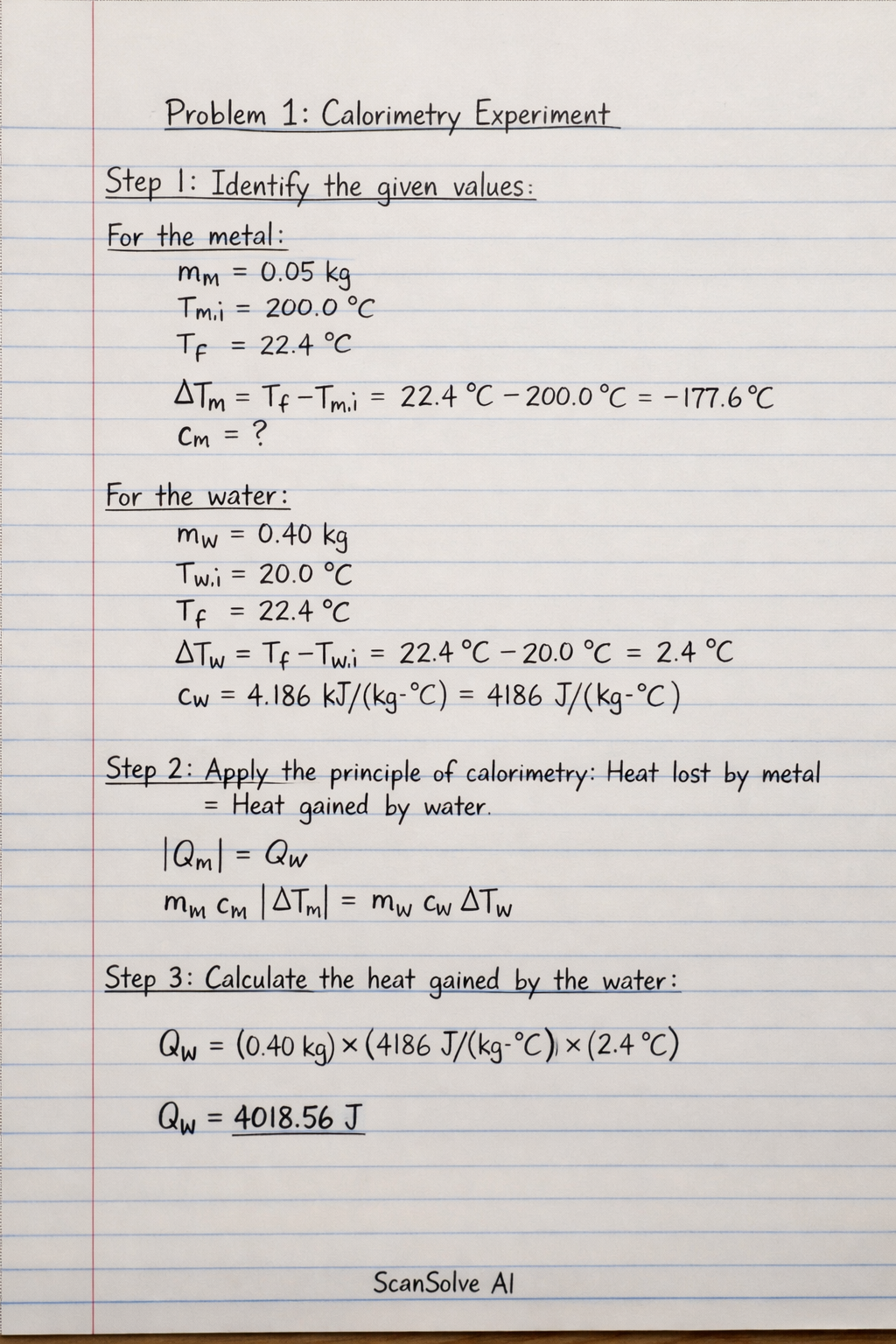
Handwritten Step-by-Step Solution
Get this as a handwritten image on WhatsApp — like a tutor wrote it for you.
Try on WhatsApp