
We read your photo as:
A 10 m ladder weighing 200 N is placed against a smooth wall at an angle of 60 degrees to the horizontal. A 500 N boy stands 2.5 m from the base of the ladder. Find the reactions at the wall and the g
ScanSolve AI Answer
Step-by-step solution
3 stepsTo solve this problem, we will apply the conditions for static equilibrium: the sum of forces in the x-direction is zero, the sum of forces in the y-direction is zero, and the sum of torques about any point is zero.
Given:
- Length of ladder () =
- Weight of ladder () = (acts at from the base)
- Angle with horizontal () =
- Weight of boy () = (acts at from the base)
- The wall is smooth, so there is no friction at the wall.
Let be the normal reaction at the wall, be the normal reaction from the ground, and be the friction force from the ground.
Calculate the normal reaction at the wall ().
We take moments (torques) about the lower end of the ladder (point B in the diagram). The forces and pass through this point, so they create no torque.
The clockwise torques are due to the weights of the ladder and the boy. The anti-clockwise torque is due to the normal reaction from the wall.Horizontal distance for from B = .
Horizontal distance for from B = .
Vertical distance for from B = .For equilibrium, the sum of torques is zero:
Substitute the given values:
Rationalize the denominator:
The normal reaction at the wall is
\boxed{\text{75\sqrt{3} N}}.Calculate the forces at the lower end of the ladder.
These forces are the normal reaction from the ground () and the friction force from the ground ().
Sum of vertical forces ():
Sum of horizontal forces ():
Since the wall is smooth, there is no friction at the wall. The only horizontal forces are the friction from the ground () and the normal reaction from the wall ().Calculate the magnitude of the resultant force acting on the lower end.
The resultant force () at the lower end is the vector
Still stuck on this one?
Ask a follow-up, and the answer starts from this question.
More Physics Questions
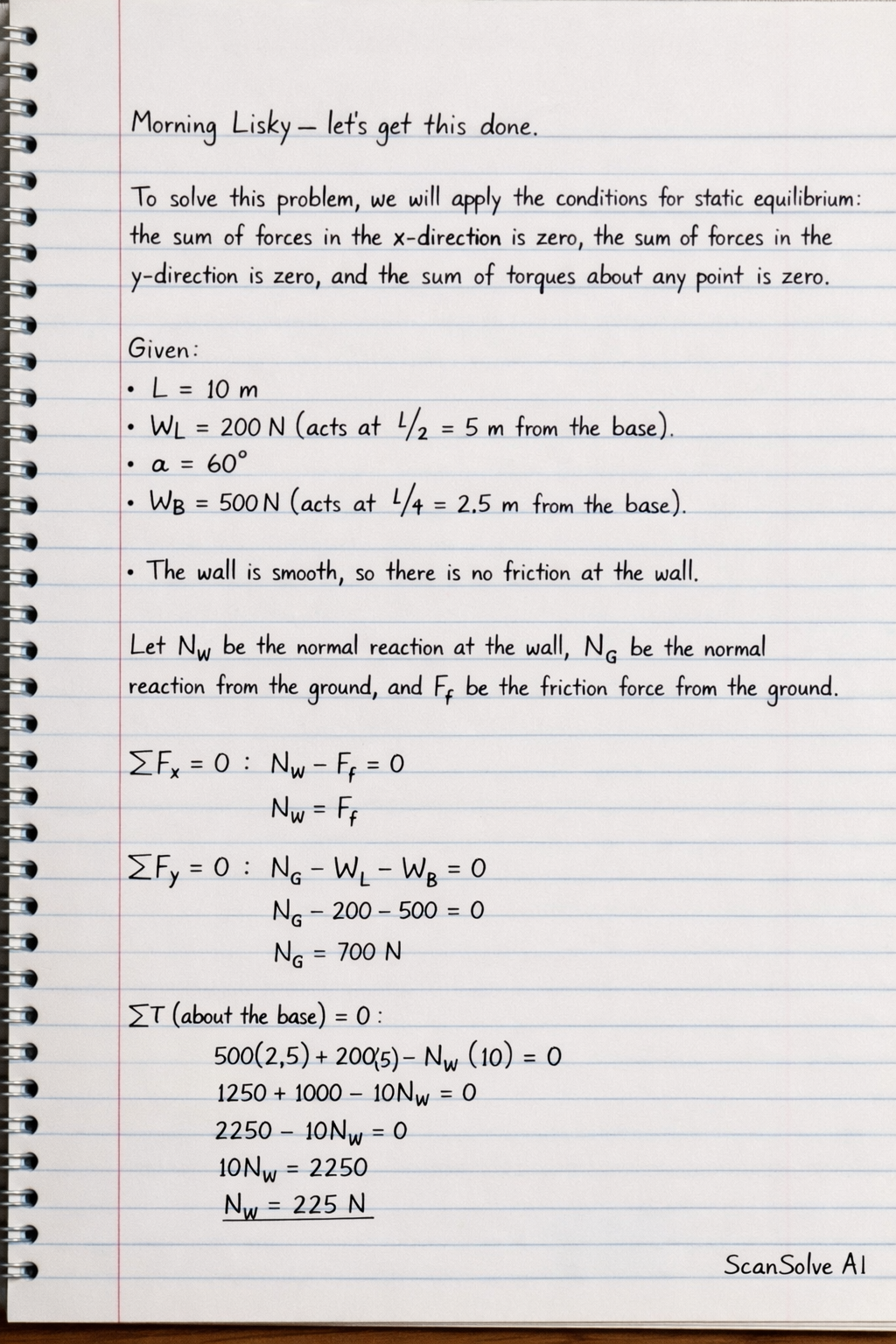
Handwritten Step-by-Step Solution
Get this as a handwritten image on WhatsApp — like a tutor wrote it for you.
Try on WhatsApp