
We read your photo as:
A 12 kg projectile is launched vertically with an initial speed of 20 m/s. If it reaches a maximum height of 18 m, what is the work done by non-conservative forces?
ScanSolve AI Answer
Answer
Step-by-step solution
5 stepsIdentify the initial and final mechanical energies.
The change in mechanical energy () is the sum of the change in kinetic energy () and the change in potential energy (). When non-conservative forces like air resistance are present, the work done by these forces () is equal to the change in mechanical energy.
Given:
Mass of projectile, kg
Initial vertical speed, m/s
Maximum height reached, m
Acceleration due to gravity,Calculate the initial kinetic energy () and initial potential energy ().
At the launch point, we set the initial height .
Calculate the final kinetic energy () and final potential energy ().
At the maximum height, the vertical speed of the projectile is momentarily zero, so .
The final height is m.
Calculate the change in mechanical energy.
Convert the result to kilojoules (kJ) and select the closest option.
Rounding to two decimal places, this is kJ.
The final answer is .
Try one yourself
A new problem that tests the same skill.
Still stuck on this one?
Ask a follow-up, and the answer starts from this question.
More Physics Questions
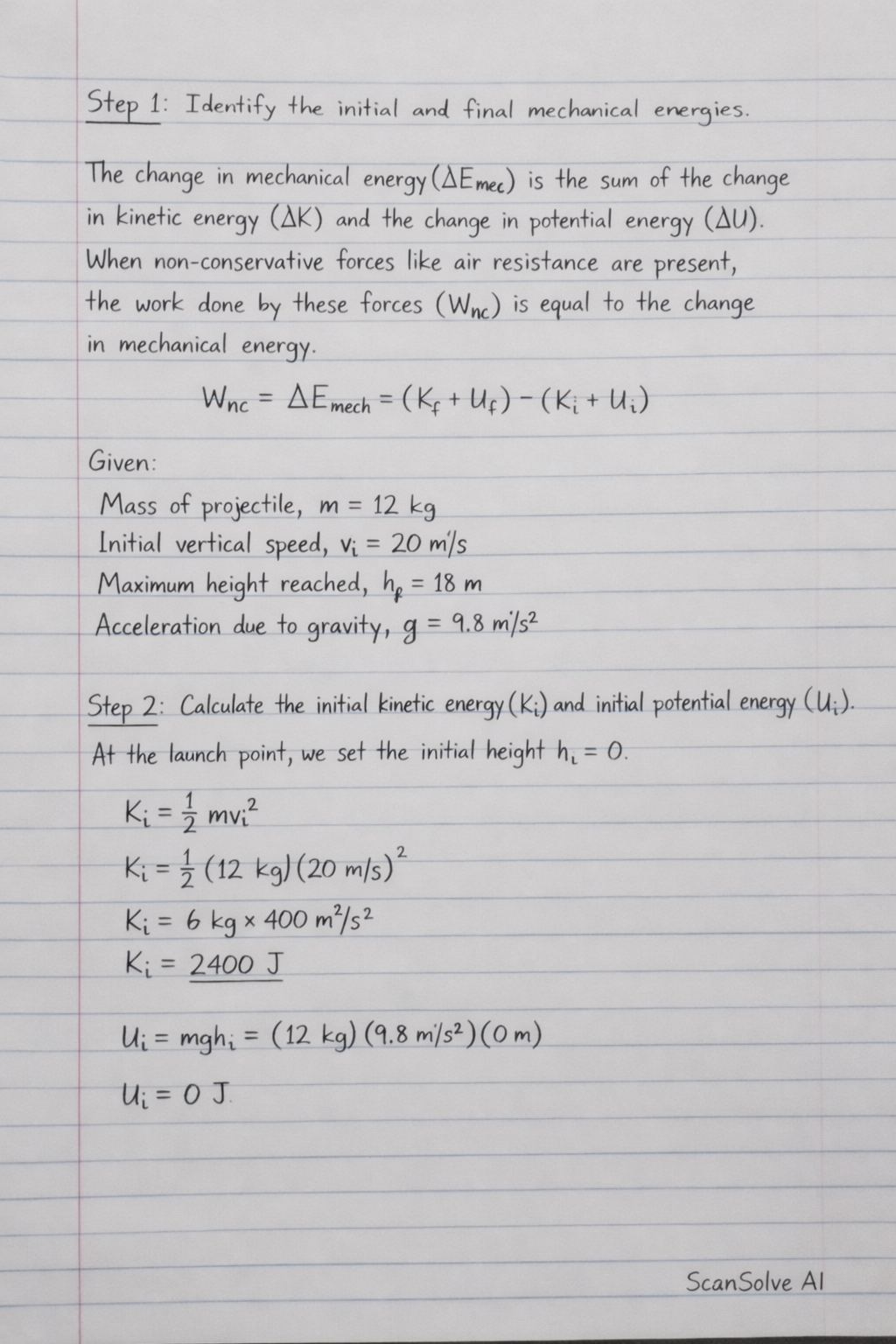
Handwritten Step-by-Step Solution
Get this as a handwritten image on WhatsApp — like a tutor wrote it for you.
Try on WhatsApp