
We read your photo as:
A 2 kg block attached to a spring with spring constant 8 N/m is displaced 2 m from equilibrium and released. What is the time it takes to reach 1 m from equilibrium?
ScanSolve AI Answer
Step-by-step solution
9 stepsCalculate the angular frequency .
The angular frequency for a mass-spring system is given by the formula:
Given and :
Use the equation of motion for simple harmonic motion (SHM).
Assuming the block is released from its maximum displacement at , the position is given by:
We want to find the time when .
Solve for .
Take the inverse cosine of both sides:
We know that .
None of the options (A. 40 sec B. 60 sec C. 30 sec D. 20 sec) match this result. There might be an issue with the question's options or interpretation. However, based on the standard SHM model, this is the time taken. If the question implies traveling to from and then back to or some other interpretation, it's not explicitly stated. Assuming the simplest interpretation of starting at and moving towards .
The final answer is .
Identify the given frequency.
The frequency of the simple pendulum is .
Calculate the angular frequency.
The relationship between angular frequency and frequency is:
Substitute the given frequency:
The final answer is .
Damping of periodic motion always results in a decrease in the amplitude of the oscillations over time due to energy dissipation.
The final answer is .
Calculate the total mass of the car and passengers.
Total mass
Calculate the total effective spring constant.
Since there are four springs supporting the car, and they are in parallel, the total effective spring constant is the sum of the individual spring constants.
Calculate the angular frequency .
The angular frequency for a mass-spring system is given by:
Calculate the frequency .
The frequency is related to the angular frequency by:
Comparing this to the given options:
A.
B.
C.
D.The calculated frequency is approximately .
The final answer is .
Still stuck on this one?
Ask a follow-up, and the answer starts from this question.
More Physics Questions
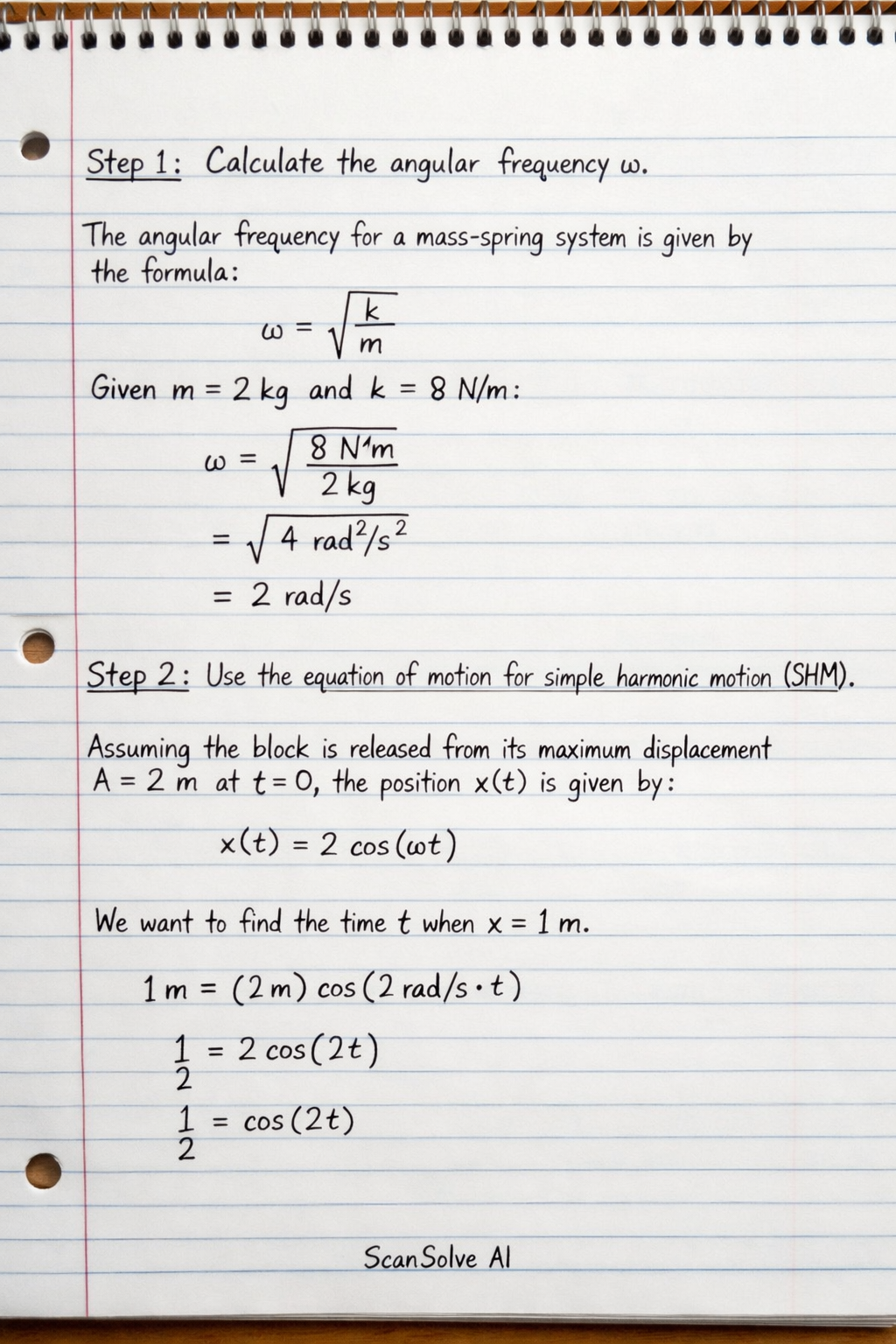
Handwritten Step-by-Step Solution
Get this as a handwritten image on WhatsApp — like a tutor wrote it for you.
Try on WhatsApp