
We read your photo as:
A 2000 kg car moving at 5 m/s collides inelastically with a 5000 kg minibus moving at -7 m/s. Find the final velocity and the impulse on the minibus.
ScanSolve AI Answer
Step-by-step solution
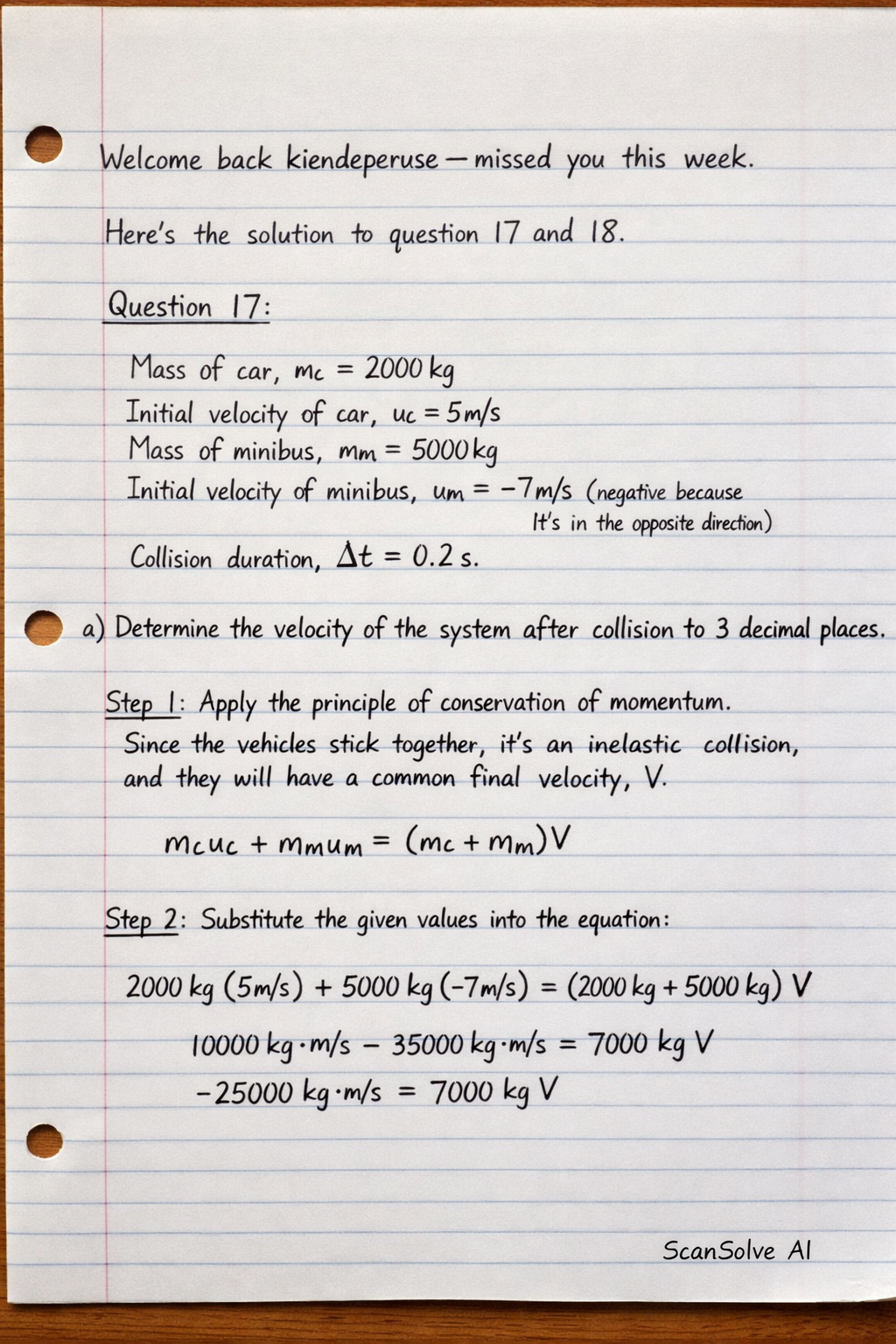
8 stepsHere's the solution to question 17 and 18.
Question 17:
Given:
Mass of car,
Initial velocity of car,
Mass of minibus,
Initial velocity of minibus, (negative because it's in the opposite direction)
Collision duration,
a) Determine the velocity of the system after collision to 3 decimal places.
Apply the principle of conservation of momentum.
Since the vehicles stick together, it's an inelastic collision, and they will have a common final velocity, .
Substitute the given values into the equation.
Solve for .
Rounding to 3 decimal places:
The negative sign indicates that the combined system moves in the initial direction of the minibus.
The velocity of the system after collision is .b) Calculate the impulsive force on the minibus.
Calculate the change in momentum of the minibus.
Impulsive force is the rate of change of momentum.
Impulse,Calculate the impulsive force using the impulse-momentum theorem, .
The impulsive force on the minibus is .
c) Calculate the change in kinetic energy of the system to 5 significant figures.
Calculate the initial kinetic energy of the system.
Calculate the final kinetic energy of the system.
Calculate the change in kinetic energy, .
Rounding to 5 significant figures:
The change in kinetic energy of the system is .
Question 18:
a) (i) State the law of floatation.
The law of floatation states that an object floats if the upthrust acting on it is equal to its weight. This occurs when the object displaces a volume of fluid whose weight is equal to the object's weight.
a) (ii) Explain why a hollow metal sphere floats on water while a solid metal sphere of the same material sinks in water.
A hollow metal sphere floats because its overall average density (total mass divided by total volume, including the air inside) is less than the density of water. A solid metal sphere of the same material sinks because its density is greater than the density of water. The hollow sphere displaces enough water to generate an upthrust equal to its weight, while the solid sphere does not.
Still stuck on this one?
Ask a follow-up, and the answer starts from this question.
More Physics Questions
Handwritten Step-by-Step Solution
Get this as a handwritten image on WhatsApp — like a tutor wrote it for you.
Try on WhatsApp