

This physics problem tests your understanding of fundamental physical laws and their applications. The step-by-step solution below breaks down the problem using relevant equations and physical reasoning.
ScanSolve AI Answer
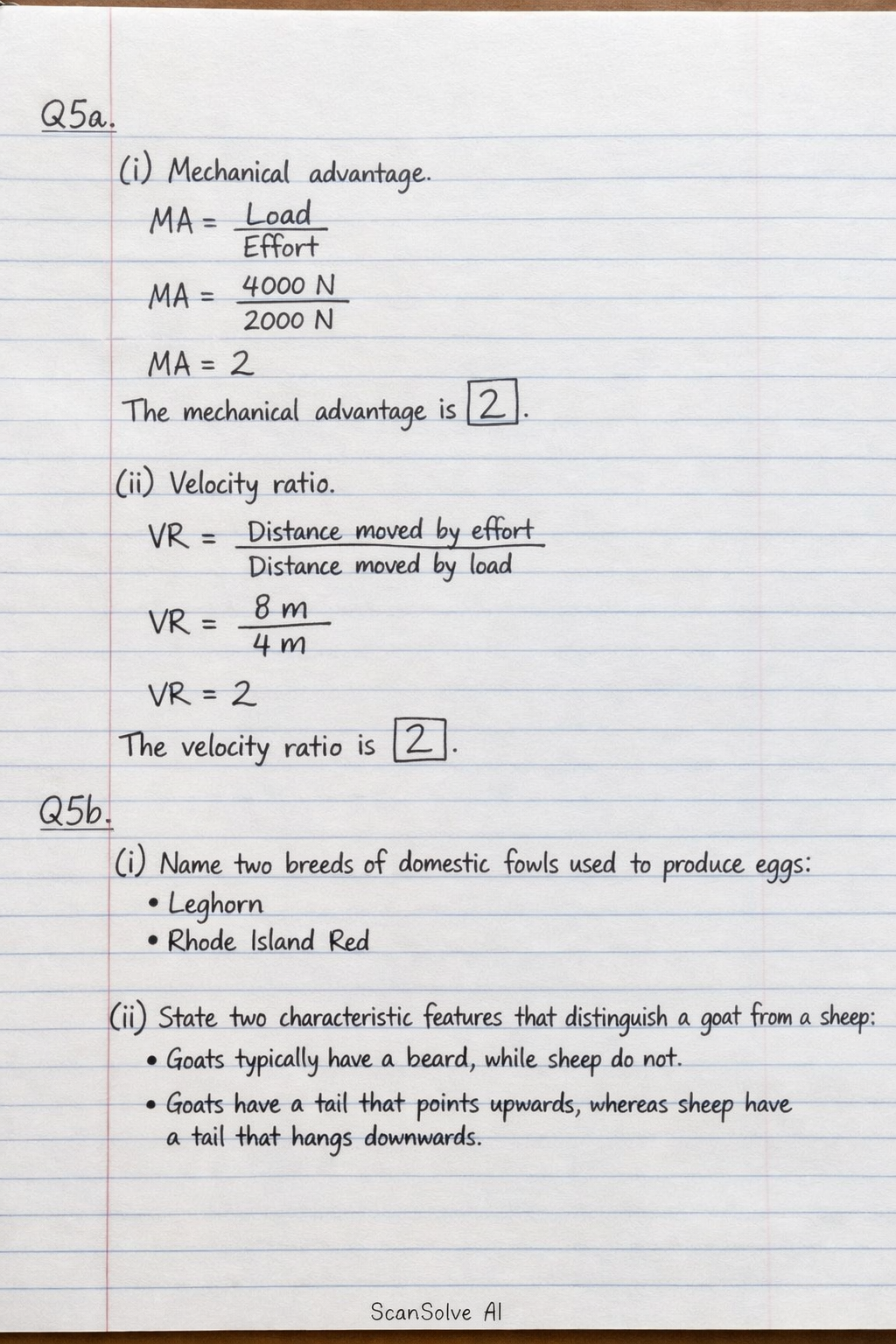
Q5a. An effort of 2000 N moves through a distance of 8 m to raise a load of 4000 N through a distance of 4 m. Calculate: (i) Mechanical advantage Step 1: State the formula for mechanical advantage. MA = LoadEffort Step 2: Substitute the given values. MA = 4000 N2000 N Step 3: Calculate the mechanical advantage. MA = 2 The mechanical advantage is 2. (ii) Velocity ratio Step 1: State the formula for velocity ratio. VR = Distance moved by effortDistance moved by load Step 2: Substitute the given values. VR = 8 m4 m Step 3: Calculate the velocity ratio. VR = 2 The velocity ratio is 2. Q5b. (i) Name two breeds of domestic fowls used to produce eggs. • Leghorn • Rhode Island Red (ii) State two characteristics features that distinguish a goat from a sheep. • Goats typically have a beard, while sheep do not. • Goats have a tail that points upwards, whereas sheep have a tail that hangs downwards. (iii) Classify each of the following quantities into base and derived quantities: Velocity, mass, amount of substance, potential difference. • Velocity: Derived quantity • Mass: Base quantity • Amount of substance: Base quantity • Potential difference: Derived quantity (iv) State the S.I unit of each of the quantities classified in (iii). • Velocity: meter per second (m/s) • Mass: kilogram (kg) • Amount of substance: mole (mol) • Potential difference: volt (V) (v) Name the two types of biasing in diode operation. • Forward biasing • Reverse biasing Q5c. The element Carbon has three isotopes. The three common isotopes of Carbon are: • Carbon-12 (^12C) • Carbon-13 (^13C) • Carbon-14 (^14C)