
We read your photo as:
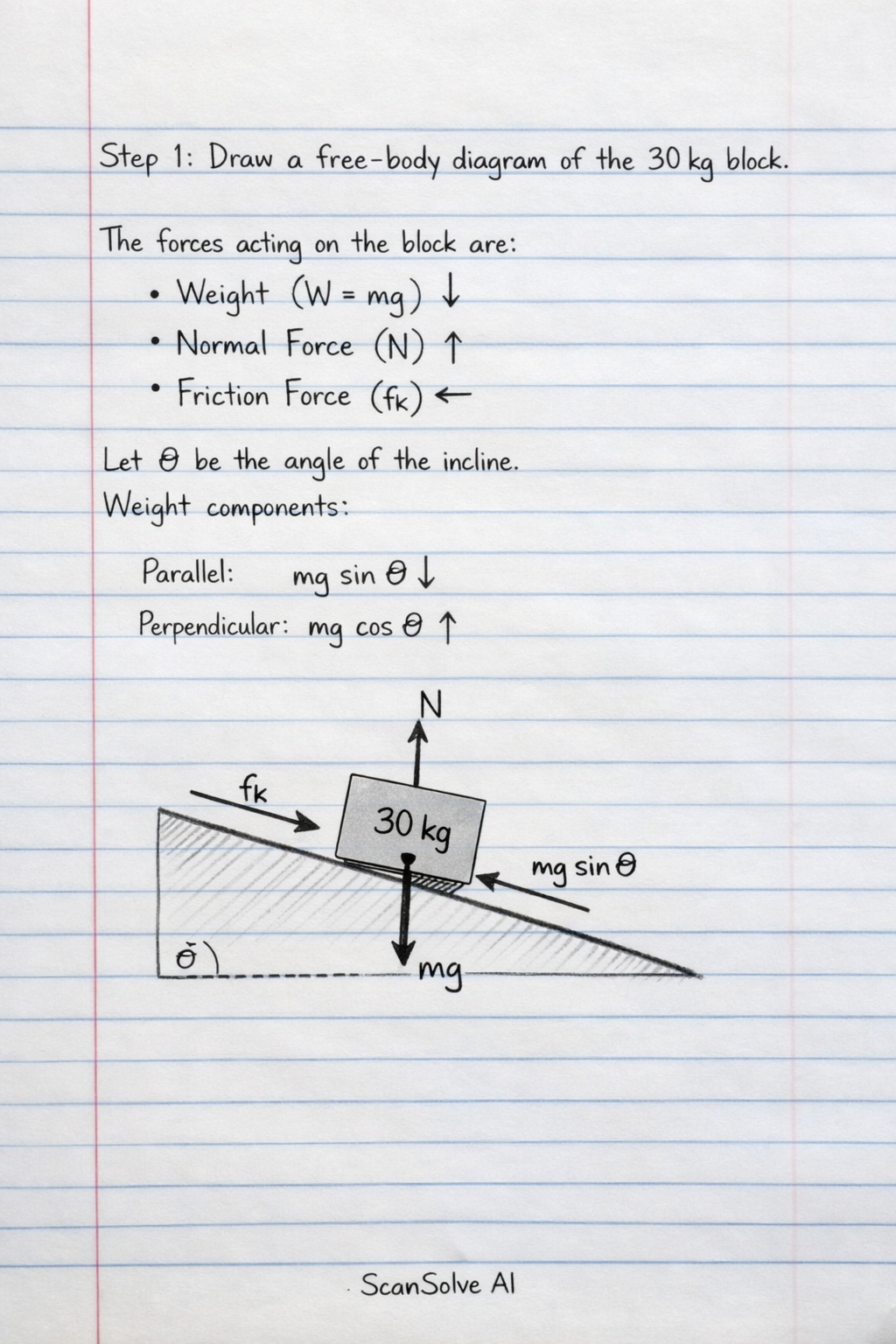
A 30 kg block is on an inclined plane. Draw its free-body diagram, showing weight, normal force, and friction.
ScanSolve AI Answer
Answer
Step-by-step solution
2 stepsDraw a free-body diagram of the block.
The forces acting on the block are:
- Weight (): Acts vertically downwards.
- Normal force (): Acts perpendicular to the inclined surface, upwards.
- Friction force (): Acts parallel to the inclined surface, opposing the motion. Since the block is moving down the incline, friction acts up the incline.
Let be the angle of inclination of the plane. The weight can be resolved into components parallel and perpendicular to the incline.
- Component of weight parallel to incline: (down the incline).
- Component of weight perpendicular to incline: (into the incline).
Here is the free-body diagram:
\begin{tikzpicture}[scale=0.8] % Inclined plane \draw (0,0) -- (6,3); \draw[dashed] (0,0) -- (6,0); \draw (5.5,0) rectangle (5.8,0.3); % Angle indicator % Block \draw[fill=lightgray] (3,1.5) rectangle (4,2.5); \node at (3.5,2) {30kg}; % Center of mass \coordinate (CM) at (3.5,2); % Weight (mg) \draw[->, thick] (CM) -- +(0,-2) node[below] {$W = mg$}; % Normal force (N) \draw[->, thick] (CM) -- ($(CM) + (-0.5,1)$) node[above left] {$N$}; % Friction force (fk) \draw[->, thick] (CM) -- ($(CM) + (-1, -0.5)$) node[above left] {$f_k$}; % Components of weight (for explanation, not usually drawn on FBD) % \draw[->, dashed] (CM) -- ($(CM) + (1, -0.5)$) node[below right] {$mg \sin\theta$}; % \draw[->, dashed] (CM) -- ($(CM) + (0.5, -1)$) node[below right] {$mg \cos\theta$}; \end{tikzpicture}Calculate the mechanical energy at point A.
The question is cut off, but based on the context, it likely asks for the mechanical energy at a specific point. We will calculate the mechanical energy at point A.
Mechanical energy () is the sum of kinetic energy () and potential energy ().The formulas are:
Given:
Mass
Height at A,
Velocity at A,
Acceleration due to gravityCalculate kinetic energy at A:
Calculate potential energy at A:
Calculate total mechanical energy at A:
The mechanical energy at point A is .
Try one yourself
A new problem that tests the same skill.
Still stuck on this one?
Ask a follow-up, and the answer starts from this question.
More Physics Questions
Handwritten Step-by-Step Solution
Get this as a handwritten image on WhatsApp — like a tutor wrote it for you.
Try on WhatsApp