

This physics problem tests your understanding of fundamental physical laws and their applications. The step-by-step solution below breaks down the problem using relevant equations and physical reasoning.
ScanSolve AI Answer
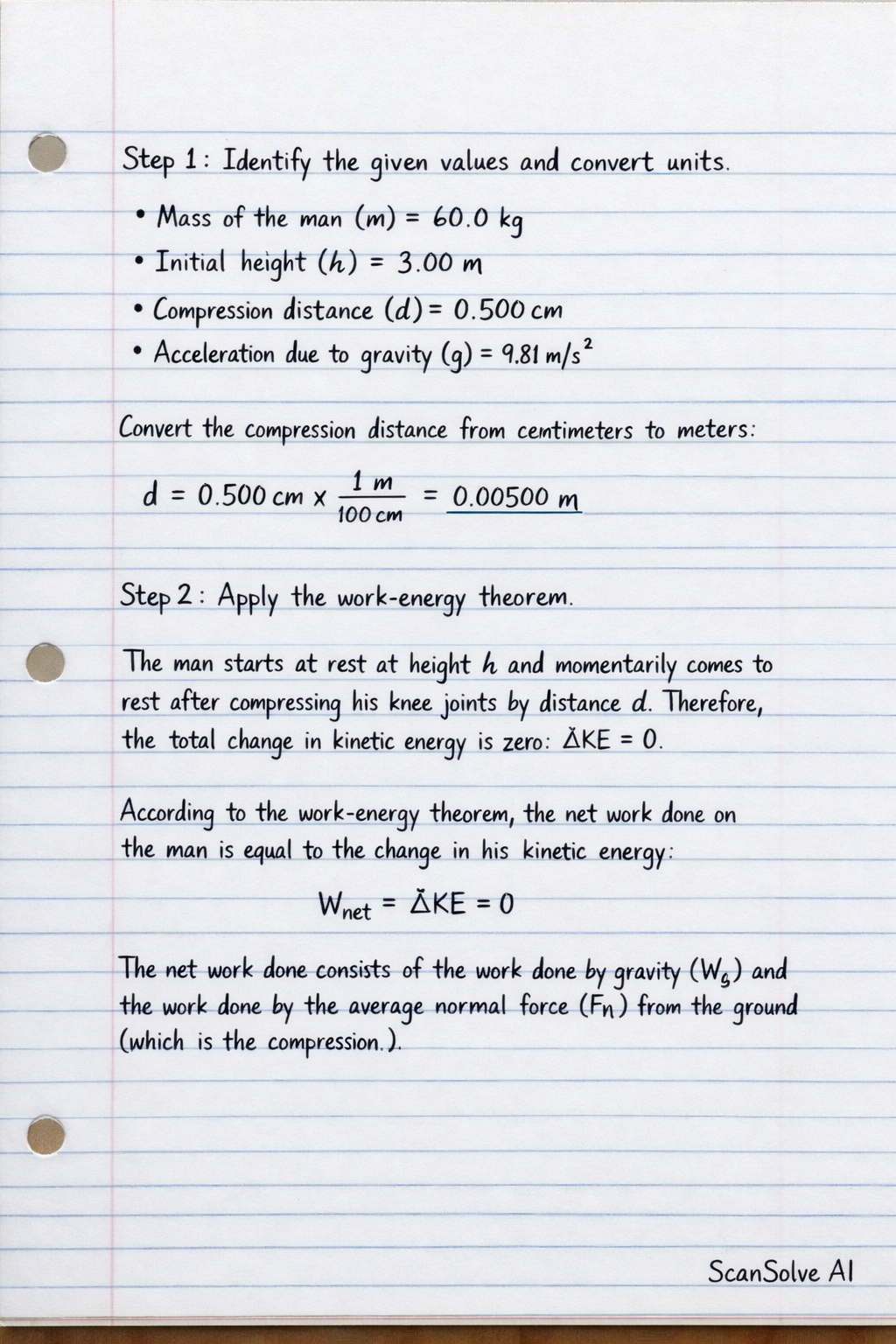
Step 1: Identify the given values and convert units. Mass of the man (m) = 60.0 kg Initial height (h) = 3.00 m Compression distance (d) = 0.500 cm Acceleration due to gravity (g) = 9.81 m/s^2 Convert the compression distance from centimeters to meters: d = 0.500 cm × 1 m100 cm = 0.00500 m Step 2: Apply the work-energy theorem. The man starts at rest at height h and momentarily comes to rest after compressing his knee joints by distance d. Therefore, the total change in kinetic energy is zero ( KE = 0). According to the work-energy theorem, the net work done on the man is equal to the change in his kinetic energy. W_net = KE = 0 The net work done consists of the work done by gravity (W_g) and the work done by the average normal force (F_N) from the ground (which is the force on the knee joints) during the compression. The total vertical distance the man's center of mass falls is h+d. The work done by gravity is: W_g = mg(h+d) The normal force F_N acts upwards, while the displacement d during compression is downwards. So, the work done by the normal force is negative: W_N = -F_N d Setting the net work to zero: W_g + W_N = 0 mg(h+d) - F_N d = 0 Step 3: Solve for the average force F_N. F_N d = mg(h+d) F_N = (mg(h+d))/(d) This can also be written as: F_N = mg ( (h)/(d) + 1 ) Step 4: Substitute the values and calculate the force. F_N = (60.0 kg)(9.81 m/s^2) ( 3.00 m0.00500 m + 1 ) F_N = (588.6 N) (600 + 1) F_N = (588.6 N) (601) F_N = 353748.6 N Step 5: Round the answer to an appropriate number of significant figures (3 significant figures, based on the given values). F_N ≈ 3.54 × 10^5 N The force on the man's knee joints is: 3.54 × 10^5 N