
We read your photo as:
A) A Beta particle is an electron (^0-1e) or positron (^0+1e) emitted from the nucleus of an atom during radioactive decay. In the context of typical beta decay, it refers to an electr
ScanSolve AI Answer
Answers
2 partsHere are the solutions to the radioactivity questions:
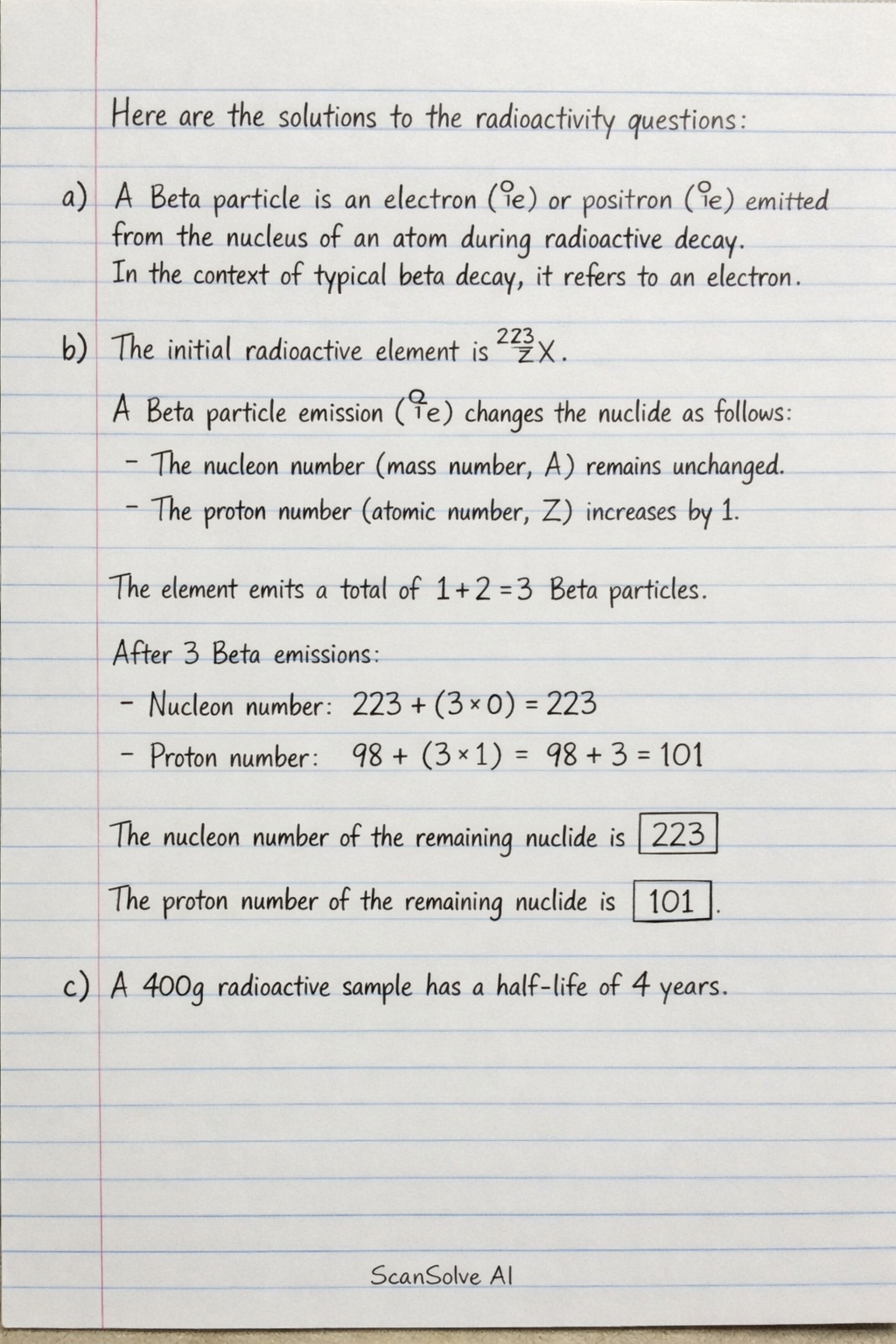
a) A Beta particle is an electron () or positron () emitted from the nucleus of an atom during radioactive decay. In the context of typical beta decay, it refers to an electron.
b) The initial radioactive element is .
A Beta particle emission () changes the nuclide as follows:
- The nucleon number (mass number, A) remains unchanged.
- The proton number (atomic number, Z) increases by 1.
The element emits a total of Beta particles.
After 3 Beta emissions:
- Nucleon number:
- Proton number:
The nucleon number of the remaining nuclide is .
The proton number of the remaining nuclide is .
c) A 400g radioactive sample has a half-life of 4 years.
i) Plot a graph to show this decay curve after the period of 32 years.
To plot the decay curve, we calculate the mass remaining after each half-life.
Initial mass () = 400 g
Half-life () = 4 years
Total time = 32 years
The number of half-lives () is .
The mass remaining () after half-lives is given by .
Here are the data points for the decay curve:
| Time (years) | Number of half-lives () | Mass remaining (g) () |
|---|---|---|
| 0 | 0 | 400 |
| 4 | 1 | |
| 8 | 2 | |
| 12 | 3 | |
| 16 | 4 | |
| 20 | 5 | |
| 24 | 6 | |
| 28 | 7 | |
| 32 | 8 |
To plot the graph:
- Draw a set of axes on graph paper.
- Label the x-axis "Time (years)" from 0 to 32 years.
- Label the y-axis "Mass remaining (g)" from 0 to 400 g.
- Plot the points from the table above.
- Draw a smooth curve connecting these points. The curve should show an exponential decrease in mass over time.
ii) What period of time would it take for the sample to reduce to 40g?
Initial mass () = 400 g
Final mass () = 40 g
Half-life () = 4 years
We use the formula , where is the number of half-lives.
To solve for , take the logarithm of both sides:
Now, calculate the total time ():
Rounding to 3 significant figures:
The period of time is approximately .
iii) Name a source of gamma radiation.
A common source of gamma radiation is Cobalt-60 (or Caesium-137).
Try one yourself
A new problem that tests the same skill.
Still stuck on this one?
Ask a follow-up, and the answer starts from this question.
More Physics Questions
Handwritten Step-by-Step Solution
Get this as a handwritten image on WhatsApp — like a tutor wrote it for you.
Try on WhatsApp