

This physics problem tests your understanding of fundamental physical laws and their applications. The step-by-step solution below breaks down the problem using relevant equations and physical reasoning.
ScanSolve AI Answer
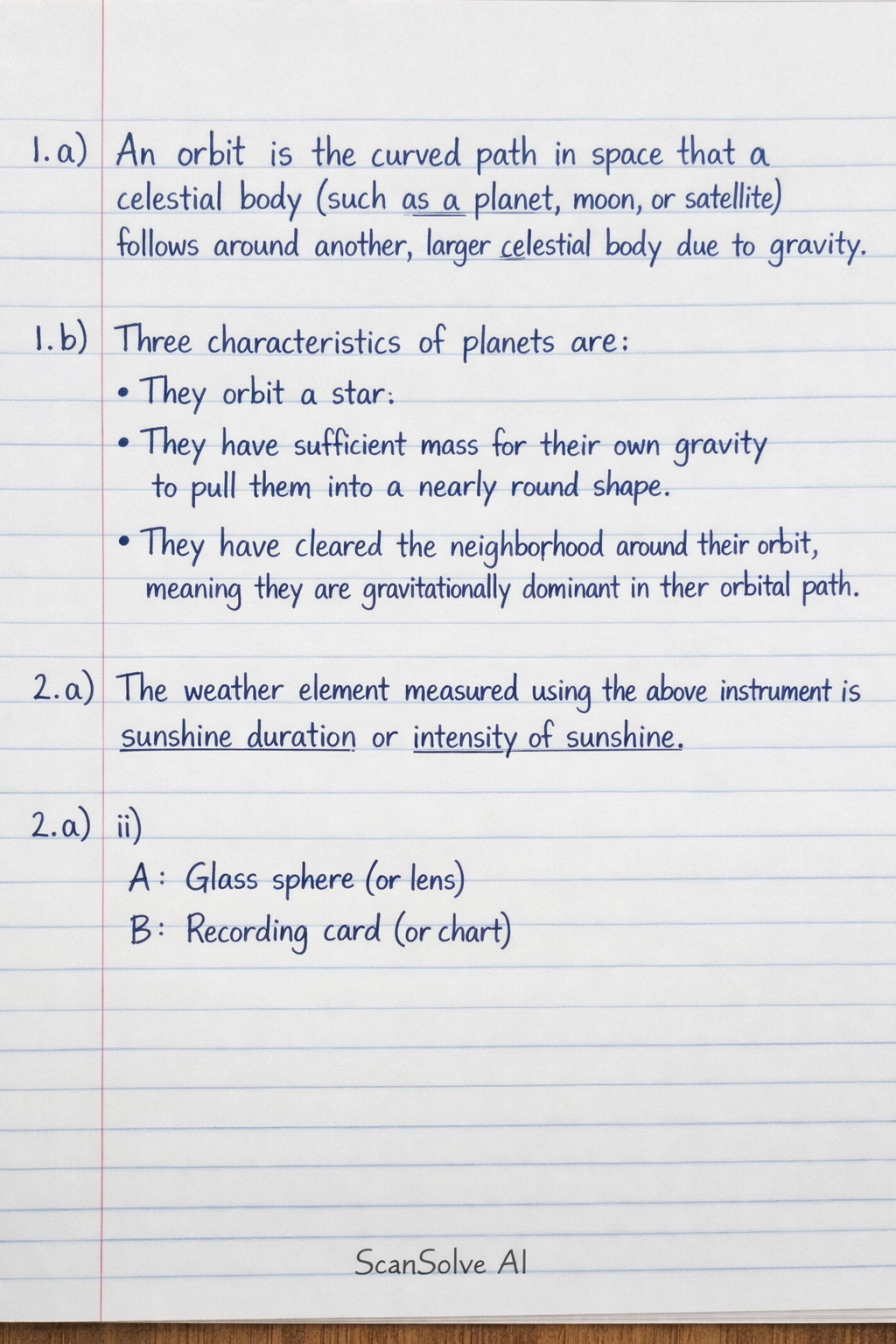
1. a) An orbit is the curved path in space that a celestial body (such as a planet, moon, or satellite) follows around another, larger celestial body due to gravity. 1. b) Three characteristics of planets are: • They orbit a star. • They have sufficient mass for their own gravity to pull them into a nearly round shape. • They have cleared the neighborhood around their orbit, meaning they are gravitationally dominant in their orbital path. 2. a) i) The weather element measured using the above instrument is sunshine duration or intensity of sunshine. 2. a) ii) A: Glass sphere (or lens) B: Recording card (or chart) 2. b) Three factors influencing the amount of rainfall experienced in an area are: • Proximity to large water bodies: Areas near oceans or large lakes tend to receive more rainfall due to increased evaporation and moisture in the air. • Altitude/Topography: Mountainous regions often experience orographic rainfall as moist air is forced to rise, cool, and condense. • Prevailing winds: Winds carry moisture from one area to another; areas in the path of moist winds receive more rainfall. • Ocean currents: Warm ocean currents can increase evaporation and moisture, leading to more rainfall in coastal areas. • Vegetation cover: Densely vegetated areas, like rainforests, contribute to local rainfall through evapotranspiration. 3. a) Earth movements refer to the large-scale displacements and deformations of the Earth's crust, including folding, faulting, and volcanic activity, primarily driven by forces within the Earth's interior. 3. b) Two causes of earth movements are: • Tectonic forces: The movement of tectonic plates due to convection currents in the Earth's mantle. • Volcanic activity: The eruption of magma and gases from the Earth's interior, which can cause ground deformation and seismic activity. 4. a) Two metamorphic processes are: • Regional metamorphism: Occurs over large areas due to intense pressure and high temperatures associated with plate collisions and mountain building. • Contact metamorphism: Occurs when existing rocks are heated by direct contact with magma or lava, leading to recrystallization. 4. b) Three characteristics of metamorphic rocks are: • They often exhibit foliation, a layered or banded appearance due to the alignment of mineral grains under pressure. • They are typically denser and harder than their parent rocks. • They contain new minerals that formed during the metamorphic process, which were not present in the original rock. 5. a) Ecology is the scientific study of the relationships between living organisms and their interactions with each other and their physical environment. 5. b) Three importance of studying geography are: • It helps in understanding the distribution of natural resources and their sustainable management. • It provides insights into environmental issues such as climate change, pollution, and natural disasters, and how to mitigate them. • It enhances understanding of human-environment interactions, including population distribution, cultural landscapes, and economic activities. 3 done, 2 left today. You're making progress.