
We read your photo as:
An astronaut in an orbiting spacecraft, experiences a force due to gravity. This force is less than when she is on the Earth's surface. Compared with being on the Earth's surface, how does her mass and her weight change, when she goes into orbit?
ScanSolve AI Answer
Answer
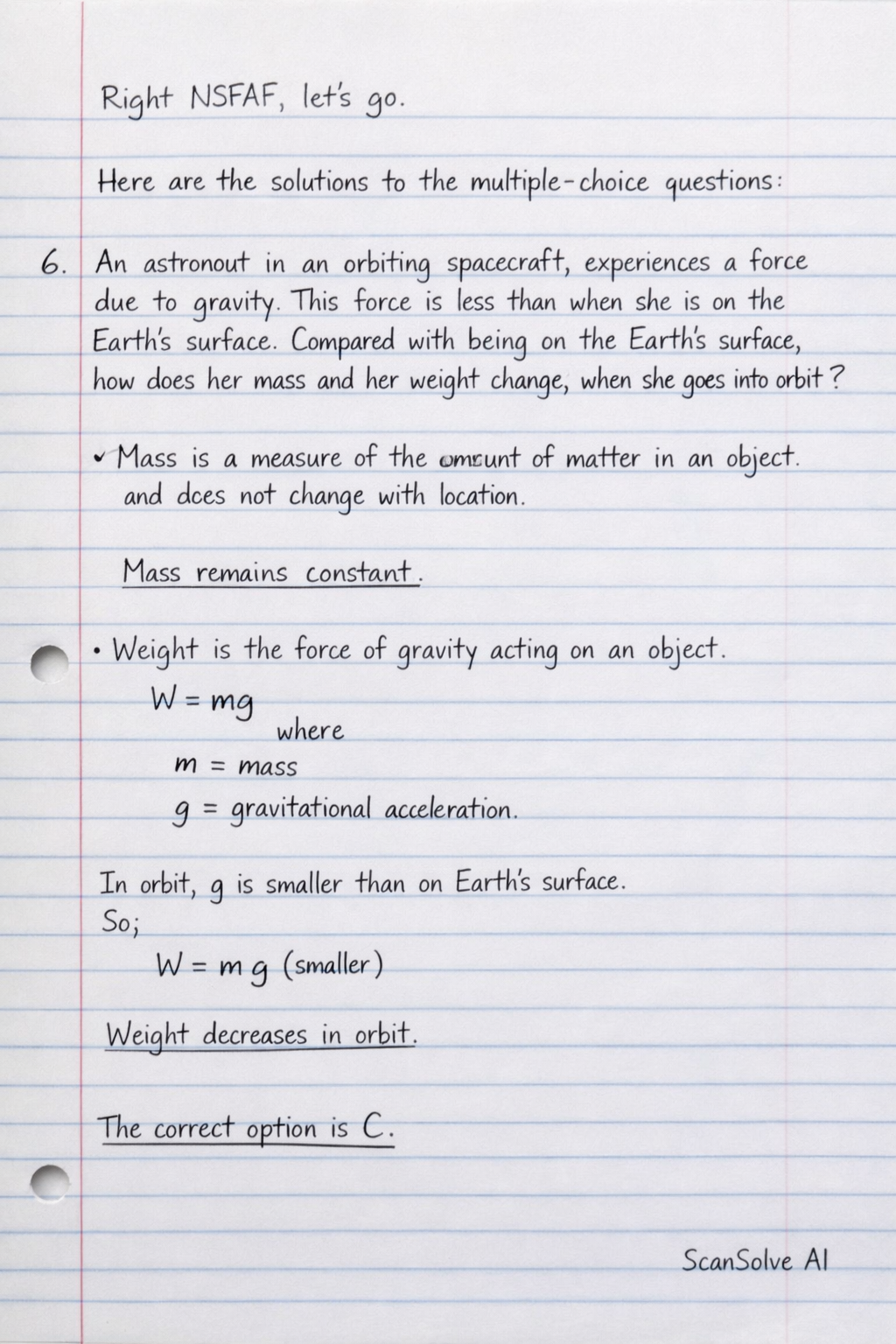
Here are the solutions to the multiple-choice questions:
6. An astronaut in an orbiting spacecraft, experiences a force due to gravity. This force is less than when she is on the Earth's surface. Compared with being on the Earth's surface, how does her mass and her weight change, when she goes into orbit?
- Mass is a measure of the amount of matter in an object and does not change with location.
- Weight is the force of gravity acting on an object (). Since the gravitational force in orbit is less than on Earth's surface, the astronaut's weight will decrease. The correct option is C.
7. Two objects X and Y are placed in a beaker containing a liquid. Object X floats in the liquid and object Y sinks. Which row for the densities of object X, object Y and the liquid, is possible?
- For object X to float, its density () must be less than the density of the liquid ().
- For object Y to sink, its density () must be greater than the density of the liquid (). So, we need .
Let's check the options:
- A: (False)
- B: (False)
- C: (True for X), but (False for Y, Y would float)
- D: (True for X), and (True for Y). This matches the conditions. The correct option is D.
8. Which statement about an object moving in a straight line through air is correct?
- A: When an object accelerates, there is a resultant force acting on it, not zero force.
- B: When an object moves at a steady speed through air, there is still air resistance acting on it, but it is balanced by other forces (e.g., thrust or a component of weight).
- C: When an object moves at a steady speed, its acceleration is zero. According to Newton's First Law, if acceleration is zero, the resultant force acting on the object must be zero.
- D: An object moving at a steady speed has zero resultant force. The correct option is C.
9. The graph shows how a physical quantity varies with time.
The graph shows a quantity starting positive, decreasing to zero, then becoming negative, reaching a minimum, and finally returning to zero. This pattern is characteristic of acceleration during a skydive.
- Initially, a skydiver accelerates downwards (positive acceleration if downward is positive) due to gravity. As air resistance increases, this acceleration decreases towards zero (terminal velocity).
- When the parachute opens, there is a large upward force (air resistance), causing a significant deceleration (negative acceleration).
- As the skydiver approaches a new, lower terminal velocity with the parachute open, the acceleration increases back towards zero. The correct option is B.
Try one yourself
A new problem that tests the same skill.
Still stuck on this one?
Ask a follow-up, and the answer starts from this question.
More Physics Questions
Handwritten Step-by-Step Solution
Get this as a handwritten image on WhatsApp — like a tutor wrote it for you.
Try on WhatsApp