
We read your photo as:
A ball is thrown horizontally from a cliff 50m high with an initial velocity of 10m/s. Calculate the time to hit the ground, final vertical velocity, and horizontal range.
ScanSolve AI Answer
Answers
3 partsStep-by-step solution
7 stepsHere are the solutions for the projectile motion problem.
Given:
Height of the cliff
Initial horizontal velocity
Acceleration due to gravity
Initial vertical velocity (since the ball is projected horizontally)
Part a· 3 steps
The time taken to reach the ground ()
Use the kinematic equation for vertical motion.
The vertical displacement is . Since the initial vertical velocity is zero, the equation is:
Substitute the given values.
Solve for .
The time taken to reach the ground is .
Part b
The vertical component of the velocity when the ball hits the ground ()
Use the kinematic equation for final vertical velocity.
Substitute the values for , , and .
The vertical component of the velocity when the ball hits the ground is .
Part c
The distance from the foot of the cliff to where the ball hits the ground (horizontal range, )
Use the formula for horizontal distance.
Since there is no horizontal acceleration, the horizontal velocity remains constant.
Substitute the values for and .
The distance from the foot of the cliff to where the ball hits the ground is .
Try one yourself
A new problem that tests the same skill.
Still stuck on this one?
Ask a follow-up, and the answer starts from this question.
More Physics Questions
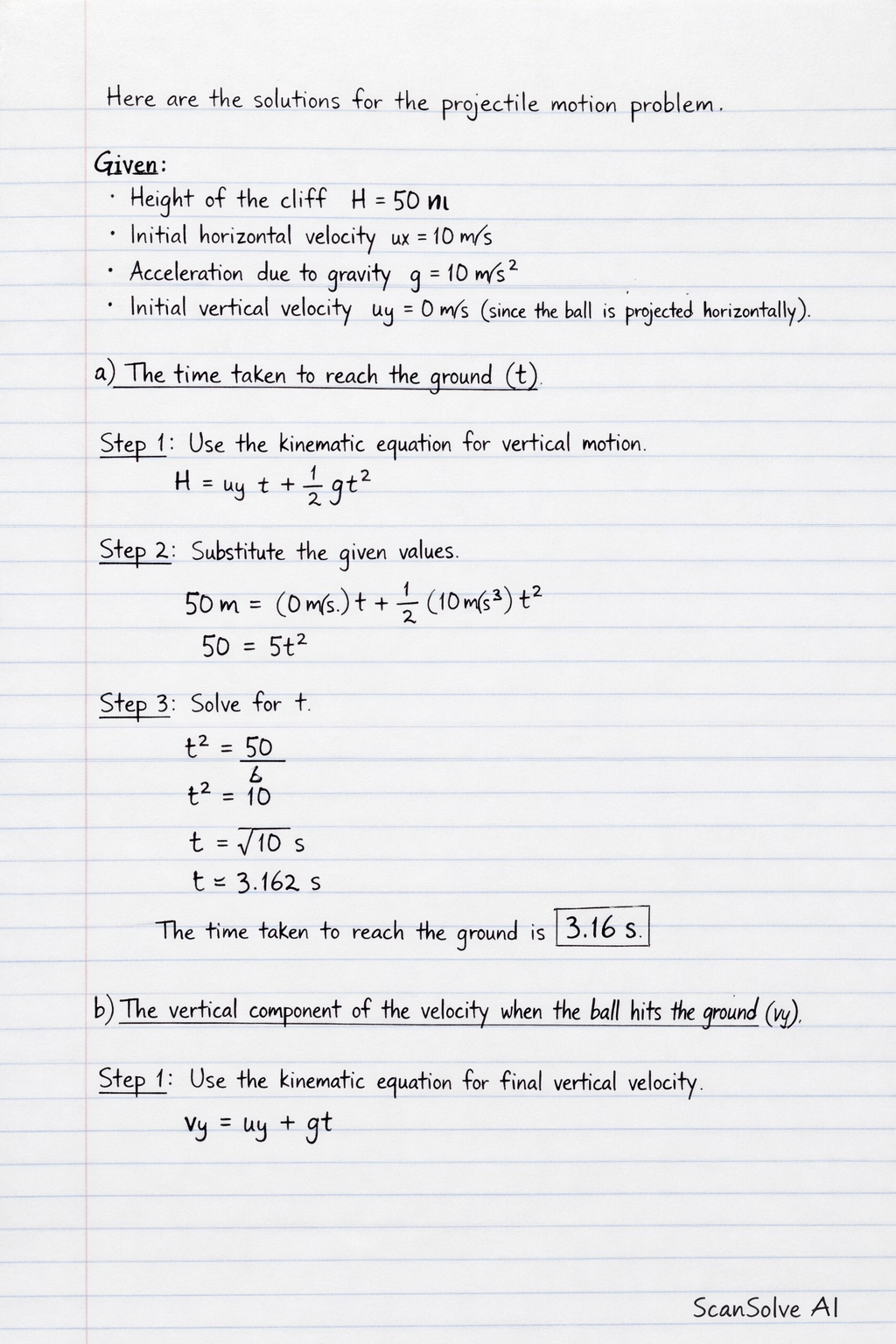
Handwritten Step-by-Step Solution
Get this as a handwritten image on WhatsApp — like a tutor wrote it for you.
Try on WhatsApp