We read your photo as:

A ball of mass 0.1 kg is thrown upwards with an initial velocity of 80 m/s. Calculate its kinetic energy as it leaves the ground, its potential energy at maximum height, and its potential energy halfw

Physics

ScanSolve AI Answer

Answers

3 parts
iii

320 J\text{320 J}

ii

320 J\text{320 J}

i

160 J\text{160 J}

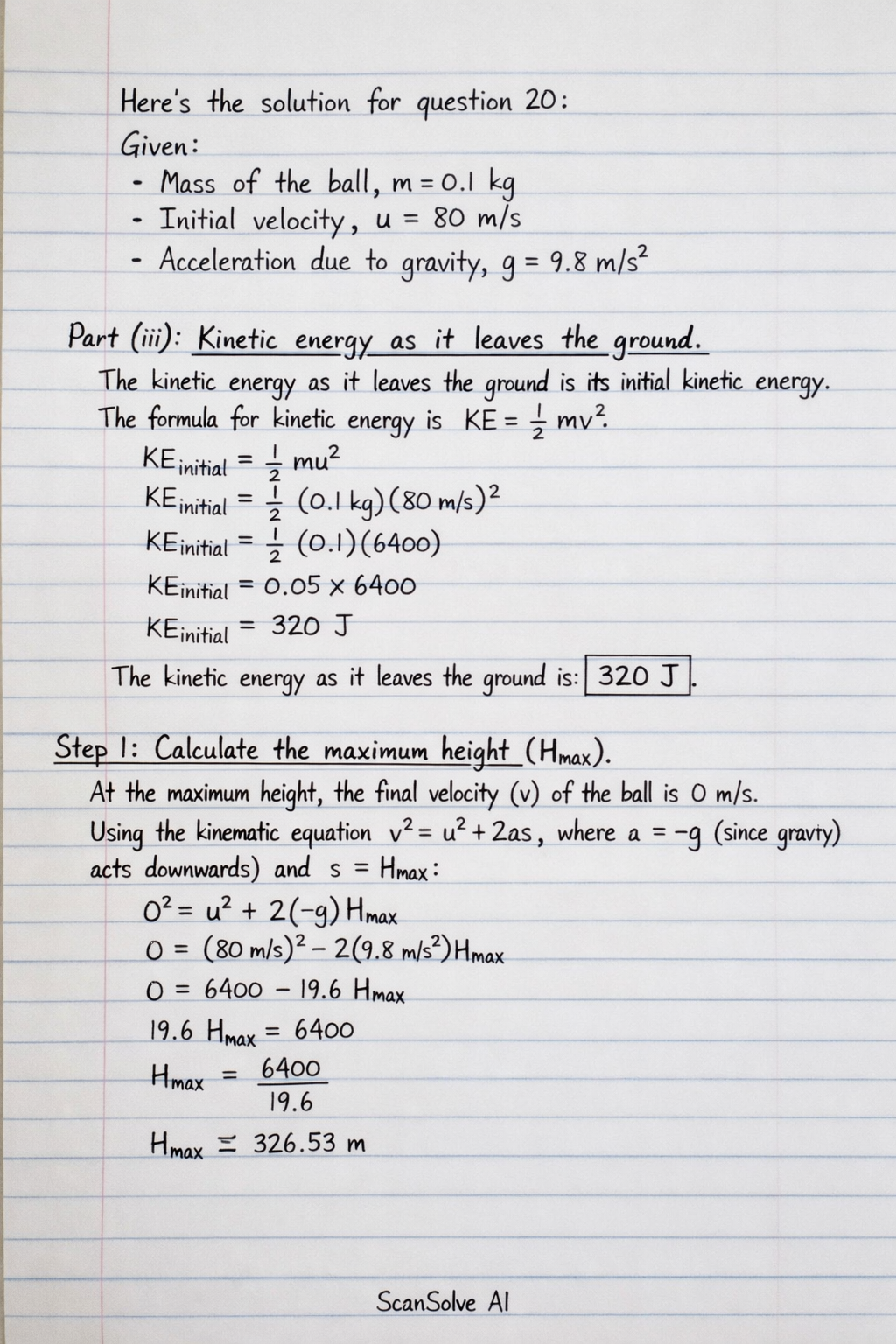
Here's the solution for question 20:

Given:

  • Mass of the ball, m=0.1 kgm = 0.1\,kg
  • Initial velocity, u=80 m/su = 80\,m/s
  • Acceleration due to gravity, g=9.8 m/s2g = 9.8\,m/s^2

Part (iii): Kinetic energy as it leaves the ground.
The kinetic energy as it leaves the ground is its initial kinetic energy.
The formula for kinetic energy is KE=12mv2KE = \frac{1}{2}mv^2.

KEinitial=12mu2KE_{initial} = \frac{1}{2}mu^2 KEinitial=12(0.1 kg)(80 m/s)2KE_{initial} = \frac{1}{2}(0.1\,kg)(80\,m/s)^2 KEinitial=12(0.1)(6400)KE_{initial} = \frac{1}{2}(0.1)(6400) KEinitial=0.05×6400KE_{initial} = 0.05 \times 6400 KEinitial=320 JKE_{initial} = 320\,J

The kinetic energy as it leaves the ground is 320 J\boxed{\text{320 J}}.

Step 1: Calculate the maximum height (HmaxH_{max}).
At the maximum height, the final velocity (vv) of the ball is 0 m/s0\,m/s. Using the kinematic equation v2=u2+2asv^2 = u^2 + 2as, where a=−ga = -g (since gravity acts downwards) and s=Hmaxs = H_{max}:

02=u2+2(−g)Hmax0^2 = u^2 + 2(-g)H_{max} 0=(80 m/s)2−2(9.8 m/s2)Hmax0 = (80\,m/s)^2 - 2(9.8\,m/s^2)H_{max} 0=6400−19.6Hmax0 = 6400 - 19.6 H_{max} 19.6Hmax=640019.6 H_{max} = 6400 Hmax=640019.6H_{max} = \frac{6400}{19.6} Hmax≈326.53 mH_{max} \approx 326.53\,m

Part (ii): Potential energy at its maximum height.
The formula for potential energy is PE=mghPE = mgh.

PEmax=mgHmaxPE_{max} = mgH_{max} PEmax=(0.1 kg)(9.8 m/s2)(326.53 m)PE_{max} = (0.1\,kg)(9.8\,m/s^2)(326.53\,m) PEmax=320 JPE_{max} = 320\,J

The potential energy at its maximum height is 320 J\boxed{\text{320 J}}.

Part (i): Potential energy half way up.
Half way up, the height is Hhalf=Hmax2H_{half} = \frac{H_{max}}{2}.

Hhalf=326.53 m2H_{half} = \frac{326.53\,m}{2} Hhalf≈163.265 mH_{half} \approx 163.265\,m

Now, calculate the potential energy at this height:

PEhalf=mgHhalfPE_{half} = mgH_{half} PEhalf=(0.1 kg)(9.8 m/s2)(163.265 m)PE_{half} = (0.1\,kg)(9.8\,m/s^2)(163.265\,m) PEhalf=160 JPE_{half} = 160\,J

The potential energy half way up is 160 J\boxed{\text{160 J}}.

Was this helpful?

Try one yourself

A new problem that tests the same skill.

Still stuck on this one?

Ask a follow-up, and the answer starts from this question.

Got a different question?Ask your own question
Handwritten step-by-step solution preview

Handwritten Step-by-Step Solution

Get this as a handwritten image on WhatsApp — like a tutor wrote it for you.

Try on WhatsApp