
We read your photo as:
Which statement is true for light bulbs connected in parallel?
ScanSolve AI Answer
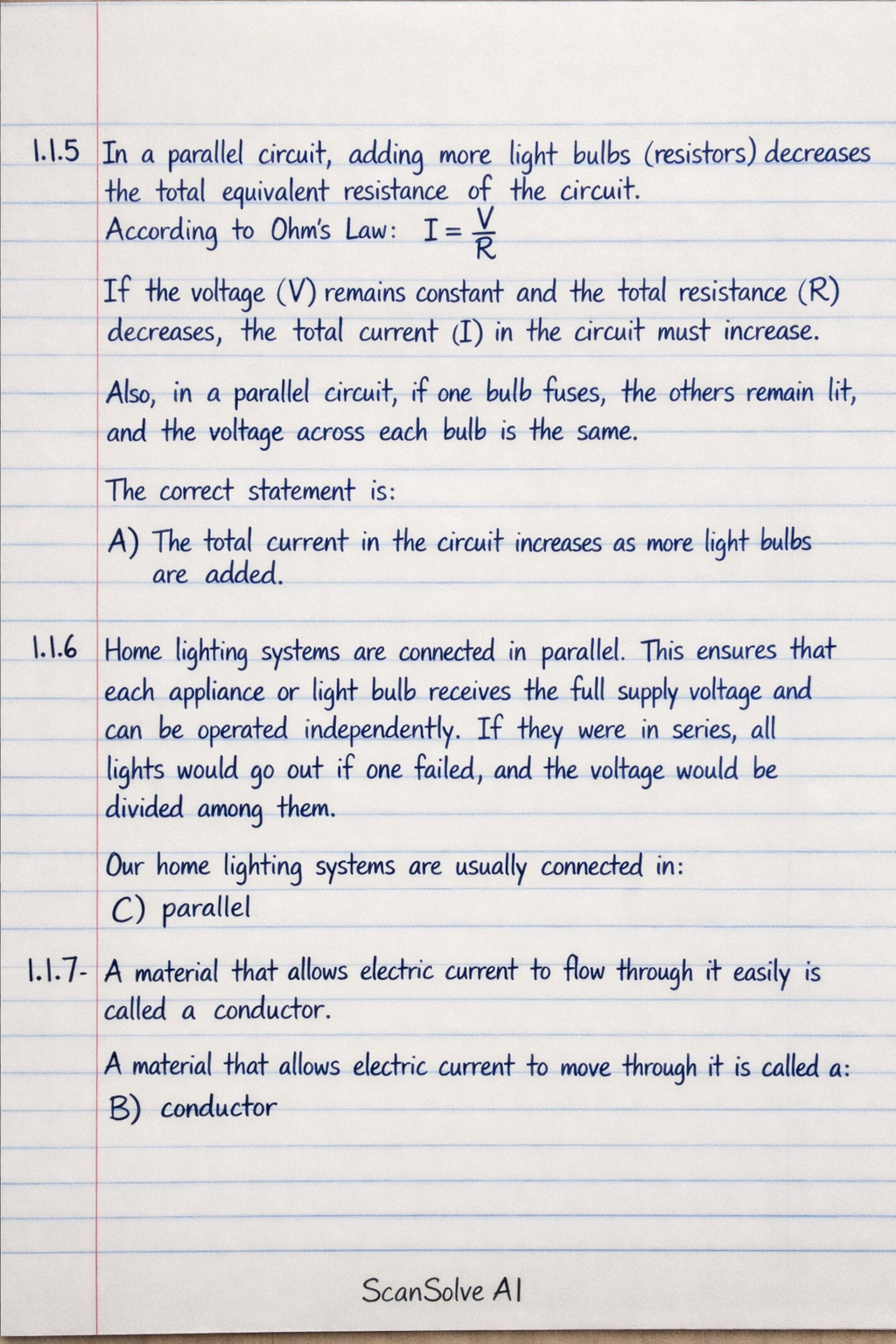
1.1.5 In a parallel circuit, adding more light bulbs (resistors) decreases the total equivalent resistance of the circuit. According to Ohm's Law (), if the voltage () remains constant and the total resistance () decreases, the total current () in the circuit must increase. Also, in a parallel circuit, if one bulb fuses, the others remain lit, and the voltage across each bulb is the same.
The correct statement is:
A) The total current in the circuit increases as more light bulbs are added.
1.1.6 Home lighting systems are connected in parallel. This ensures that each appliance or light bulb receives the full supply voltage and can be operated independently. If they were in series, all lights would go out if one failed, and the voltage would be divided among them.
Our home lighting systems are usually connected in:
C) parallel
1.1.7 A material that allows electric current to flow through it easily is called a conductor.
A material that allows electric current to move through it is called a:
B) conductor
1.1.8 A spring balance is an instrument used to measure force or weight by the extension or compression of a spring.
The instrument used to measure force size is a:
C) Spring balance
1.1.9 The force of friction is a resistive force that opposes the relative motion or tendency of motion between two surfaces in contact.
The effect of the force of friction is that it:
B) Opposes motion
Still stuck on this one?
Ask a follow-up, and the answer starts from this question.
More Physics Questions
Handwritten Step-by-Step Solution
Get this as a handwritten image on WhatsApp — like a tutor wrote it for you.
Try on WhatsApp