
We read your photo as:
A circuit consists of four 1.5 V cells in series, and three bulbs A, B, and C. Bulbs A and B have resistances of 2 Ω each and are connected in parallel. Bulb C has a resistance of 3 Ω and is connected
ScanSolve AI Answer
Step-by-step solution
3 stepsAnswer Question 1.
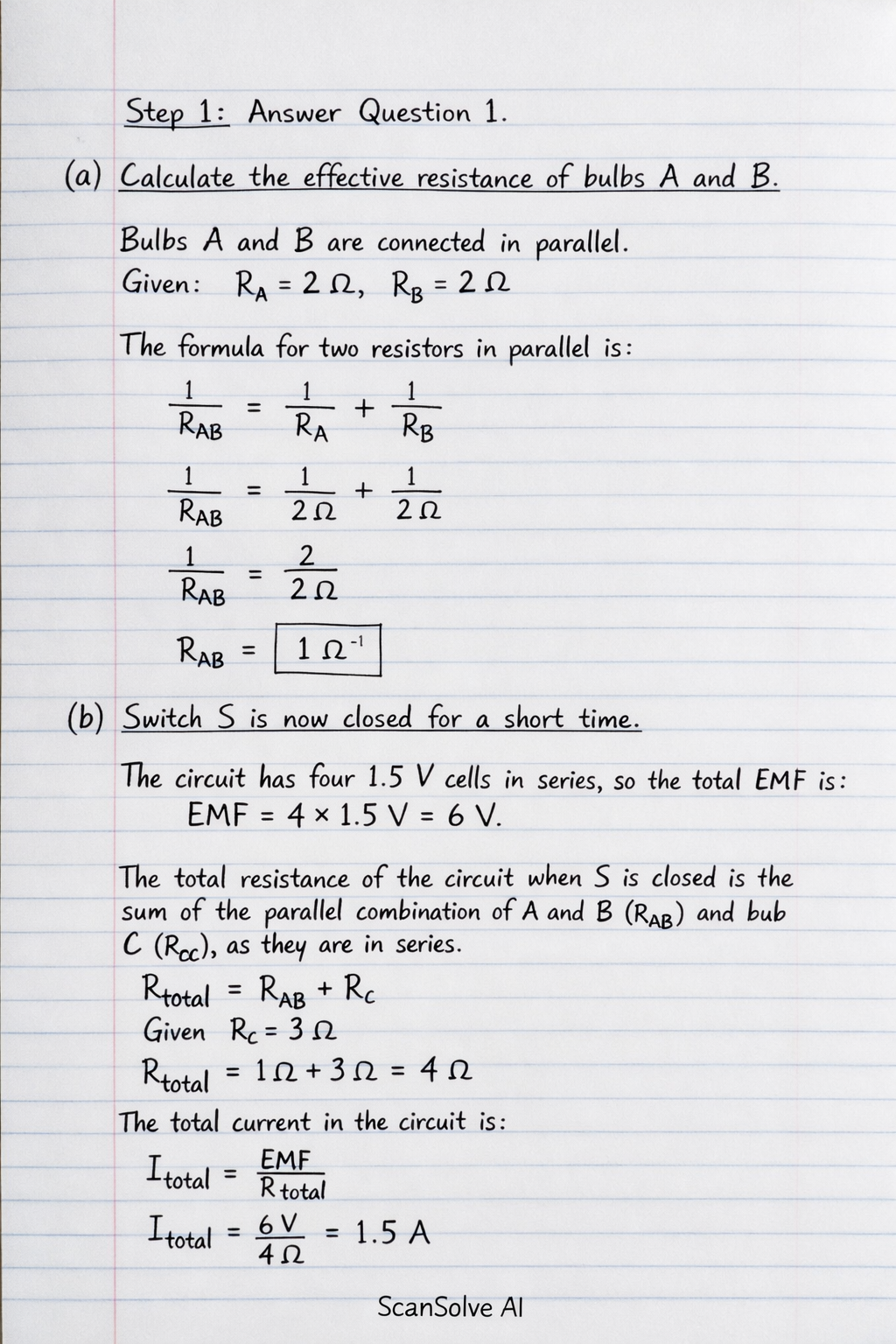
a) Calculate the effective resistance of bulbs A and B.
Bulbs A and B are connected in parallel.
Given: , .
The formula for two resistors in parallel is:b) Switch S is now closed for a short time.
The circuit has four 1.5 V cells in series, so the total electromotive force (EMF) is:The total resistance of the circuit when S is closed is the sum of the parallel combination of A and B () and bulb C (), as they are in series.
Given .
The total current in the circuit is:
i) Determine the reading on Voltmeter V1.
Voltmeter V1 measures the potential difference across the battery. Assuming an ideal battery with no internal resistance, V1 reads the total EMF.ii) Determine the reading on Voltmeter V3.
Voltmeter V3 measures the potential difference across bulb C. Using Ohm's Law:c) Calculate the energy transferred in bulb C in 3 seconds if the current in the circuit is 2 A.
Given: Current , Resistance , Time .
The energy transferred (electrical energy) is given by the formula:d) ALL the bulbs are now connected in parallel. How will the total current in the circuit be affected? Write down only INCREASES, DECREASES or REMAINS THE SAME.
Original total resistance (A and B in parallel, then C in series): .
New configuration: Bulbs A, B, and C are all connected in parallel.
, , .
The formula for resistors in parallel is:Comparing the total resistances: is less than .
Since the total resistance decreases, and the EMF of the battery remains constant, the total current () will increase.
The total current in the circuit will be: .Answer Question 2.
a) A perspex ruler is rubbed with a silk cloth, what charge will the ruler obtain?
Negative chargeb) Resistors in series are ______ dividers.
Voltagec) An object that opposes the flow of current ______.
Resistanced) Voltmeter measures the amount of ______ per charge.
Energy (or potential difference)e) Define the following terms:
i) Resistance
Resistance is the opposition to the flow of electric current in a circuit.ii) Series circuit
A series circuit is an electrical circuit in which components are connected end-to-end, forming a single path for the current to flow through all components.Answer Question 3.
The specific questions for Question 3 are not visible in the provided image. Please provide the questions you would like me to answer for this section.
Still stuck on this one?
Ask a follow-up, and the answer starts from this question.
More Physics Questions
Handwritten Step-by-Step Solution
Get this as a handwritten image on WhatsApp — like a tutor wrote it for you.
Try on WhatsApp