
We read your photo as:
A balloon filled with 3 m³ of hydrogen gas has a fabric mass of 2 kg. If the density of air is 1.25 kg/m³ and hydrogen is 0.085 kg/m³, what is the upward acceleration of the balloon?
ScanSolve AI Answer
Step-by-step solution
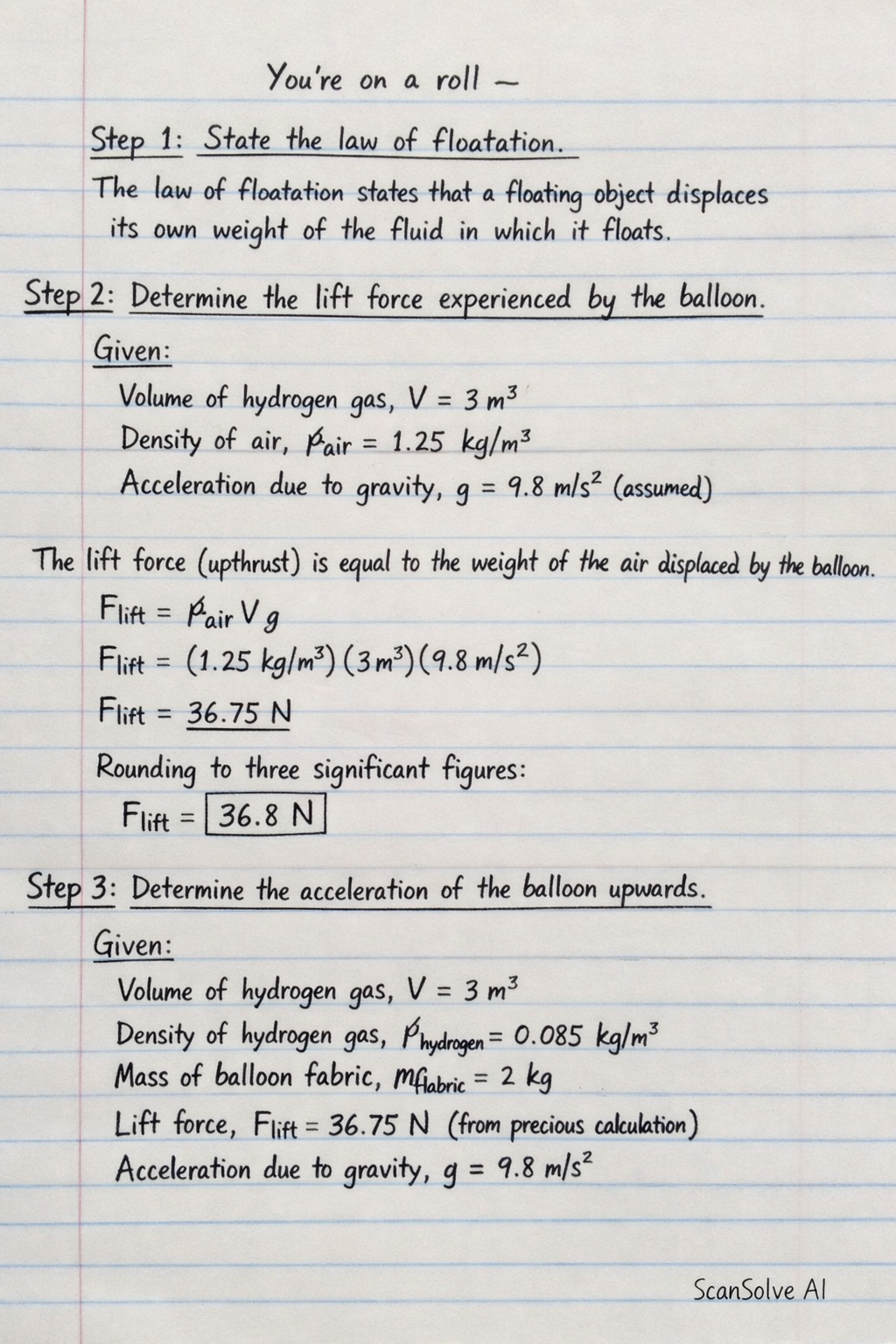
8 stepsState the law of floatation.
The law of floatation states that a floating object displaces its own weight of the fluid in which it floats.
Determine the lift force experienced by the balloon.
Given:
Volume of hydrogen gas,
Density of air,
Acceleration due to gravity, (assumed)The lift force (upthrust) is equal to the weight of the air displaced by the balloon.
Rounding to three significant figures:
Determine the acceleration of the balloon upwards.
Given:
Volume of hydrogen gas,
Density of hydrogen gas,
Mass of balloon fabric,
Lift force, (from previous calculation)
Acceleration due to gravity,First, calculate the mass of hydrogen gas:
Next, calculate the total mass of the balloon system:
Then, calculate the total weight of the balloon system:
Now, calculate the net force acting on the balloon:
Finally, calculate the acceleration using Newton's second law ():
Rounding to three significant figures:
Explain why the oil spreads over water.
Oil spreads over water because the adhesive forces between the oil molecules and water molecules are stronger than the cohesive forces between the oil molecules themselves. Additionally, the surface tension of water is higher than that of oil, causing the water surface to pull the oil outwards.
Determine the volume of the oil drop.
Given:
Diameter of oil drop,
Radius of oil drop,The volume of a spherical drop is given by:
Rounding to three significant figures:
Determine the area of the oil patch.
Given:
Diameter of circular patch,
Radius of circular patch,The area of a circular patch is given by:
Rounding to three significant figures:
Determine the size of the oil molecule.
Assume the oil spreads to form a monolayer (one molecule thick). The volume of the oil drop is equal to the volume of the oil patch.
Volume of patch = Area of patch thickness (size of molecule)Using the calculated values:
Rounding to three significant figures:
State two assumptions made in b(iii) above.
Two assumptions made are:
- The oil drop spreads to form a monomolecular layer (one molecule thick).
- The oil molecules are spherical and of uniform size. (Alternatively: The oil patch is of uniform thickness).
Still stuck on this one?
Ask a follow-up, and the answer starts from this question.
More Physics Questions
Handwritten Step-by-Step Solution
Get this as a handwritten image on WhatsApp — like a tutor wrote it for you.
Try on WhatsApp