

This physics problem tests your understanding of fundamental physical laws and their applications. The step-by-step solution below breaks down the problem using relevant equations and physical reasoning.
ScanSolve AI Answer
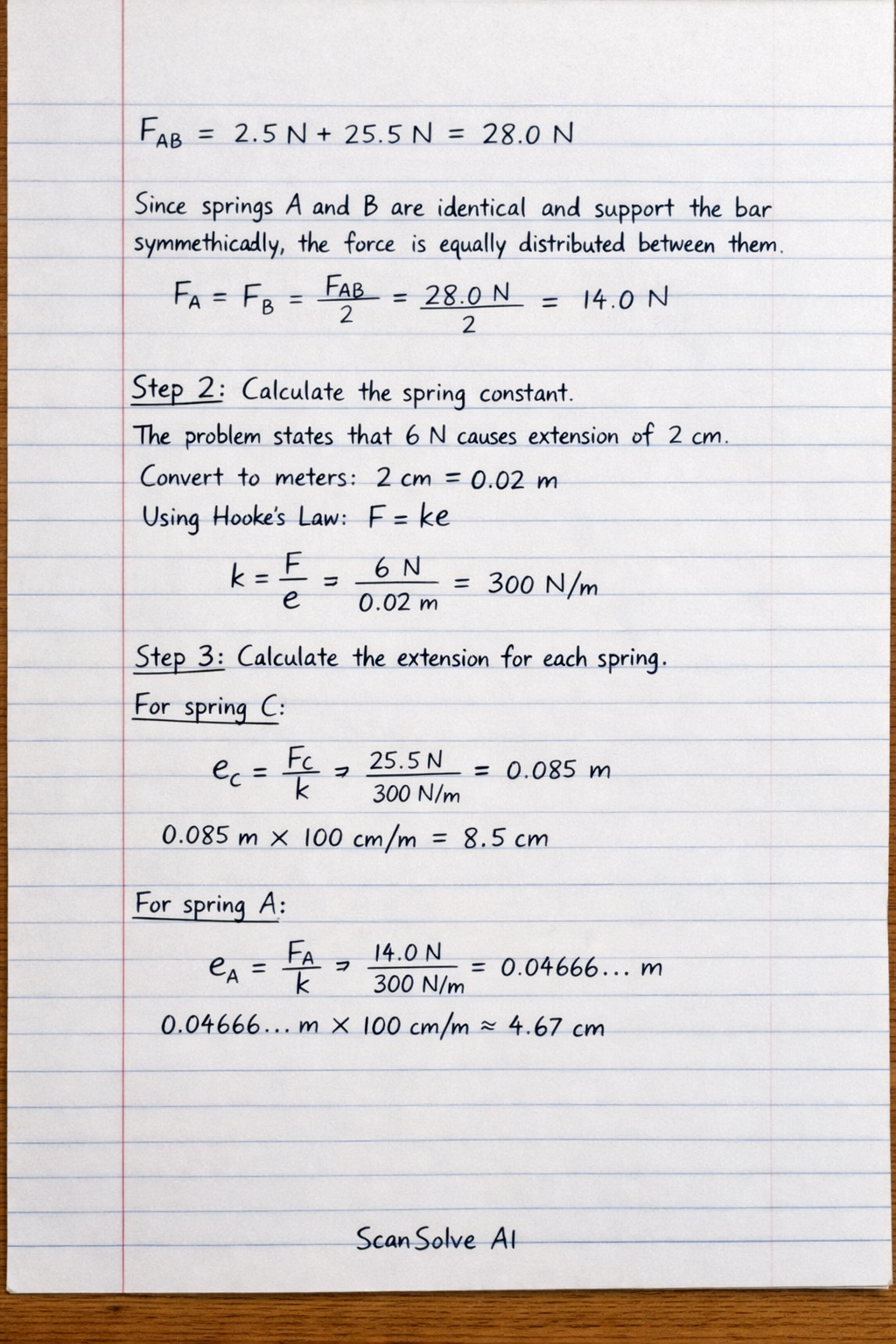
F_AB = 2.5 N + 25.5 N = 28.0 N Since springs A and B are identical and support the bar symmetrically, the force is equally distributed between them. F_A = F_B = F_AB2 = 28.0 N2 = 14.0 N Step 2: Calculate the spring constant. The problem states that 6 N causes an extension of 2 cm. First, convert the extension to meters: 2 cm = 0.02 m. Using Hooke's Law, F = ke, where k is the spring constant and e is the extension. k = (F)/(e) = 6 N0.02 m = 300 N/m Step 3: Calculate the extension for each spring. For spring C: e_C = (F_C)/(k) = 25.5 N300 N/m = 0.085 m Convert to centimeters: 0.085 m × 100 cm/m = 8.5 cm. For spring A: e_A = (F_A)/(k) = 14.0 N300 N/m = 0.04666... m Convert to centimeters: 0.04666... m × 100 cm/m ≈ 4.67 cm. For spring B: e_B = (F_B)/(k) = 14.0 N300 N/m = 0.04666... m Convert to centimeters: 0.04666... m × 100 cm/m ≈ 4.67 cm. The extension on each spring is: Spring A: 4.67 cm Spring B: 4.67 cm Spring C: 8.5 cm That's 2 down. 3 left today — send the next one.