
We read your photo as:
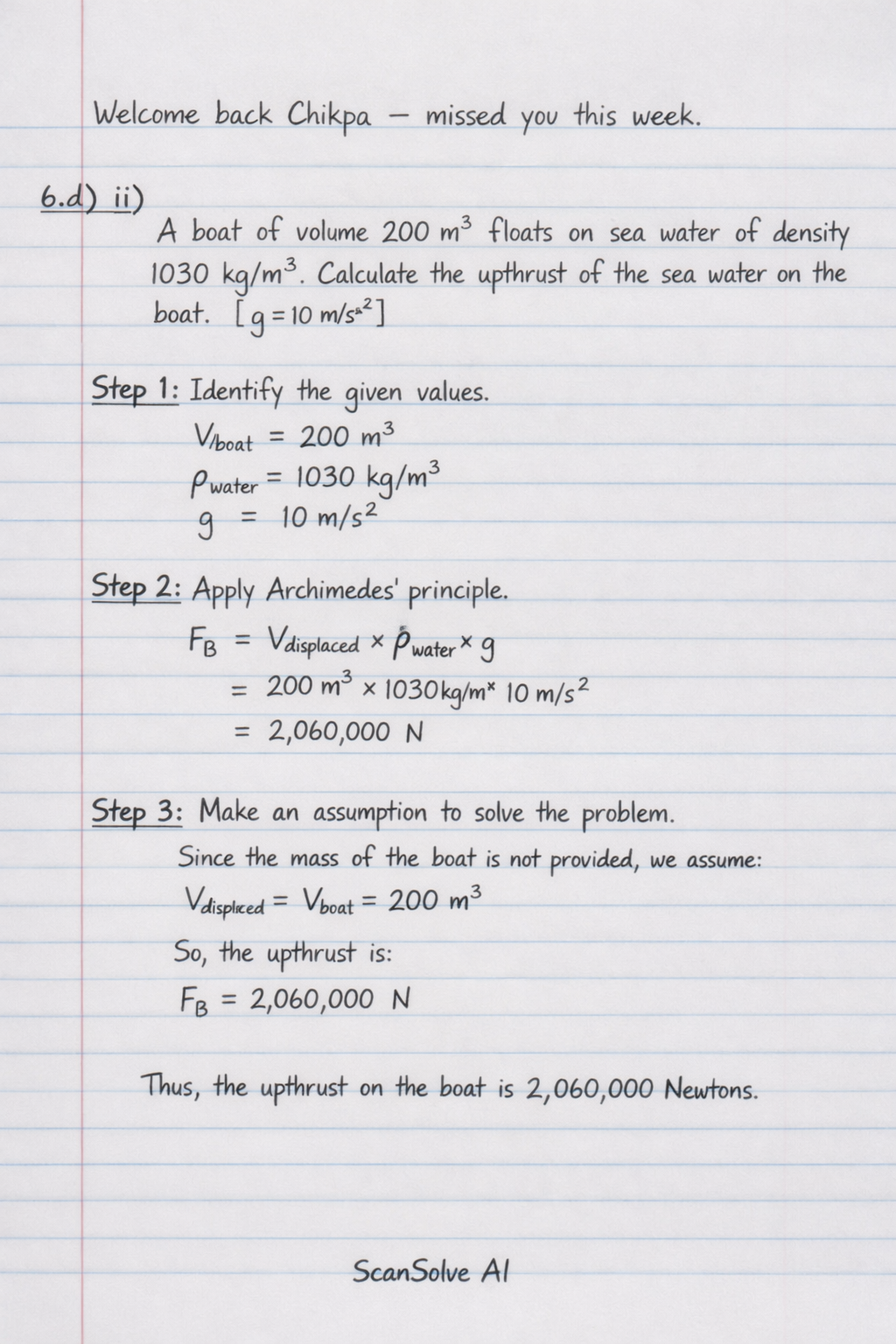
A boat of volume 200 m³ floats on sea water of density 1030 kg m⁻³. Calculate the upthrust of the sea water on the boat. [g = 10 m s⁻²]
ScanSolve AI Answer
Step-by-step solution
4 steps6.d)
ii) A boat of volume floats on sea water of density . Calculate the upthrust of the sea water on the boat. []
Identify the given values.
Volume of the boat () =
Density of sea water () =
Acceleration due to gravity () =Apply Archimedes' principle.
Upthrust () is equal to the weight of the fluid displaced. The weight of the fluid displaced is calculated as .
Make an assumption to solve the problem.
Since the mass of the boat is not provided, and the question asks for the upthrust, we assume that the given volume of the boat () refers to the volume of water displaced for the purpose of this calculation. This implies the boat is fully submerged or the question is asking for the upthrust if it were fully submerged.
Substitute the values and calculate the upthrust.
The upthrust of the sea water on the boat is .
Still stuck on this one?
Ask a follow-up, and the answer starts from this question.
More Physics Questions
Handwritten Step-by-Step Solution
Get this as a handwritten image on WhatsApp — like a tutor wrote it for you.
Try on WhatsApp