

This physics problem tests your understanding of fundamental physical laws and their applications. The step-by-step solution below breaks down the problem using relevant equations and physical reasoning.
ScanSolve AI Answer
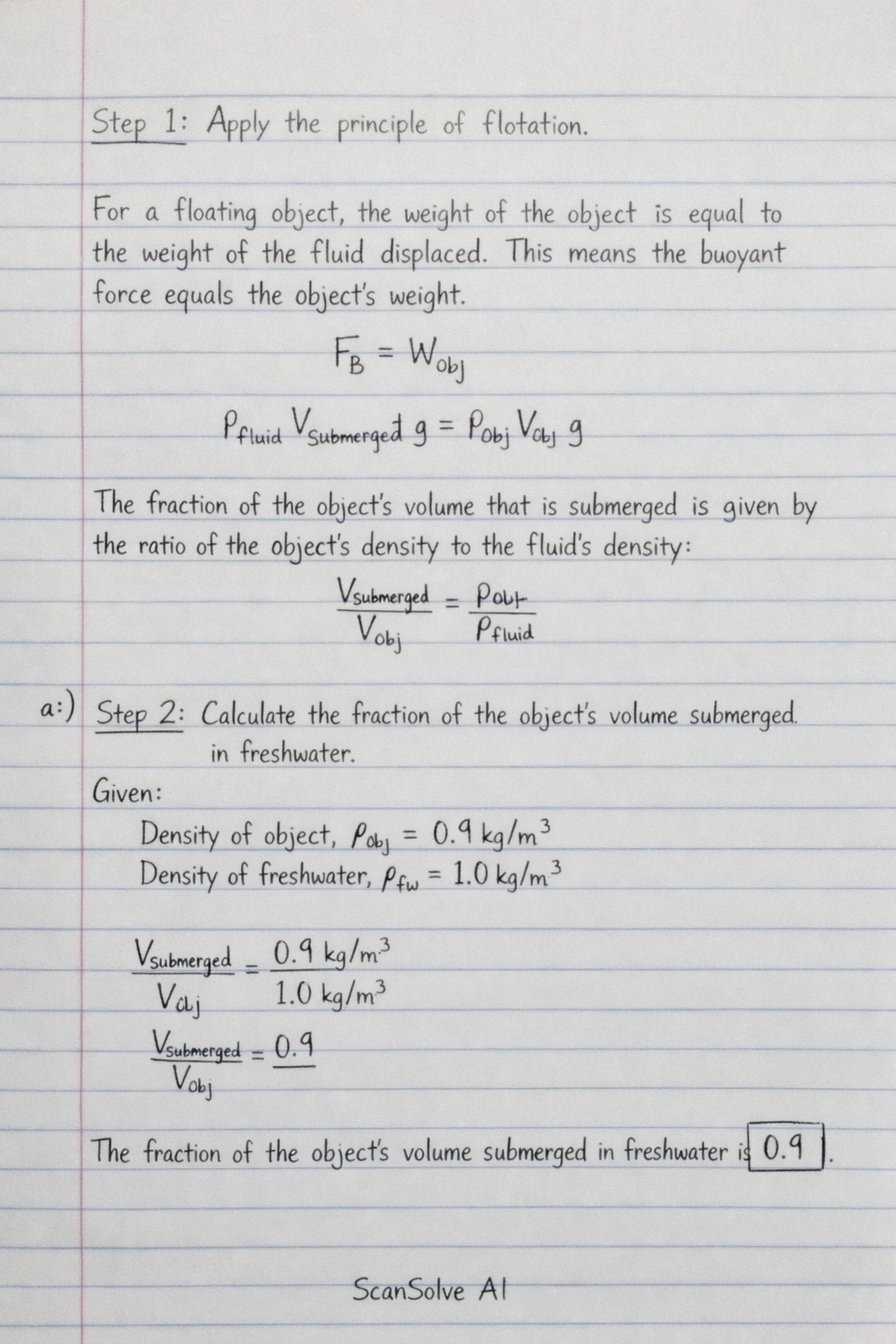
Step 1: Apply the principle of flotation. For a floating object, the weight of the object is equal to the weight of the fluid displaced. This means the buoyant force equals the object's weight. F_B = W_obj _fluid V_submerged g = _obj V_obj g The fraction of the object's volume that is submerged is given by the ratio of the object's density to the fluid's density: V_submergedV_obj = _obj_fluid a) Step 2: Calculate the fraction of the object's volume submerged in freshwater. Given: Density of object, _obj = 0.9 \, kg/m^3 Density of freshwater, _fw = 1.0 \, kg/m^3 V_submergedV_obj = 0.9 \, kg/m^31.0 \, kg/m^3 V_submergedV_obj = 0.9 The fraction of the object's volume submerged in freshwater is 0.9. b) Step 3: Calculate the fraction of the object's volume submerged in seawater. Given: Density of object, _obj = 0.9 \, kg/m^3 Density of seawater, _sw = 1.03 \, kg/m^3 V_submergedV_obj = 0.9 \, kg/m^31.03 \, kg/m^3 V_submergedV_obj ≈ 0.873786 Step 4: Convert the fraction to a percentage. Percentage submerged = ( V_submergedV_obj ) × 100\% Percentage submerged = 0.873786 × 100\% Percentage submerged ≈ 87.38\% The percentage volume of the object submerged in seawater is 87.38\%$. Send me the next one 📸