
We read your photo as:
A solid irregular object has a mass of 78.4 g. When submerged in a graduated cylinder, it raises the water level from 20 mL to 50 mL. What is the density of the object?
Physics
ScanSolve AI Answer
Answer
Step-by-step solution
2 stepsCalculate the volume of the solid.
The volume of the irregular solid is determined by the displacement of water.
Given initial water level = and final water level = .Calculate the density of the solid.
The density is given by the formula .
Given mass of solid = and calculated volume of solid = .The density of the irregular solid is .
Was this helpful?
Try one yourself
A new problem that tests the same skill.
Still stuck on this one?
Ask a follow-up, and the answer starts from this question.
Got a different question?Ask your own question
More Physics Questions
QA mass of 120g half immersed in water displaced a volume of 20cm³. Calculate the density of the…QA rock has a mass of 30g. When submerged in water, it displaces 3mL of water. What is the rock's…QAn object has a density of 0.9 kg/m3. Calculate the fraction of its volume submerged in freshwater…QA stone with a mass of 2400 g is submerged in water in a rectangular tank with base dimensions 17 cm…QA cube of side 10cm and mass 0.5kg floats in a liquid with only \((1)/(5)\) of its height above the…
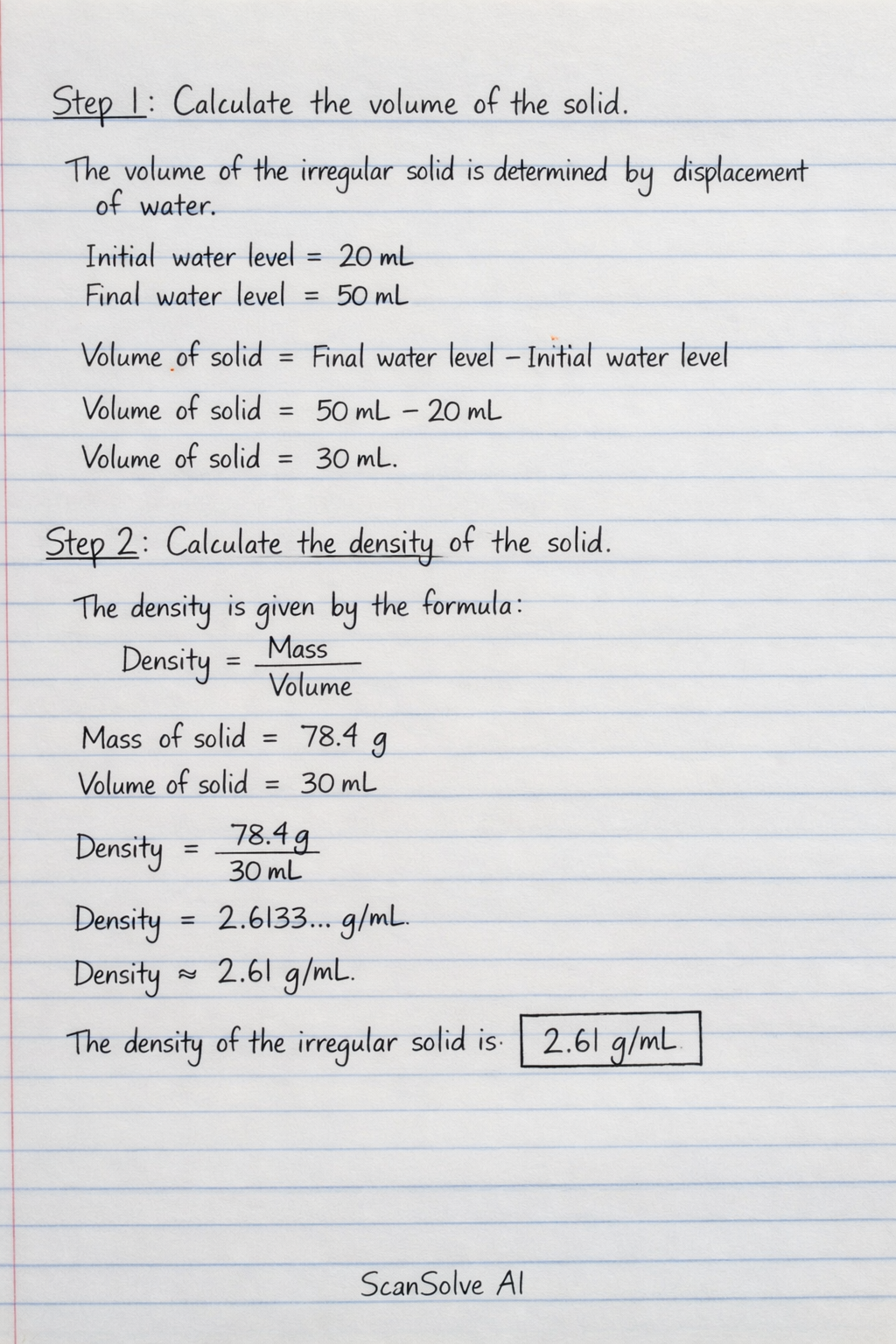
Handwritten Step-by-Step Solution
Get this as a handwritten image on WhatsApp — like a tutor wrote it for you.
Try on WhatsApp