
A cube of side 10cm and mass 0.5kg floats in a liquid with only \((1)/(5)\) of its height above the liquid surface. What is the relative density of the liquid?
ScanSolve AI Answer
Answer
Step-by-step solution
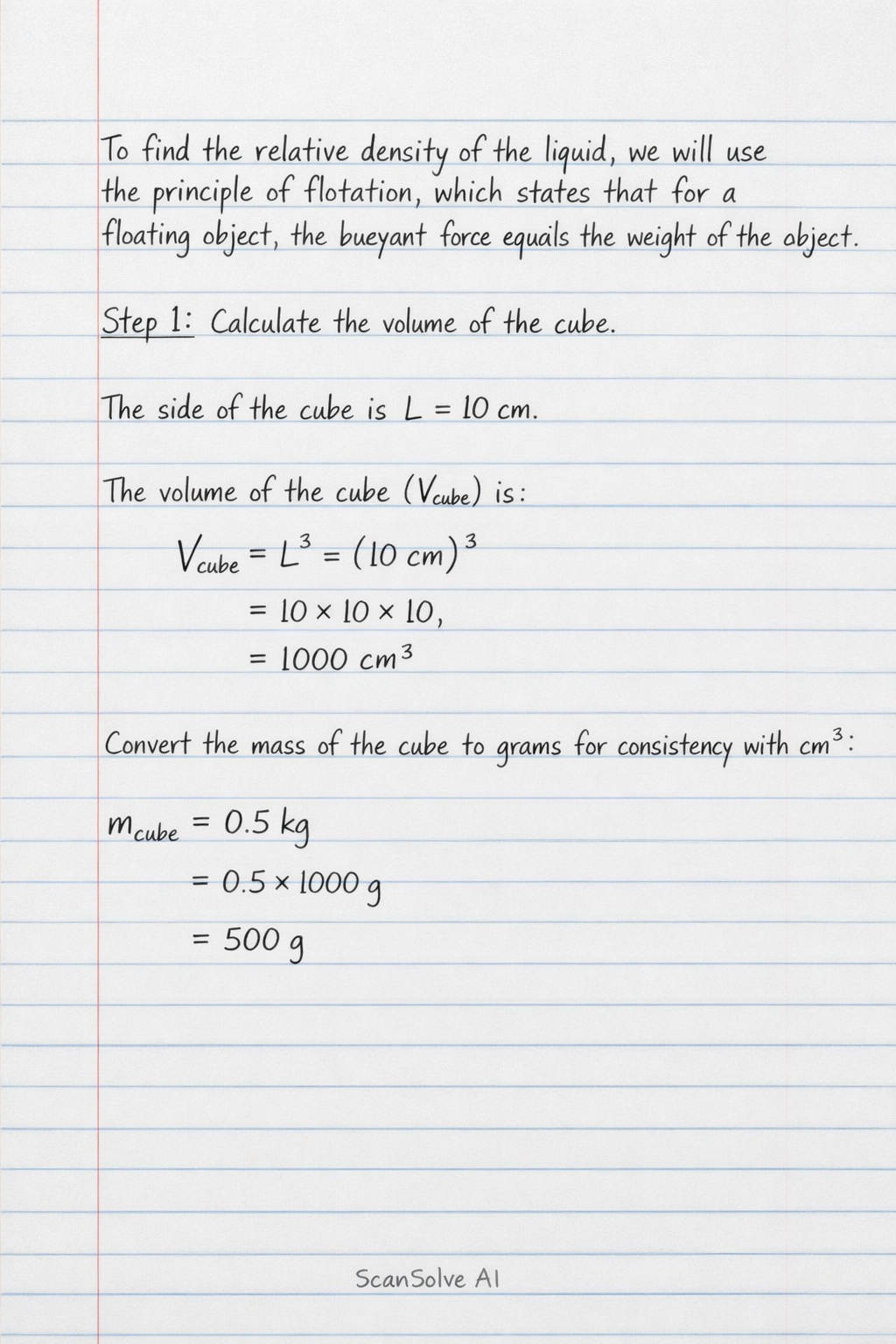
4 stepsTo find the relative density of the liquid, we will use the principle of flotation, which states that for a floating object, the buoyant force equals the weight of the object.
Calculate the volume of the cube.
The side of the cube is .
The volume of the cube () is:Convert the mass of the cube to grams for consistency with cm:
Determine the volume of the cube submerged in the liquid.
The problem states that of the cube's height is above the liquid surface. This means that the fraction of the cube's height submerged in the liquid is .
The height submerged () is:The volume of the cube submerged () is the base area multiplied by the submerged height:
Apply the principle of flotation to find the density of the liquid.
For a floating object, the weight of the object is equal to the weight of the displaced liquid.
Weight of cube = Weight of displaced liquidWe can cancel from both sides:
Now, solve for the density of the liquid ():
Substitute the values:
Calculate the relative density of the liquid.
Relative density (RD) is the ratio of the density of the substance to the density of water. The density of water () is .
The final answer is .
Try one yourself
A new problem that tests the same skill.
Still stuck on this one?
Ask a follow-up, and the answer starts from this question.
More Physics Questions
Handwritten Step-by-Step Solution
Get this as a handwritten image on WhatsApp — like a tutor wrote it for you.
Try on WhatsApp