
We read your photo as:
A piece of floater has a density of 0.30 x 10³ kgm⁻³. It floats in a liquid of density 1.30 x 10⁵ kgm⁻³. What fraction of the volume of the floater is immersed?
ScanSolve AI Answer
Answer
Step-by-step solution
5 stepsHere are the solutions to the questions from the image:
Part c· 5 steps
Buoyancy Problem
To find the fraction of the volume of the floater immersed, we use the principle of flotation, which states that the weight of the floating object is equal to the weight of the fluid it displaces.
State the principle of flotation.
Weight of floater = Buoyant force
where is the density of the floater, is the total volume of the floater, is the density of the liquid, and is the volume of the floater immersed in the liquid. is the acceleration due to gravity.
Simplify the equation by canceling from both sides.
Rearrange the equation to find the fraction of the volume immersed, .
Substitute the given values.
Density of floater () =
Density of liquid () =Calculate the fraction.
As a decimal, this is approximately:
The fraction of the volume of the floater immersed is .
Part d(i)
For an **elastic collision
Conditions for Collisions
- Kinetic energy is conserved. (Momentum is also conserved).
Part d(ii)
For an **inelastic collision
- Kinetic energy is not conserved. (Momentum is conserved, but some kinetic energy is converted to other forms like heat, sound, or deformation).
9. (a) Heating Curve of a Solid
To draw a heating curve of a solid, you would plot Temperature on the y-axis and Time (or Heat Added) on the x-axis.
The curve would show the following features:
- Solid phase: An initial upward sloping line, indicating that as heat is added, the temperature of the solid increases.
- Melting point: A horizontal segment on the graph, representing the constant temperature at which the solid begins to melt into a liquid.
- Melting phase: This horizontal segment also represents the melting process, where the added heat (latent heat of fusion) is used to change the state from solid to liquid, without a change in temperature. During this phase, both solid and liquid coexist.
- Liquid phase: After all the solid has melted, the curve becomes an upward sloping line again, indicating that as more heat is added, the temperature of the liquid increases.
Here's a description of how the graph would look:
- Start at a low temperature on the y-axis (solid phase).
- Draw a line sloping upwards to the right, showing increasing temperature with time.
- At a specific temperature (the melting point), draw a horizontal line segment. This is the melting phase.
- After the horizontal segment, draw another line sloping upwards to the right, starting from the melting point temperature and continuing to higher temperatures (liquid phase).
Try one yourself
A new problem that tests the same skill.
Still stuck on this one?
Ask a follow-up, and the answer starts from this question.
More Physics Questions
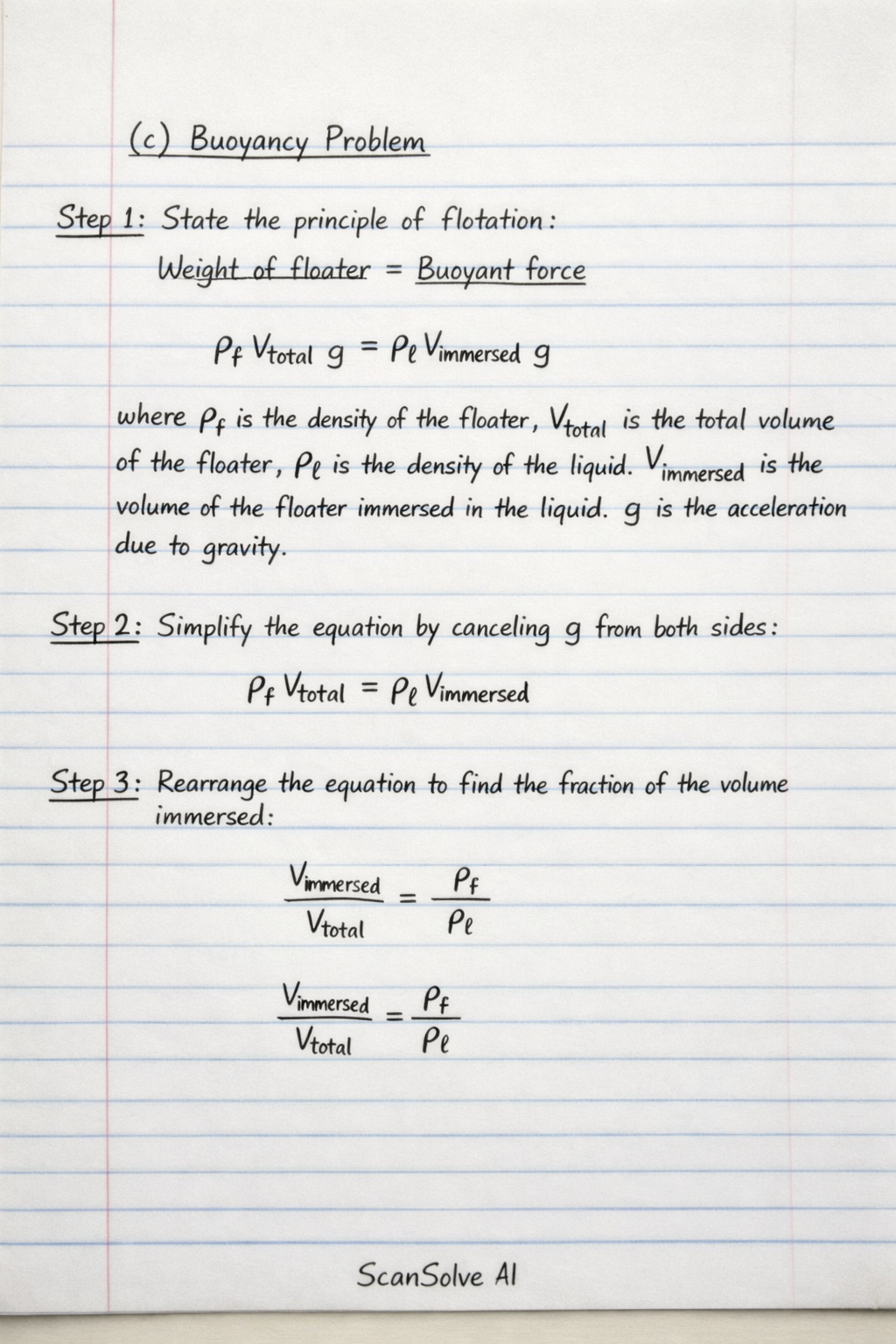
Handwritten Step-by-Step Solution
Get this as a handwritten image on WhatsApp — like a tutor wrote it for you.
Try on WhatsApp