
We read your photo as:
Calculate the density of a mixture formed by mixing 180 cm³ of fresh water with 2800 cm³ of sea water.
ScanSolve AI Answer
Answer
Step-by-step solution
4 stepsCalculate the mass of fresh water.
Given:
Volume of fresh water
Density of fresh waterFirst, convert the volume to cubic meters:
Now, calculate the mass of fresh water ():
Calculate the mass of sea water.
Given:
Volume of sea water
Density of sea waterFirst, convert the volume to cubic meters:
Now, calculate the mass of sea water ():
Calculate the total mass and total volume of the mixture.
Total mass :
Total volume :
Convert total volume to cubic meters:
Calculate the density of the mixture.
Density of mixture :
The final answer is .
4. Explain why fish can survive under water.
Fish can survive underwater because they possess specialized respiratory organs called gills. Gills are highly efficient at extracting dissolved oxygen from the water. Water contains oxygen in a dissolved state, which fish absorb as it passes over their gills. The gills have a large surface area and a rich blood supply, facilitating the efficient exchange of oxygen from the water into the fish's bloodstream and carbon dioxide from the blood into the water.
Try one yourself
A new problem that tests the same skill.
Still stuck on this one?
Ask a follow-up, and the answer starts from this question.
More Physics Questions
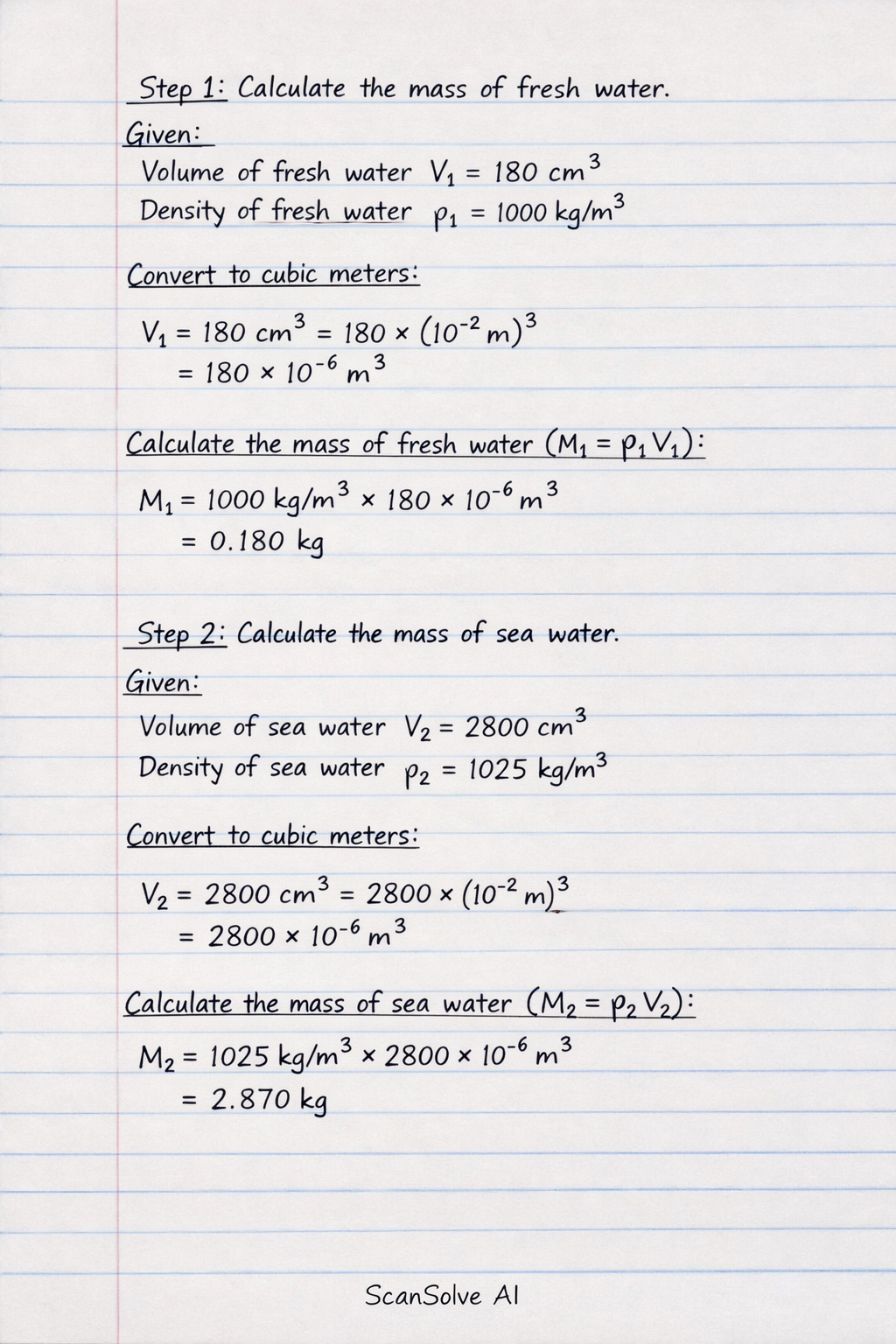
Handwritten Step-by-Step Solution
Get this as a handwritten image on WhatsApp — like a tutor wrote it for you.
Try on WhatsApp