

This physics problem tests your understanding of fundamental physical laws and their applications. The step-by-step solution below breaks down the problem using relevant equations and physical reasoning.
ScanSolve AI Answer
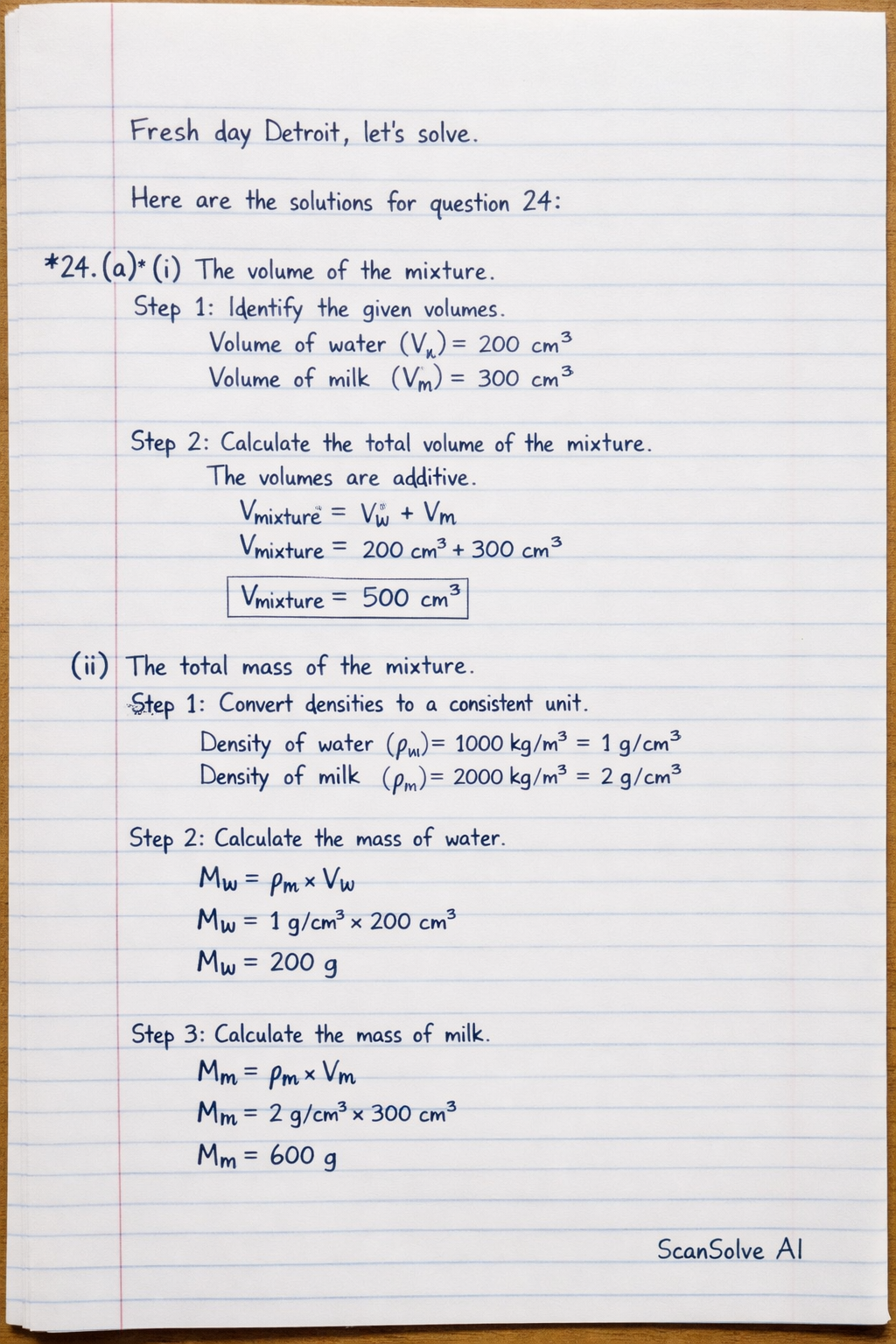
Fresh day Detroit, let's solve. Here are the solutions for question 24: 24. (a) (i) The volume of the mixture. Step 1: Identify the given volumes. Volume of water (V_w) = 200 cm^3 Volume of milk (V_m) = 300 cm^3 Step 2: Calculate the total volume of the mixture. The volumes are additive. V_mixture = V_w + V_m V_mixture = 200 cm^3 + 300 cm^3 V_mixture = 500 cm^3 (ii) The total mass of the mixture. Step 1: Convert densities to a consistent unit (e.g., g/cm^3) or volumes to m^3. Let's use g/cm^3. Density of water (_w) = 1000 kg/m^3 = 1 g/cm^3 Density of milk (_m) = 2000 kg/m^3 = 2 g/cm^3 Step 2: Calculate the mass of water. M_w = _w × V_w M_w = 1 g/cm^3 × 200 cm^3 M_w = 200 g Step 3: Calculate the mass of milk. M_m = _m × V_m M_m = 2 g/cm^3 × 300 cm^3 M_m = 600 g Step 4: Calculate the total mass of the mixture. M_mixture = M_w + M_m M_mixture = 200 g + 600 g M_mixture = 800 g (iii) The density of the mixture. Step 1: Use the total mass and total volume of the mixture. Total mass (M_mixture) = 800 g Total volume (V_mixture) = 500 cm^3 Step 2: Calculate the density of the mixture. _mixture = M_mixtureV_mixture _mixture = 800 g500 cm^3 _mixture = 1.6 g/cm^3 Step 3: Convert the density to kg/m^3 if desired (as original densities were in kg/m^3). 1.6 g/cm^3 = 1.6 × 1 kg1000 g × (100 cm)^3(1 m)^3 1.6 g/cm^3 = 1.6 × (1)/(1000) × 1,000,000 kg/m^3 _mixture = 1600 kg/m^3 24. (b) Calculate the volume of a cylindrical measuring cylinder of radius 3.5 cm and height 12.5 cm. Step 1: Identify the given dimensions. Radius (r) = 3.5 cm Height (h) = 12.5 cm Step 2: Use the formula for the volume of a cylinder (V = r^2 h). Using = (22)/(7): V = r^2 h V = (22)/(7) × (3.5 cm)^2 × 12.5 cm V = (22)/(7) × 12.25 cm^2 × 12.5 cm V = 22 × 1.75 cm^2 × 12.5 cm V = 38.5 cm^2 × 12.5 cm V = 481.25 cm^3 Send me the next one 📸