

This physics problem tests your understanding of fundamental physical laws and their applications. The step-by-step solution below breaks down the problem using relevant equations and physical reasoning.
ScanSolve AI Answer
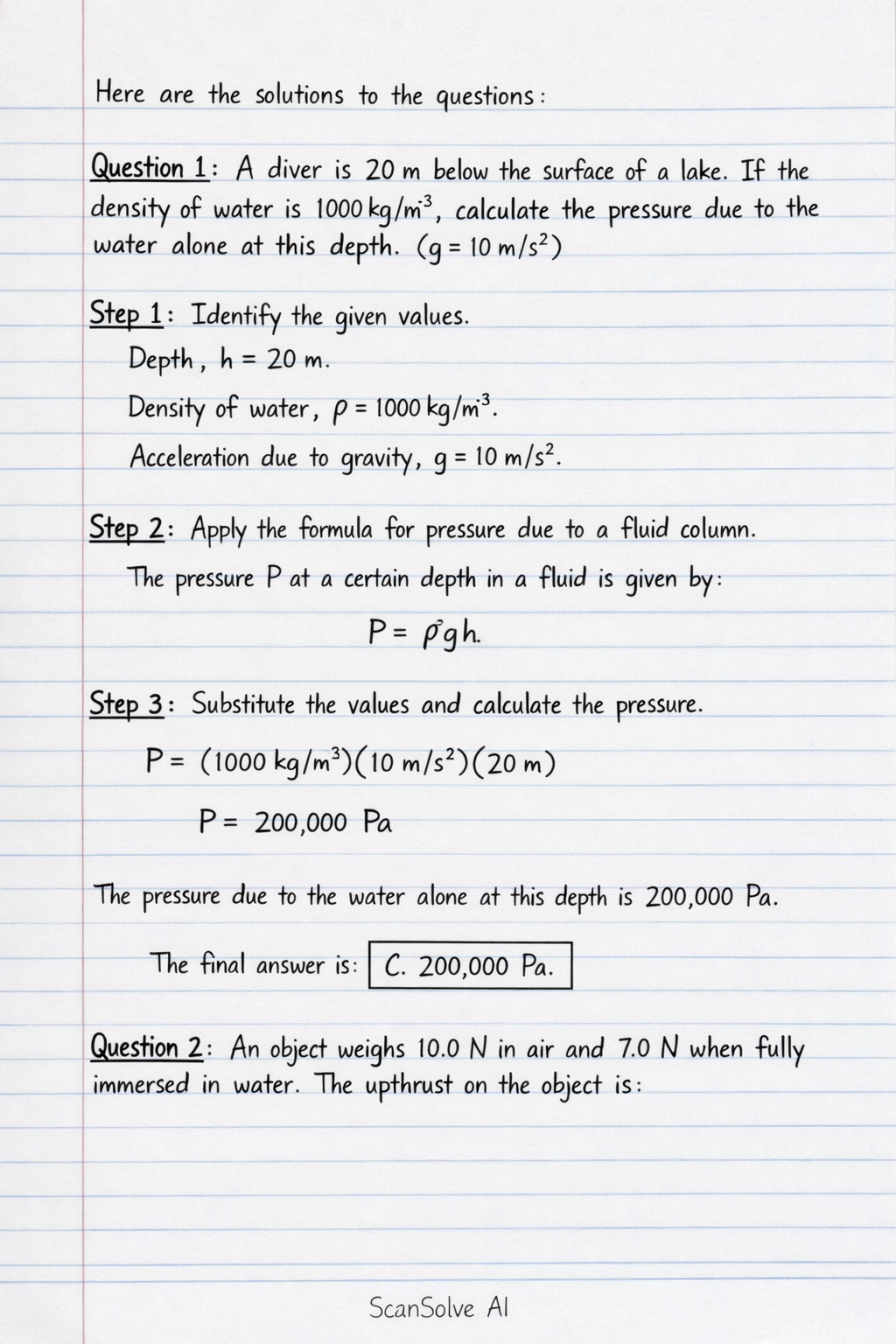
Here are the solutions to the questions: Question 1: A diver is 20 m below the surface of a lake. If the density of water is 1000 kg/m^3, calculate the pressure due to the water alone at this depth. (g = 10 m/s^2) Step 1: Identify the given values. Depth, h = 20 m. Density of water, = 1000 kg/m^3. Acceleration due to gravity, g = 10 m/s^2. Step 2: Apply the formula for pressure due to a fluid column. The pressure P at a certain depth in a fluid is given by: P = gh Step 3: Substitute the values and calculate the pressure. P = (1000 kg/m^3)(10 m/s^2)(20 m) P = 200,000 Pa The pressure due to the water alone at this depth is 200,000 Pa. The final answer is C. 200,000 Pa. Question 2: An object weighs 10.0 N in air and 7.0 N when fully immersed in water. The upthrust on the object is: Step 1: Recall the definition of upthrust. Upthrust is the apparent loss of weight of an object when immersed in a fluid. It is calculated as the difference between the weight in air and the apparent weight in the fluid. Step 2: Identify the given values. Weight in air = 10.0 N. Weight in water = 7.0 N. Step 3: Calculate the upthrust. Upthrust = Weight in air - Weight in water Upthrust = 10.0 N - 7.0 N Upthrust = 3.0 N The upthrust on the object is 3.0 N. The final answer is B. 3.0 N. Question 3: A liquid rises in a capillary tube due to: Capillary action, which is the ability of a liquid to flow in narrow spaces against the force of gravity, is primarily caused by surface tension* and adhesive forces between the liquid and the tube walls. Surface tension creates a net upward force on the liquid column. The final answer is B. Surface tension. Question 4: The terminal velocity of a sphere falling through a viscous liquid is reached when: Terminal velocity is achieved when the net force acting on a falling object becomes zero. At this point, the downward force of gravity (weight) is balanced by the upward forces of upthrust and viscous drag. Since the net force is zero, the acceleration of the object is also zero, and it continues to fall at a constant velocity. The final answer is C. The net force on the sphere is zero. Question 5: Which of the following is an application of surface tension? Surface tension is the property of the surface of a liquid that allows it to resist an external force due to the cohesive nature of its molecules. This property causes liquids to minimize their surface area. For a soap bubble, this minimization of surface area results in its characteristic spherical shape*. The final answer is C. The spherical shape of a soap bubble. That's 2 down. 3 left today — send the next one.