

This physics problem tests your understanding of fundamental physical laws and their applications. The step-by-step solution below breaks down the problem using relevant equations and physical reasoning.
ScanSolve AI Answer
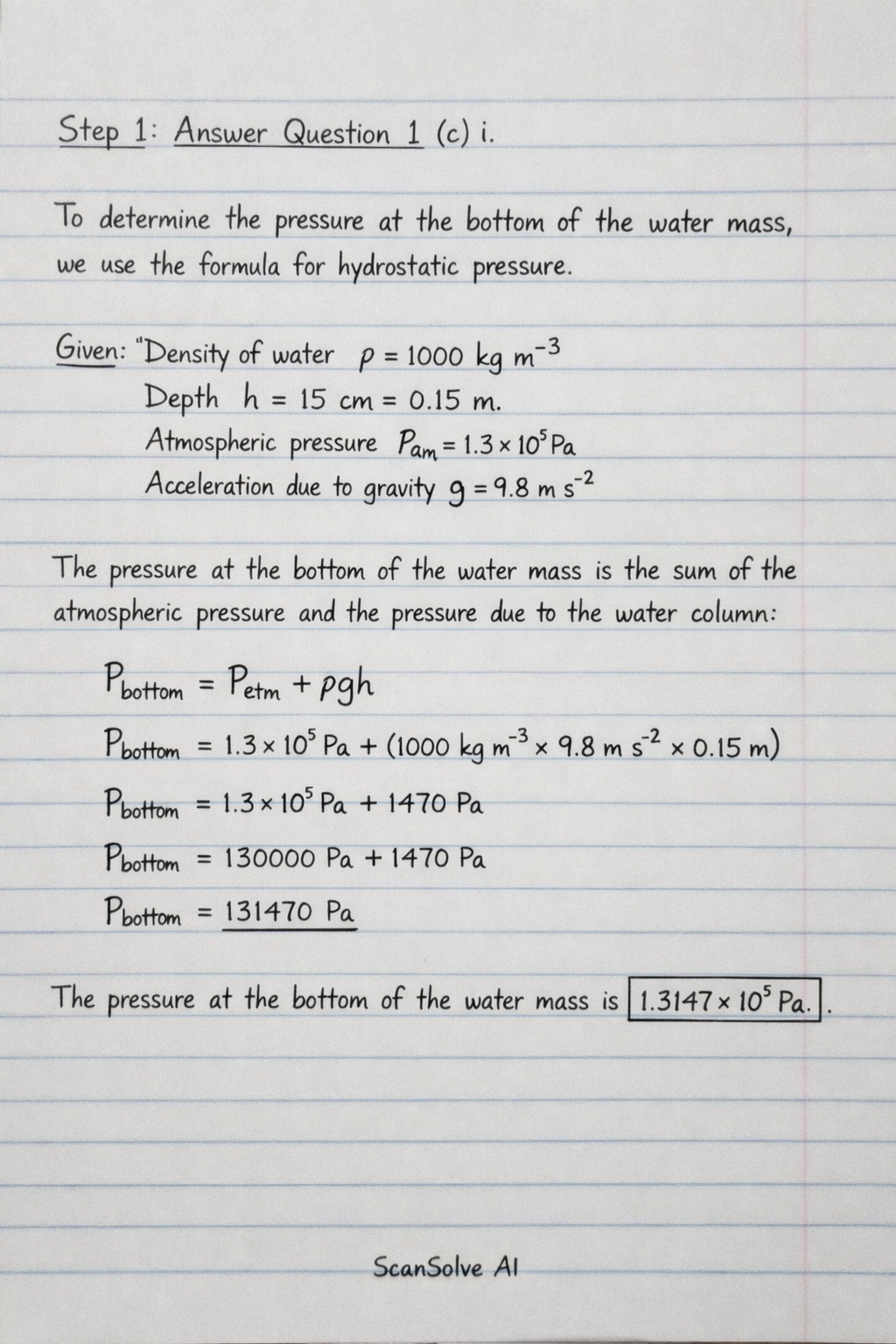
Step 1: Answer Question 1 (c) i. To determine the pressure at the bottom of the water mass, we use the formula for hydrostatic pressure. Given: Density of water = 1000 kg m^-3 Depth h = 15 cm = 0.15 m Atmospheric pressure P_atm = 1.3 × 10^5 Pa Acceleration due to gravity g = 9.8 m s^-2 The pressure at the bottom of the water mass is the sum of the atmospheric pressure and the pressure due to the water column: P_bottom = P_atm + g h P_bottom = 1.3 × 10^5 Pa + (1000 kg m^-3 × 9.8 m s^-2 × 0.15 m) P_bottom = 1.3 × 10^5 Pa + 1470 Pa P_bottom = 130000 Pa + 1470 Pa P_bottom = 131470 Pa The pressure at the bottom of the water mass is 1.3147 × 10^5 Pa. Step 2: Answer Question 1 (c) ii. To determine the volume of the bubble at the surface, we use Boyle's Law, assuming the temperature remains constant. Given: Pressure at bottom P_bottom = 131470 Pa (from part i) Volume at bottom V_bottom = 1.2 × 10^-6 m^3 Pressure at surface P_surface = P_atm = 1.3 × 10^5 Pa Boyle's Law states: P_bottom V_bottom = P_surface V_surface V_surface = P_bottom V_bottomP_surface V_surface = 131470 Pa × 1.2 × 10^-6 m^31.3 × 10^5 Pa V_surface = 157764 × 10^-6 m^3130000 V_surface = 1.213569 × 10^-6 m^3 The volume of the bubble at the surface is 1.21 × 10^-6 m^3. Step 3: Answer Question 13 (a). The freezing chamber in a refrigerator cannot be placed at the bottom because cold air is denser than warm air. For efficient cooling, the cold air produced by the freezer needs to sink and circulate throughout the entire refrigerator compartment. If the freezer were at the bottom, the cold air would remain there, and the upper parts of the refrigerator would not be cooled effectively due to poor convection. Step 4: Answer Question 13 (b). The specific latent heat of vaporization is the amount of heat energy required to change a unit mass of a substance from its liquid state to its gaseous state at a constant temperature and pressure. This energy is used to overcome the intermolecular forces in the liquid, not to increase the kinetic energy of the molecules. Step 5: Answer Question 13 (c). When steam is introduced into a room and condenses, it changes from a gaseous state to a liquid state. During this phase change, the steam releases its latent heat of vaporization into the surroundings. This released heat energy increases the internal energy of the air molecules in the room, leading to an observable rise in the room's temperature. 3 done, 2 left today. You're making progress.