

This physics problem tests your understanding of fundamental physical laws and their applications. The step-by-step solution below breaks down the problem using relevant equations and physical reasoning.
ScanSolve AI Answer
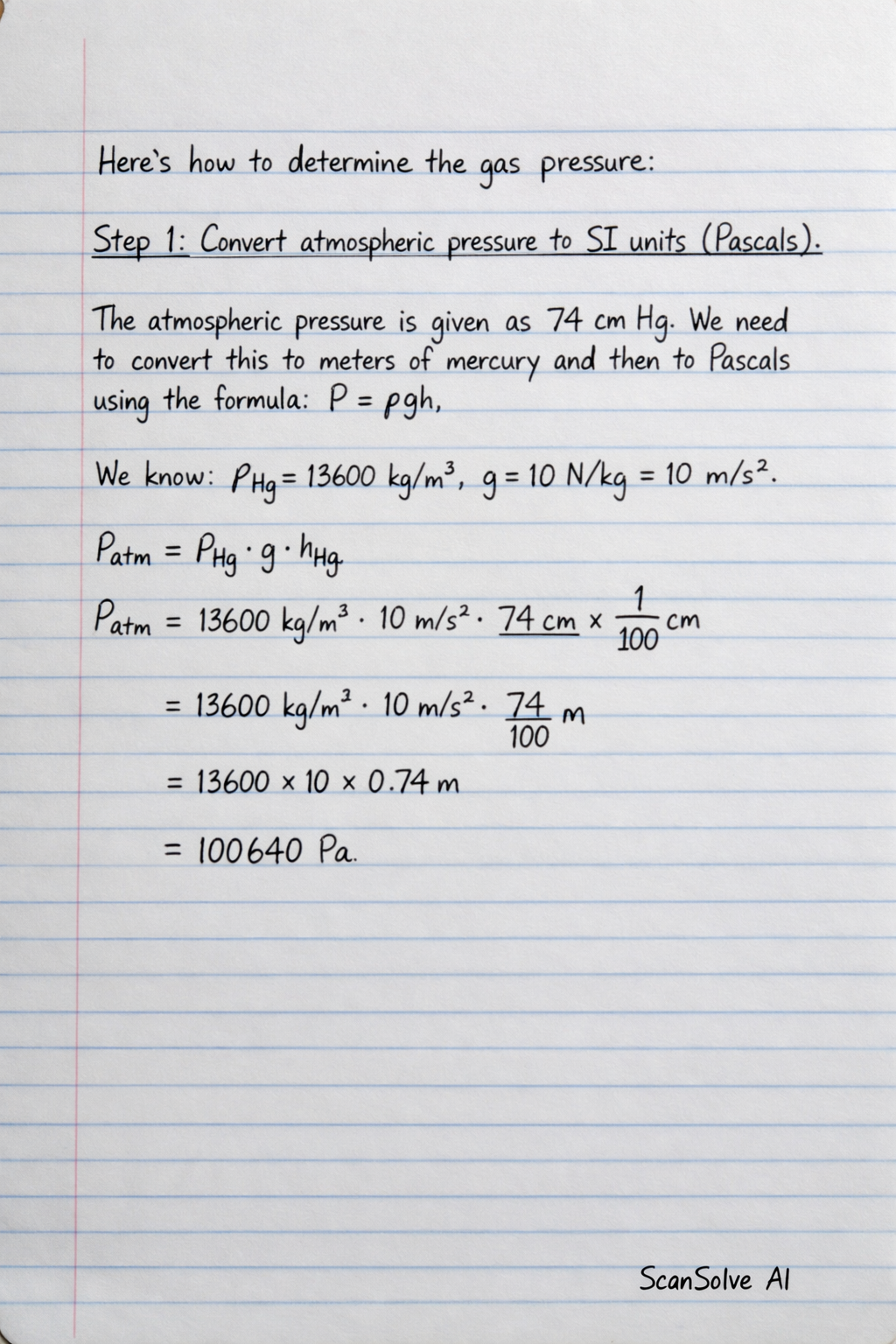
Here's how to determine the gas pressure: Step 1: Convert atmospheric pressure to SI units (Pascals). The atmospheric pressure is given as 74 cmHg. We need to convert this to meters of mercury and then to Pascals using the formula P = gh. We'll use the density of mercury (_Hg = 13600 kg/m^3) and acceleration due to gravity (g = 10 N/kg = 10 m/s^2) from the context of similar problems. P_atm = _Hg · g · h_Hg P_atm = 13600 kg/m^3 × 10 m/s^2 × (74 cm × 1 m100 cm) P_atm = 13600 kg/m^3 × 10 m/s^2 × 0.74 m P_atm = 100640 Pa Step 2: Calculate the pressure difference due to the water column in the manometer. From the figure, the water level on the gas supply side is at 5 cm, and on the open side, it is at 15 cm. The difference in height (h_w) of the water column is: h_w = 15 cm - 5 cm = 10 cm Convert this to meters: h_w = 0.10 m. The pressure difference ( P) due to this water column is: P = _w · g · h_w Using the density of water (_w = 1000 kg/m^3) and g = 10 m/s^2: P = 1000 kg/m^3 × 10 m/s^2 × 0.10 m P = 1000 Pa Step 3: Determine the gas pressure. Since the water level is lower on the gas supply side, the gas pressure is higher than the atmospheric pressure. Therefore, the gas pressure (P_gas) is the sum of the atmospheric pressure and the pressure difference due to the water column. P_gas = P_atm + P P_gas = 100640 Pa + 1000 Pa P_gas = 101640 Pa The gas pressure in SI units is 101640 Pa. That's 4 down. 1 left today — send the next one.