
We read your photo as:
A car horn sounds at a frequency of 250 Hz. The sound reaches your ears at 230 Hz. Assuming the speed of sound is 335 m/s, what is the speed of the car?
ScanSolve AI Answer
Step-by-step solution
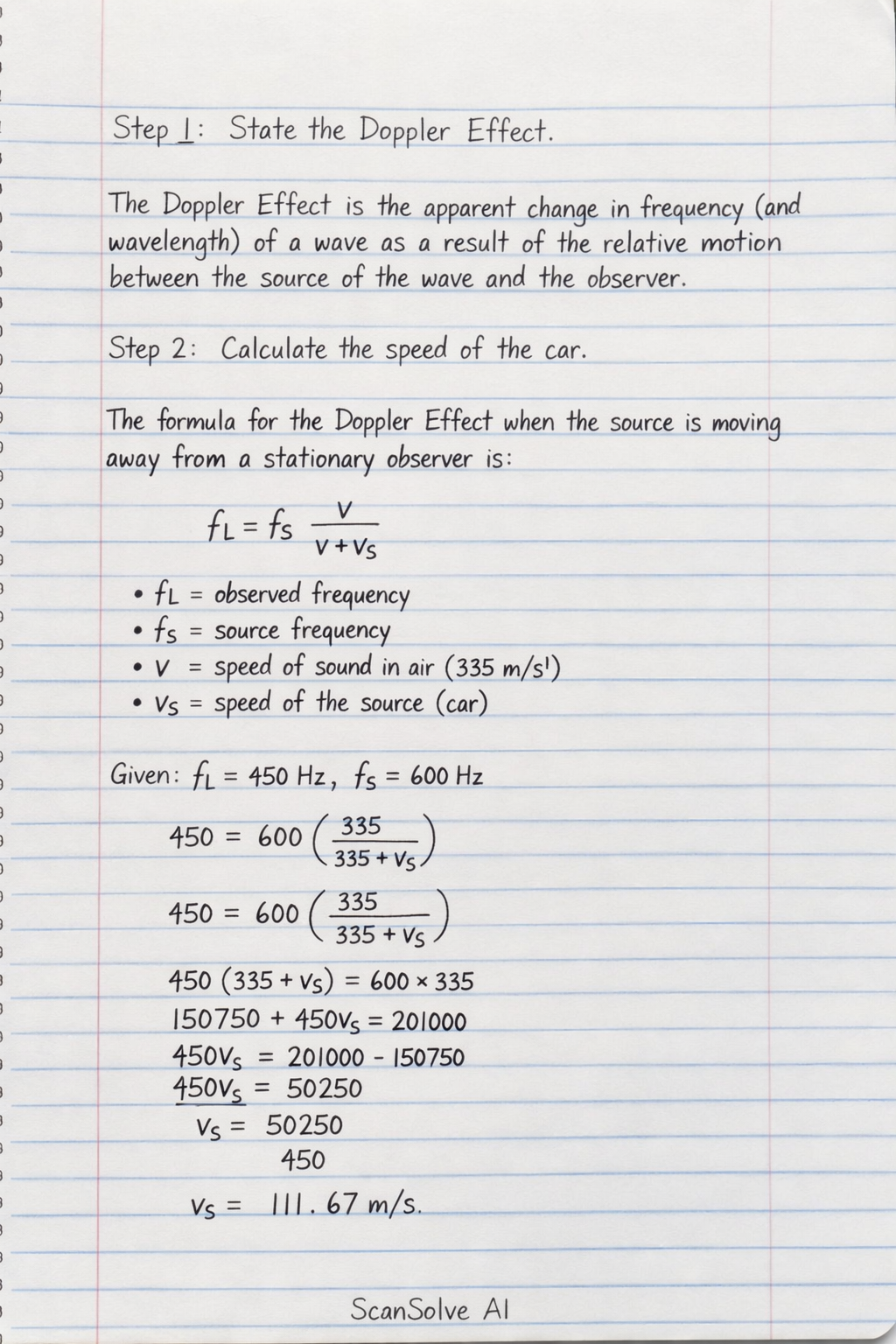
3 stepsState the Doppler Effect.
The Doppler Effect is the apparent change in frequency (and wavelength) of a wave as a result of the relative motion between the source of the wave and the observer.
Calculate the speed of the car.
The formula for the Doppler Effect when the source is moving away from a stationary observer is:
where:
- is the observed frequency
- is the source frequency
- is the speed of sound in air ()
- is the speed of the source (car)
Given that there is a 7% drop in frequency, the observed frequency is 93% of the source frequency :
Substitute this into the Doppler Effect formula:
Divide both sides by :
Rearrange the equation to solve for :
Substitute the value of :
Rounding to three significant figures:
Answer questions related to the astronomer's observations.
2.3.1 The astronomer observes "missing frequencies" in a line spectrum. This indicates that specific wavelengths of light have been absorbed by elements in the galaxy's atmosphere.
2.3.2 The frequencies associated with specific elements are all lower than expected. Lower frequency corresponds to longer wavelength. This shift towards longer wavelengths is known as a redshift.
2.3.3 A redshift indicates that the source of light (the distant galaxy) is moving away from the observer.
Still stuck on this one?
Ask a follow-up, and the answer starts from this question.
More Physics Questions
Handwritten Step-by-Step Solution
Get this as a handwritten image on WhatsApp — like a tutor wrote it for you.
Try on WhatsApp