
We read your photo as:
A car moves for 2 minutes at a constant velocity of 6 m/s, then accelerates at 1 m/s2 for 6 seconds. Calculate the total displacement of the car.
ScanSolve AI Answer
Answer
Step-by-step solution
4 stepsHere's how to find the displacement of the car by calculating the area under its velocity-time graph:
Convert time units and identify the motion phases.
The car moves for at constant velocity, and then for with constant acceleration.
First, convert to seconds:The total time interval is .
Calculate the displacement during the constant velocity phase (0 to 120 s).
During this phase, the velocity is constant at .
On a velocity-time graph, this is represented by a horizontal line from to at . The area under this segment is a rectangle.Calculate the displacement during the acceleration phase (120 s to 126 s).
At the start of this phase (at ), the initial velocity is .
The acceleration is for .
First, calculate the final velocity at :On a velocity-time graph, this phase is represented by a straight line sloping upwards from to . The area under this segment is a trapezium.
The displacement is the area of this trapezium:Calculate the total displacement.
The total displacement is the sum of the displacements from both phases.
The total displacement of the car is .
Try one yourself
A new problem that tests the same skill.
Still stuck on this one?
Ask a follow-up, and the answer starts from this question.
More Physics Questions
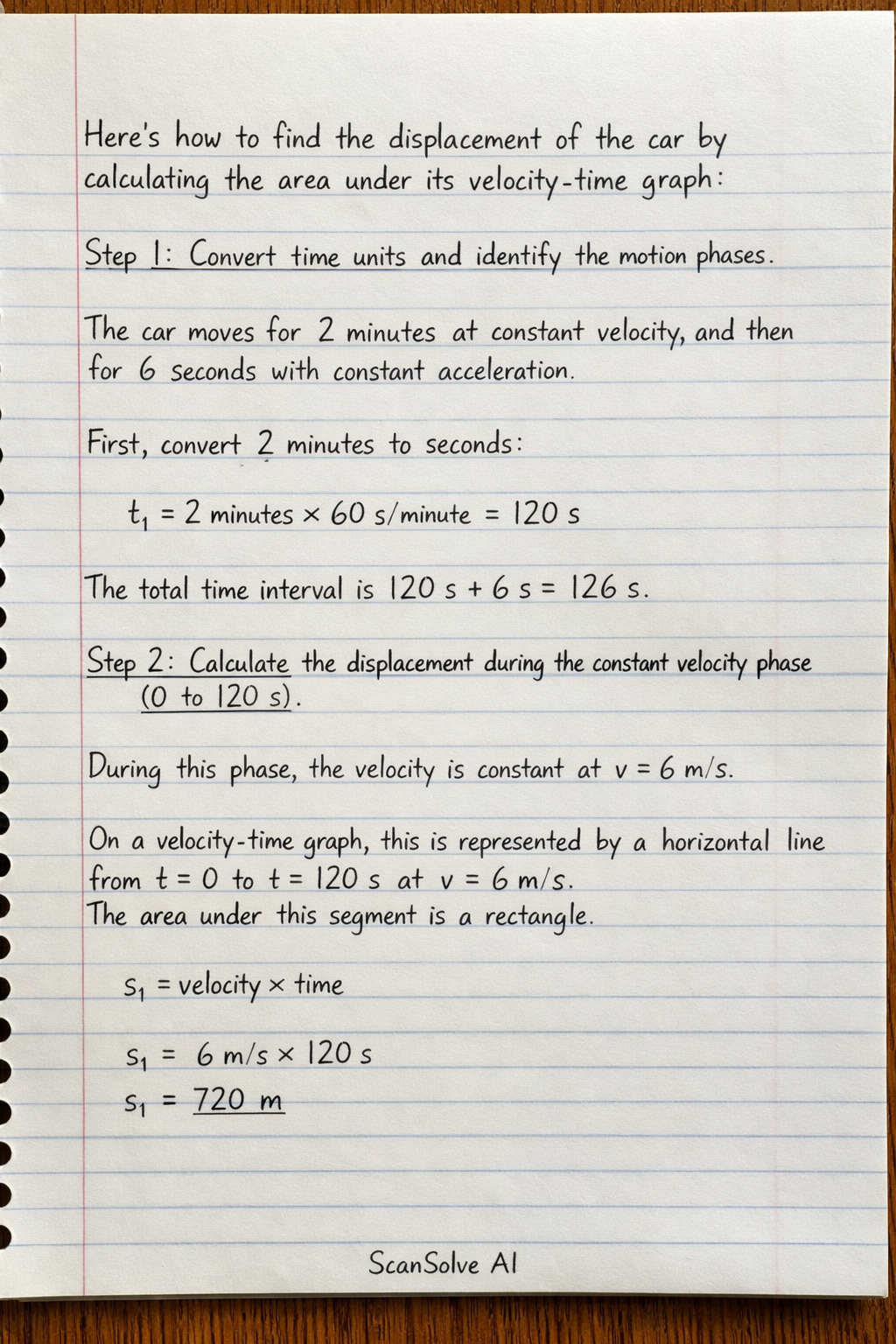
Handwritten Step-by-Step Solution
Get this as a handwritten image on WhatsApp — like a tutor wrote it for you.
Try on WhatsApp