We read your photo as:

A car starts with a speed of 24 m/s. It decelerates for 3 seconds at 2 m/s2, then travels at a constant speed for 10 seconds, and finally decelerates at 3 m/s2 until it stops. Draw a speed-time graph

Physics

ScanSolve AI Answer

Answers

6 parts
a

18 m/s\text{18 m/s}

b

243 m\text{243 m}

c

19 s\text{19 s}

d

297 m\text{297 m}

e

15.63 m/s (to 2 d.p.)\text{15.63 m/s (to 2 d.p.)}

f

12 m/s\text{12 m/s}

8x38x^3

12
Graph of y = 2x⁴ + 5

Use the left and right arrow keys to trace the curve, up and down to jump between key points, and plus and minus to zoom.

Key points of y = 2x⁴ + 5
Pointxy
y-intercept05

Step-by-step solution

16 steps

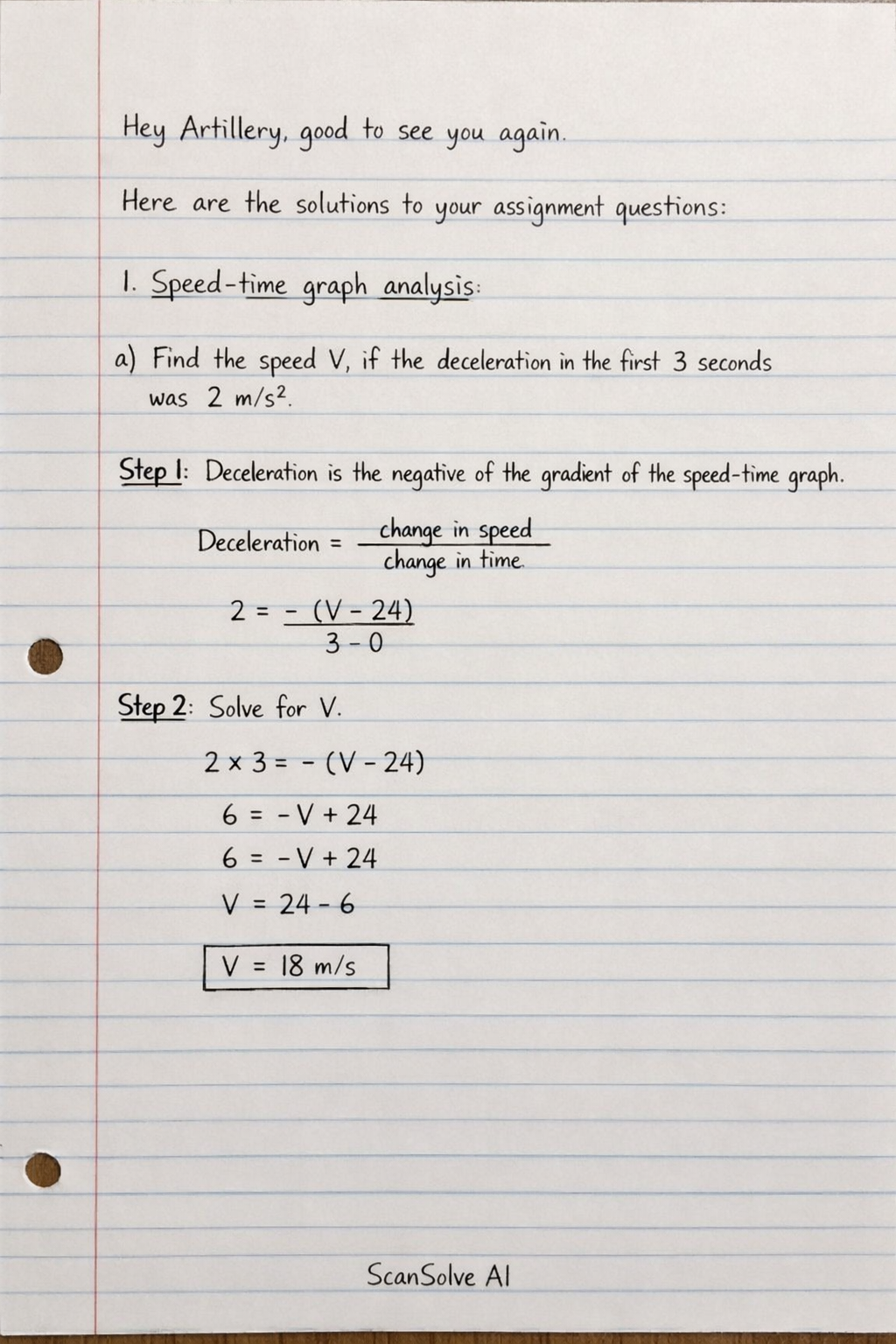
Here are the solutions to your assignment questions:

1. Speed-time graph analysis

Part a· 2 steps

Find the speed VV, if the deceleration in the first 3 seconds was 2 m/s22 \, \text{m/s}^2.

  1. Deceleration is the negative of the gradient of the speed-time graph.

    Deceleration=−change in speedchange in time\text{Deceleration} = -\frac{\text{change in speed}}{\text{change in time}} 2=−V−243−02 = -\frac{V - 24}{3 - 0}
  2. Solve for VV.

    2×3=−(V−24)2 \times 3 = -(V - 24) 6=−V+246 = -V + 24 V=24−6V = 24 - 6 V=18 m/sV = \boxed{\text{18 m/s}}

Part b

243 m\text{243 m}

Distance covered in the first 13 seconds.

  1. The distance is the area under the speed-time graph.

    This consists of a trapezium (from t=0t=0 to t=3t=3) and a rectangle (from t=3t=3 to t=13t=13).

    Area of trapezium=12(u+v)h=12(24+18)×3\text{Area of trapezium} = \frac{1}{2} (u + v) h = \frac{1}{2} (24 + 18) \times 3 Area of trapezium=12(42)×3=21×3=63 m\text{Area of trapezium} = \frac{1}{2} (42) \times 3 = 21 \times 3 = 63 \, \text{m}
  2. Calculate the area of the rectangle.

    Area of rectangle=width×height=(13−3)×18\text{Area of rectangle} = \text{width} \times \text{height} = (13 - 3) \times 18 Area of rectangle=10×18=180 m\text{Area of rectangle} = 10 \times 18 = 180 \, \text{m}
  3. Sum the areas to find the total distance.

    Total distance=63+180=243 m\text{Total distance} = 63 + 180 = \boxed{\text{243 m}}

Part c

19 s\text{19 s}

Value of tt.

  1. The car decelerates at 3 m/s23 \, \text{m/s}^2 from t=13t=13 until it comes to rest (speed 0 m/s0 \, \text{m/s}).

    The initial speed for this segment is V=18 m/sV = 18 \, \text{m/s}.

    Acceleration=change in speedchange in time\text{Acceleration} = \frac{\text{change in speed}}{\text{change in time}} −3=0−18t−13-3 = \frac{0 - 18}{t - 13}
  2. Solve for tt.

    −3(t−13)=−18-3 (t - 13) = -18 t−13=−18−3t - 13 = \frac{-18}{-3} t−13=6t - 13 = 6 t=13+6t = 13 + 6 t=19 st = \boxed{\text{19 s}}

Part d

297 m\text{297 m}

Total distance for the whole journey.

  1. The total distance is the sum of the distance covered in the first 13 seconds (from part b) and the distance covered in the last segment (from t=13t=13 to t=19t=19).

    Distance in first 13 s=243 m\text{Distance in first 13 s} = 243 \, \text{m}
  2. Calculate the distance in the last segment (area of a triangle).

    Area of triangle=12×base×height=12×(19−13)×18\text{Area of triangle} = \frac{1}{2} \times \text{base} \times \text{height} = \frac{1}{2} \times (19 - 13) \times 18 Area of triangle=12×6×18=3×18=54 m\text{Area of triangle} = \frac{1}{2} \times 6 \times 18 = 3 \times 18 = 54 \, \text{m}
  3. Sum the distances.

    Total distance=243+54=297 m\text{Total distance} = 243 + 54 = \boxed{\text{297 m}}

Part e

15.63 m/s (to 2 d.p.)\text{15.63 m/s (to 2 d.p.)}

Average speed of the car.

  1. Average speed is calculated as total distance divided by total time.

    Average speed=Total distanceTotal time\text{Average speed} = \frac{\text{Total distance}}{\text{Total time}} Average speed=297 m19 s\text{Average speed} = \frac{297 \, \text{m}}{19 \, \text{s}} Average speed=15.63 m/s (to 2 d.p.)\text{Average speed} = \boxed{\text{15.63 m/s (to 2 d.p.)}}

Part f

12 m/s\text{12 m/s}

Speed of the car at 15 seconds.

  1. At t=15t=15 seconds, the car is in the final deceleration phase, which starts at t=13t=13 with a speed of 18 m/s18 \, \text{m/s} and a deceleration of 3 m/s23 \, \text{m/s}^2.

    Using the formula v=u+at′v = u + at', where u=18 m/su=18 \, \text{m/s}, a=−3 m/s2a=-3 \, \text{m/s}^2, and t′=15−13=2 st' = 15 - 13 = 2 \, \text{s}.

    v=18+(−3)×2v = 18 + (-3) \times 2 v=18−6v = 18 - 6 v=12 m/sv = \boxed{\text{12 m/s}}

    2. If y=2x4+5y = 2x^4 + 5, find dydx\frac{dy}{dx}.

  2. Differentiate each term with respect to xx.

    dydx=ddx(2x4)+ddx(5)\frac{dy}{dx} = \frac{d}{dx}(2x^4) + \frac{d}{dx}(5)
  3. Apply the power rule for differentiation (ddx(axn)=anxn−1\frac{d}{dx}(ax^n) = anx^{n-1}) and the rule for constants (ddx(c)=0\frac{d}{dx}(c) = 0).

    dydx=2×4x4−1+0\frac{dy}{dx} = 2 \times 4x^{4-1} + 0 dydx=8x3\frac{dy}{dx} = \boxed{8x^3}

    3. Evaluate ∫02(3x2+2x) dx\int_{0}^{2} (3x^2 + 2x)\,dx.

  4. Find the indefinite integral of the function.

    ∫(3x2+2x) dx=3x2+12+1+2x1+11+1+C\int (3x^2 + 2x)\,dx = 3\frac{x^{2+1}}{2+1} + 2\frac{x^{1+1}}{1+1} + C ∫(3x2+2x) dx=3x33+2x22+C\int (3x^2 + 2x)\,dx = 3\frac{x^3}{3} + 2\frac{x^2}{2} + C ∫(3x2+2x) dx=x3+x2+C\int (3x^2 + 2x)\,dx = x^3 + x^2 + C
  5. Evaluate the definite integral using the limits of integration.

    [x3+x2]02=(23+22)−(03+02)\left[x^3 + x^2\right]_{0}^{2} = (2^3 + 2^2) - (0^3 + 0^2) =(8+4)−(0+0)= (8 + 4) - (0 + 0) =12−0= 12 - 0 =12= \boxed{12}
Was this helpful?

Still stuck on this one?

Ask a follow-up, and the answer starts from this question.

Got a different question?Ask your own question
Handwritten step-by-step solution preview

Handwritten Step-by-Step Solution

Get this as a handwritten image on WhatsApp — like a tutor wrote it for you.

Try on WhatsApp