
We read your photo as:
A charge distribution consists of q1=2q at (0,0,0), q2=-q at (0,0,a), and q3=q at (0,0,a). Compute the monopole moment, dipole moment, and approximate potential at large distance r.
ScanSolve AI Answer
Step-by-step solution
4 stepsHere's the solution to question 3:
The given charge distribution consists of:
- A charge at
- A charge at
- A charge at
Compute the monopole moment.
The monopole moment is the total charge of the distribution.
The monopole moment is .
Compute the dipole moment.
The dipole moment is given by .
The dipole moment is .
Compute the approximate potential at large distance in spherical coordinates.
The multipole expansion for the potential at a large distance is given by:
Since and , the dominant term in the expansion is the monopole term.
The approximate potential at large distance is .
Compute the electrical field due to the charge distribution.
The electric field is related to the potential by .
In spherical coordinates, for a potential that only depends on :Substitute the potential :
The electrical field is .
Still stuck on this one?
Ask a follow-up, and the answer starts from this question.
More Physics Questions
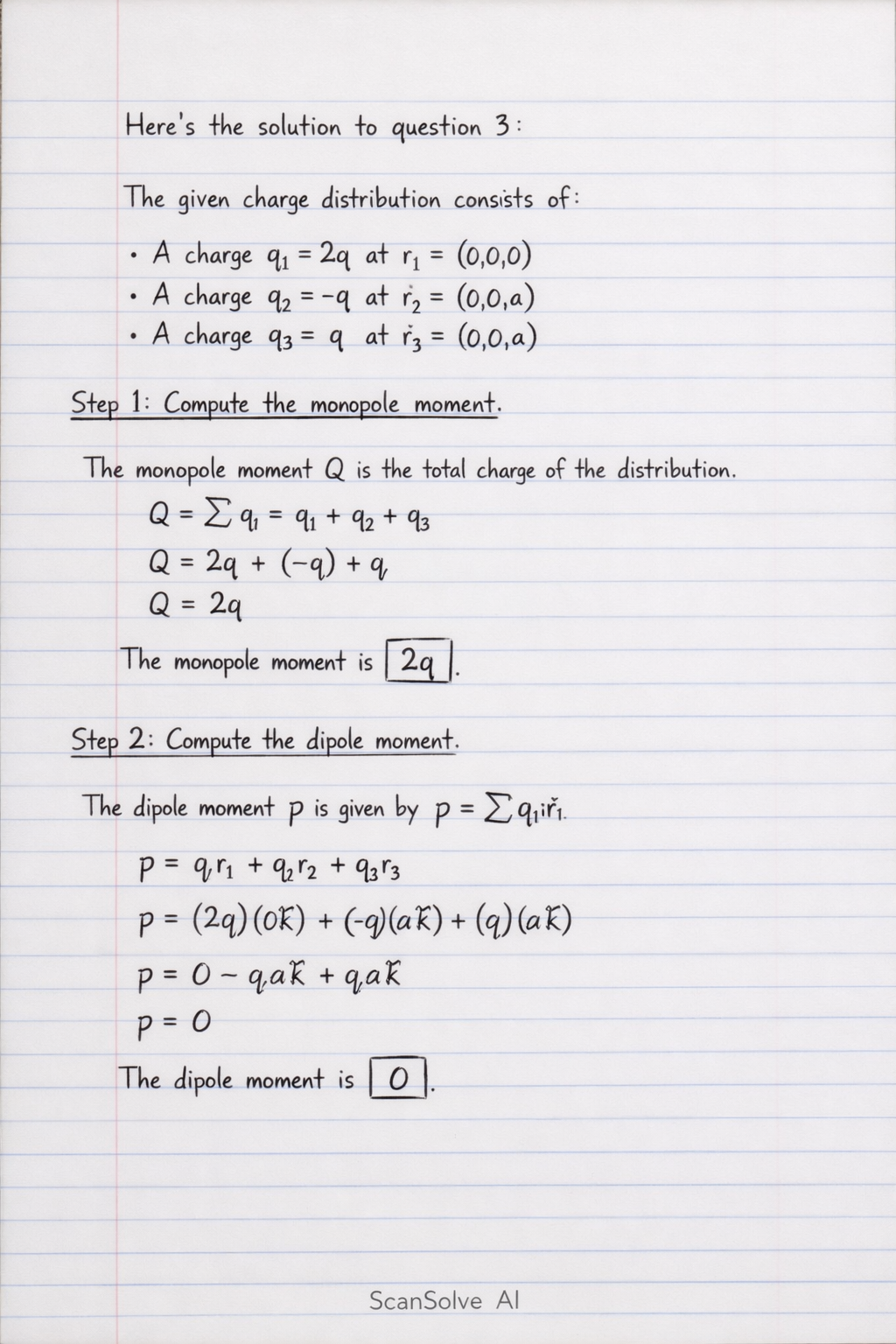
Handwritten Step-by-Step Solution
Get this as a handwritten image on WhatsApp — like a tutor wrote it for you.
Try on WhatsApp