
We read your photo as:
A charge -q is placed at the center of a circle of radius r. Four charges -q, -q, +q, +q are placed at points A, B, C, D respectively on the circumference of the circle. Find the net electrostatic for
ScanSolve AI Answer
Step-by-step solution
2 stepsIdentify the charges and their positions.
We have a charge at the center O of a circle with radius .
On the circumference, there are four charges:- At A:
- At B:
- At C:
- At D: The distance from each charge on the circumference to the center O is .
Calculate the electrostatic force due to each charge on the charge at O.
The magnitude of the force between two point charges and separated by a distance is given by Coulomb's Law: .
Let . All individual forces will have this magnitude.-
Force due to charge at A () on charge at O (): Since both charges are negative, the force is repulsive. The charge at A is at the top, so it repels the charge at O downwards. is in the negative y-direction, with magnitude .
-
Force due to charge at B () on charge at O (): Since both charges are negative, the force is repulsive. The charge at B is to the right, so it repels the charge at O to the left. is in the negative x-direction, with magnitude .
-
Force due to charge at C () on charge at O (): Since the charges are opposite, the force is attractive. The charge at C is at the bottom, so it attracts the charge at O downwards. is in the negative y-direction, with magnitude .
-
Force due to charge at D () on charge at O (): Since the charges are opposite, the force is attractive. The charge at D is to the left, so it attracts the charge
-
Still stuck on this one?
Ask a follow-up, and the answer starts from this question.
More Physics Questions
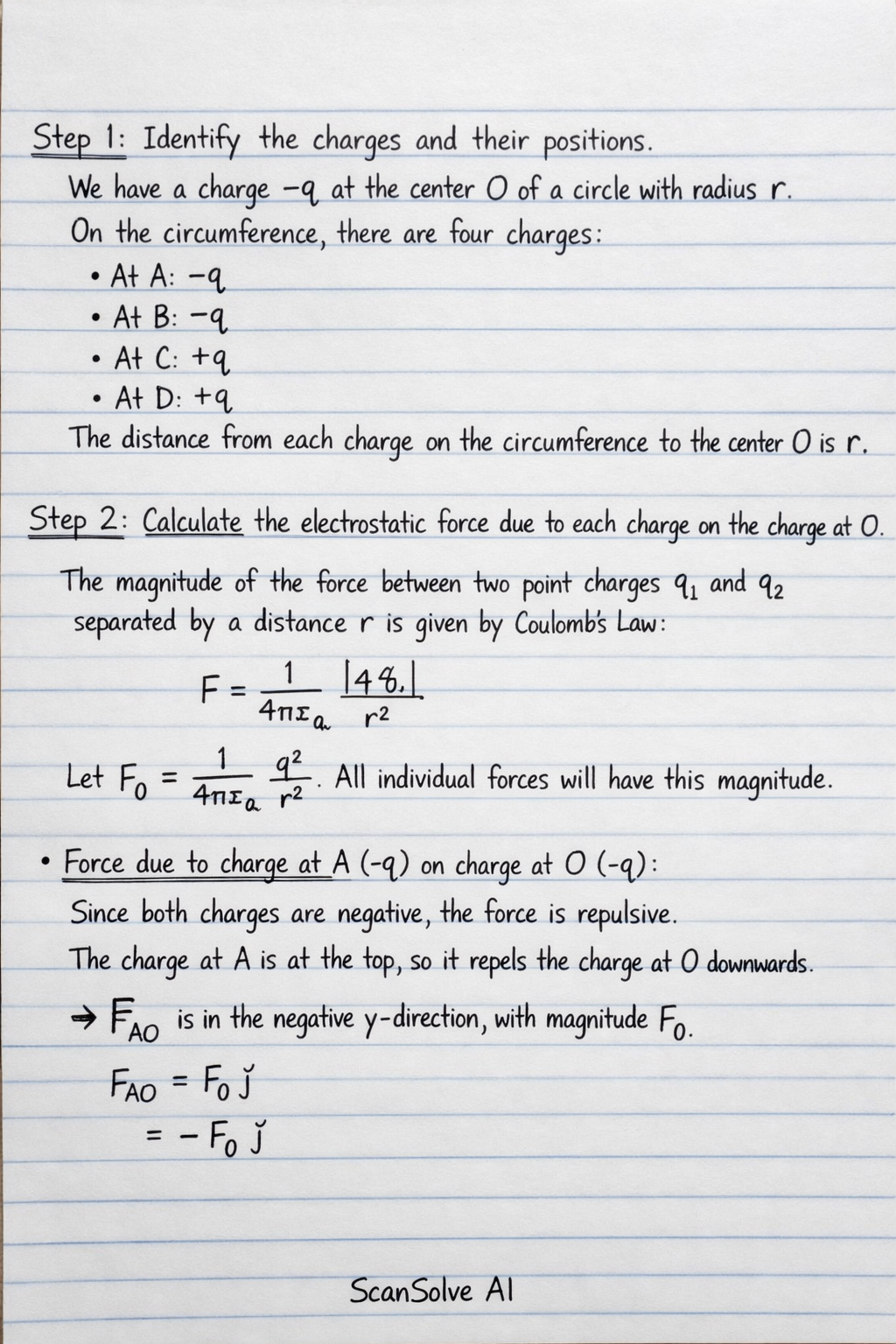
Handwritten Step-by-Step Solution
Get this as a handwritten image on WhatsApp — like a tutor wrote it for you.
Try on WhatsApp