We read your photo as:

A Charged Capacitor of Capacitance 10 µF and p.d 30 v is Connected across an uncharged 50 µF capacitor. Calculate, i) The final p.d across the combination ii) The initial and final energies of the capacitors iii) Account for the difference in the initial & final energies.

Physics

ScanSolve AI Answer

Answers

2 parts
i

5 V5 \, V

ii

4.5×10⁻³ J4.5 \times 10^{-3} \, J

0.75×10⁻³ J0.75 \times 10^{-3} \, J

Step-by-step solution

8 steps

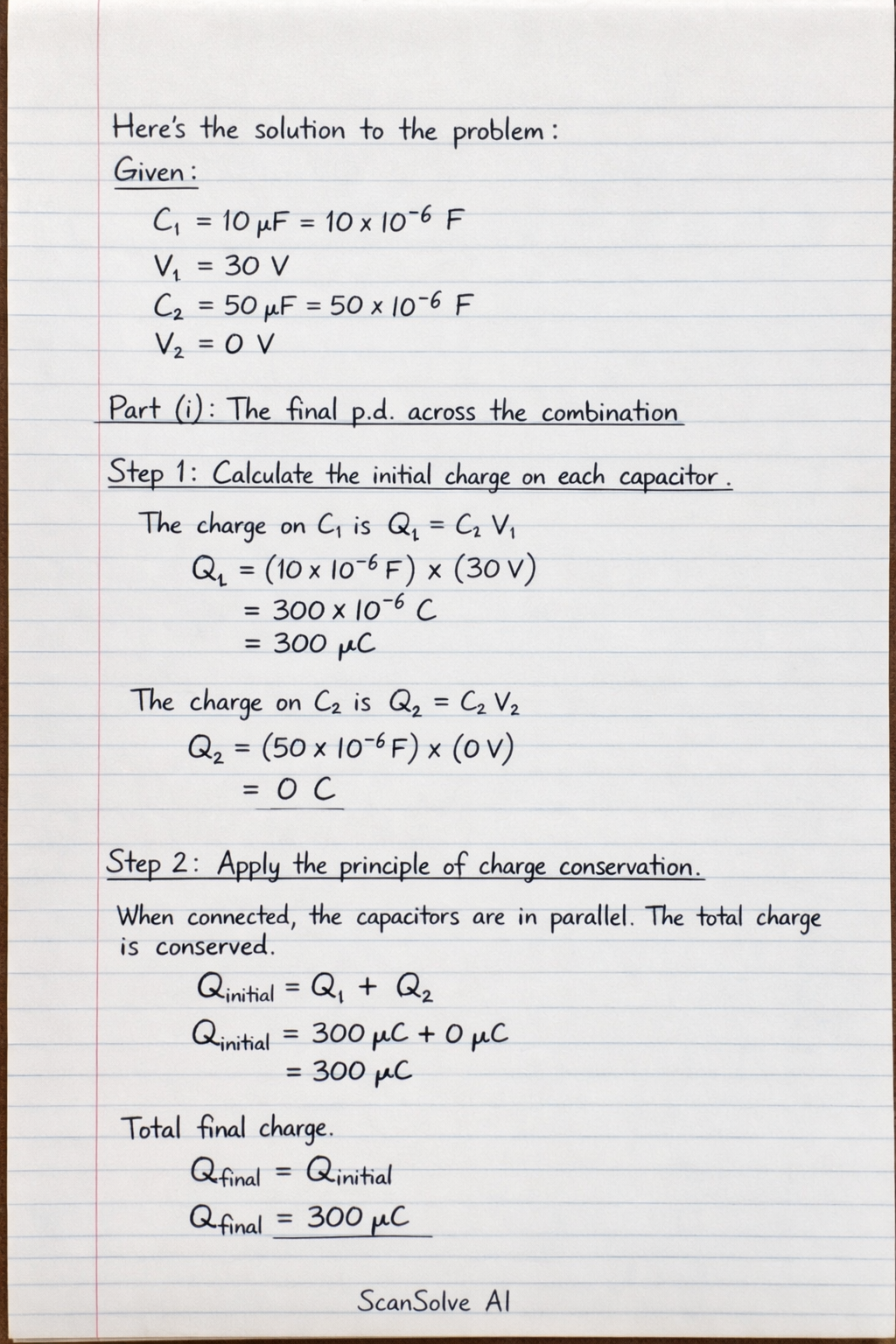
Here's the solution to the problem:

Given:

  • Capacitance of the charged capacitor, C1=10 μF=10×10−6 FC_1 = 10 \, \mu F = 10 \times 10^{-6} \, F
  • Initial potential difference across C1C_1, V1=30 VV_1 = 30 \, V
  • Capacitance of the uncharged capacitor, C2=50 μF=50×10−6 FC_2 = 50 \, \mu F = 50 \times 10^{-6} \, F
  • Initial potential difference across C2C_2, V2=0 VV_2 = 0 \, V

Part i· 4 steps

The final p.d. across the combination

  1. Calculate the initial charge on each capacitor.

    The initial charge on C1C_1 is Q1=C1V1Q_1 = C_1 V_1.

    Q1=(10×10−6 F)×(30 V)=300×10−6 C=300 μCQ_1 = (10 \times 10^{-6} \, F) \times (30 \, V) = 300 \times 10^{-6} \, C = 300 \, \mu C

    The initial charge on C2C_2 is Q2=C2V2Q_2 = C_2 V_2. Since C2C_2 is uncharged, V2=0 VV_2 = 0 \, V.

    Q2=(50×10−6 F)×(0 V)=0 CQ_2 = (50 \times 10^{-6} \, F) \times (0 \, V) = 0 \, C
  2. Apply the principle of charge conservation.

    When the capacitors are connected, they are in parallel. The total charge in the system is conserved.
    Total initial charge Qinitial=Q1+Q2=300 μC+0 μC=300 μCQ_{initial} = Q_1 + Q_2 = 300 \, \mu C + 0 \, \mu C = 300 \, \mu C.
    Total final charge Qfinal=Qinitial=300 μCQ_{final} = Q_{initial} = 300 \, \mu C.

  3. Calculate the equivalent capacitance of the parallel combination.

    For capacitors in parallel, the equivalent capacitance Ceq=C1+C2C_{eq} = C_1 + C_2.

    Ceq=10 μF+50 μF=60 μF=60×10−6 FC_{eq} = 10 \, \mu F + 50 \, \mu F = 60 \, \mu F = 60 \times 10^{-6} \, F
  4. Calculate the final potential difference (VfV_f).

    The final potential difference across the combination is Vf=QfinalCeqV_f = \frac{Q_{final}}{C_{eq}}.

    Vf=300×10−6 C60×10−6 F=30060 V=5 VV_f = \frac{300 \times 10^{-6} \, C}{60 \times 10^{-6} \, F} = \frac{300}{60} \, V = 5 \, V

    The final p.d. across the combination is 5 V\boxed{5 \, V}.

Part ii

4.5×10⁻³ J4.5 \times 10^{-3} \, J

The initial and final energies of the capacitors

  1. Calculate the total initial energy (EinitialE_{initial}).

    The energy stored in a capacitor is E=12CV2E = \frac{1}{2} C V^2.
    Initial energy in C1C_1:

    E1=12C1V12=12(10×10−6 F)(30 V)2E_1 = \frac{1}{2} C_1 V_1^2 = \frac{1}{2} (10 \times 10^{-6} \, F) (30 \, V)^2 E1=12(10×10−6)(900) J=4500×10−6 J=4.5×10⁻³ JE_1 = \frac{1}{2} (10 \times 10^{-6}) (900) \, J = 4500 \times 10^{-6} \, J = 4.5 \times 10^{-3} \, J

    Initial energy in C2C_2 is 0 J0 \, J as it is uncharged.
    Total initial energy:

    Einitial=E1+0=4.5×10⁻³ JE_{initial} = E_1 + 0 = 4.5 \times 10^{-3} \, J
  2. Calculate the total final energy (EfinalE_{final}).

    After connection, both capacitors have the final potential difference Vf=5 VV_f = 5 \, V.
    Final energy in C1C_1:

    E1f=12C1Vf2=12(10×10−6 F)(5 V)2E_{1f} = \frac{1}{2} C_1 V_f^2 = \frac{1}{2} (10 \times 10^{-6} \, F) (5 \, V)^2 E1f=12(10×10−6)(25) J=125×10−6 J=0.125×10⁻³ JE_{1f} = \frac{1}{2} (10 \times 10^{-6}) (25) \, J = 125 \times 10^{-6} \, J = 0.125 \times 10^{-3} \, J

    Final energy in C2C_2:

    E2f=12C2Vf2=12(50×10−6 F)(5 V)2E_{2f} = \frac{1}{2} C_2 V_f^2 = \frac{1}{2} (50 \times 10^{-6} \, F) (5 \, V)^2 E2f=12(50×10−6)(25) J=625×10−6 J=0.625×10⁻³ JE_{2f} = \frac{1}{2} (50 \times 10^{-6}) (25) \, J = 625 \times 10^{-6} \, J = 0.625 \times 10^{-3} \, J

    Total final energy:

    Efinal=E1f+E2f=(0.125+0.625)×10−3 J=0.750×10⁻³ JE_{final} = E_{1f} + E_{2f} = (0.125 + 0.625) \times 10^{-3} \, J = 0.750 \times 10^{-3} \, J

    The initial energy is 4.5×10⁻³ J\boxed{4.5 \times 10^{-3} \, J} and the final energy is 0.75×10⁻³ J\boxed{0.75 \times 10^{-3} \, J}.

Part iii· 2 steps

Account for the difference in the initial and final energies.

  1. Calculate the energy difference.

    ΔE=Einitial−Efinal=(4.5−0.75)×10−3 J=3.75×10⁻³ J\Delta E = E_{initial} - E_{final} = (4.5 - 0.75) \times 10^{-3} \, J = 3.75 \times 10^{-3} \, J
  2. Explain the energy difference.

    When the charged capacitor is connected to the uncharged capacitor, charge flows from the charged capacitor to the uncharged capacitor until they reach a common potential. This flow of charge constitutes a current. Due to the resistance of the connecting wires, some of the initial stored electrical energy is dissipated as heat during this charge redistribution process.

    3 de faites, encore 2 aujourd'hui. Tu progresses.

Was this helpful?

Try one yourself

A new problem that tests the same skill.

Still stuck on this one?

Ask a follow-up, and the answer starts from this question.

Got a different question?Ask your own question
Handwritten step-by-step solution preview

Handwritten Step-by-Step Solution

Get this as a handwritten image on WhatsApp — like a tutor wrote it for you.

Try on WhatsApp