

This physics problem tests your understanding of fundamental physical laws and their applications. The step-by-step solution below breaks down the problem using relevant equations and physical reasoning.
ScanSolve AI Answer
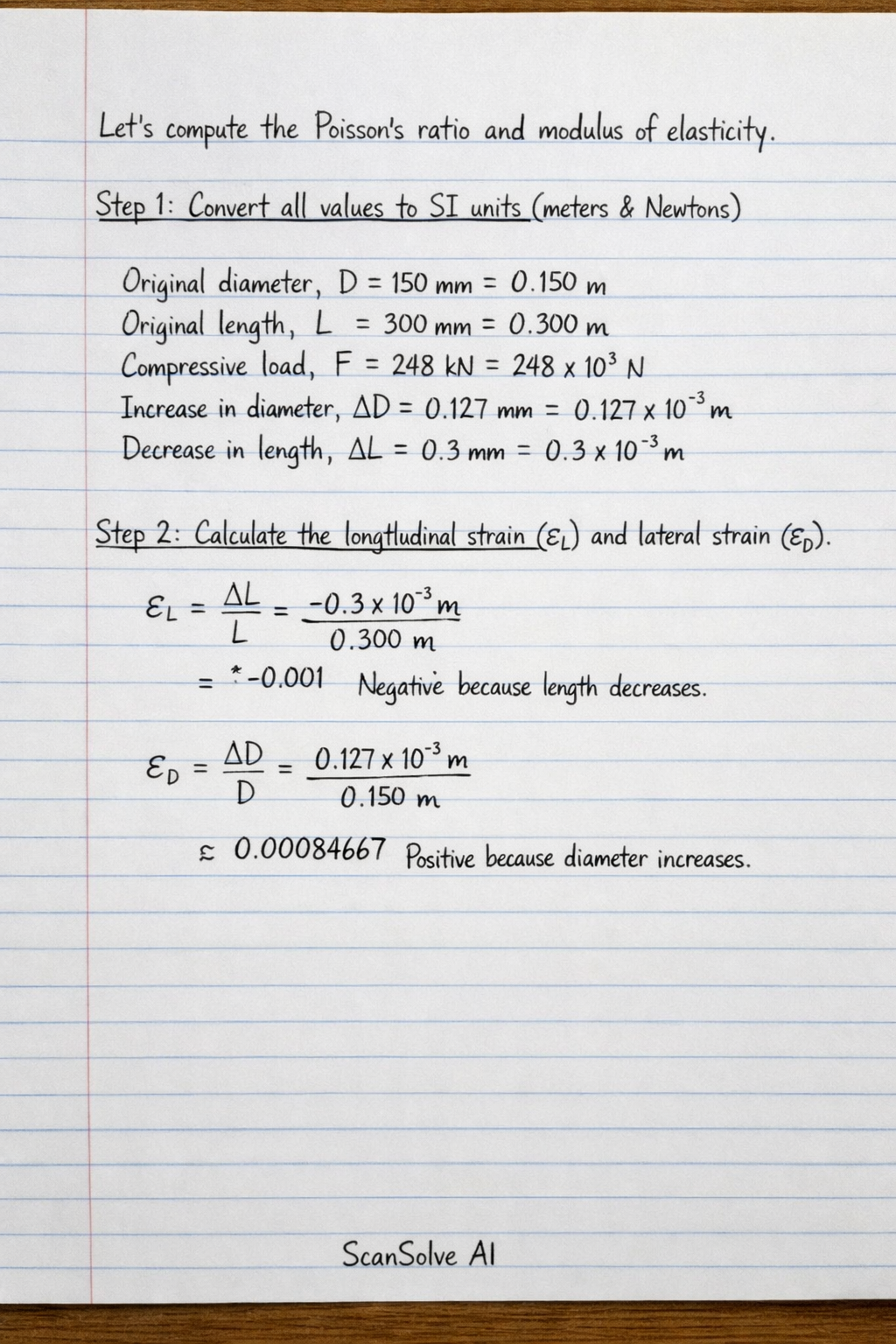
let's compute the Poisson's ratio and modulus of elasticity. Step 1: Convert all given values to SI units (meters and Newtons). Original diameter, D = 150 mm = 0.150 m Original length, L = 300 mm = 0.300 m Compressive load, F = 248 kN = 248 × 10^3 N Increase in diameter, D = 0.127 mm = 0.127 × 10^-3 m Decrease in length, L = 0.3 mm = 0.3 × 10^-3 m Step 2: Calculate the longitudinal strain (_L) and lateral strain (_D). Longitudinal strain is the change in length divided by the original length. Since it's a decrease, we use a negative sign for the change in length. _L = ( L)/(L) = -0.3 × 10^-3 m0.300 m = -0.001 Lateral strain is the change in diameter divided by the original diameter. Since it's an increase, it's positive. _D = ( D)/(D) = 0.127 × 10^-3 m0.150 m ≈ 0.00084667 Step 3: Compute Poisson's ratio (). Poisson's ratio is the negative ratio of lateral strain to longitudinal strain. = -(_D)/(_L) = -(0.00084667)/(-0.001) = 0.84667 Rounding to three significant figures: Poisson's ratio ≈ 0.847 Step 4: Calculate the cross-sectional area (A) of the cylinder. A = ( D^2)/(4) = (0.150 m)^24 = × 0.0225 m^24 ≈ 0.017671 m^2 Step 5: Calculate the compressive stress (). Stress is the force divided by the cross-sectional area. = (F)/(A) = 248 × 10^3 N0.017671 m^2 ≈ 14033900 Pa Step 6: Compute the modulus of elasticity (E). The modulus of elasticity (Young's modulus) is the ratio of stress to the magnitude of longitudinal strain. E = ()/(|_L|) = 14033900 Pa0.001 = 14033900000 Pa Converting to GigaPascals (GPa): E = 14.0339 GPa Rounding to three significant figures: Modulus of elasticity ≈ 14.0 GPa What's next?