
We read your photo as:
A cubic container with side 0.4 m is placed on a floor. The floor can support a maximum pressure of 5000 N/m2. What is the maximum gross mass the container can have? (g = 10 m/s2)
ScanSolve AI Answer
Step-by-step solution
5 stepsHere's how to determine the maximum gross mass:
Identify the given values.
Floor limit (maximum pressure, ) =
Side of cubic container () =
Acceleration due to gravity () =Calculate the base area of the cubic container.
Since it's a cubic container, the base is a square.
Calculate the maximum force (weight) the floor can support.
The formula for pressure is , where is the force and is the area.
Rearranging for force:Calculate the maximum gross mass.
The force calculated in Step 3 is the maximum weight () the floor can support. Weight is related to mass () by the formula .
Rearranging for mass:Compare the result with the given options.
A) 80 kg
B) 800 kg
C) 32 kg
D) 320 kgThe calculated maximum gross mass is 80 kg, which matches option A.
The maximum gross mass is:
Still stuck on this one?
Ask a follow-up, and the answer starts from this question.
More Physics Questions
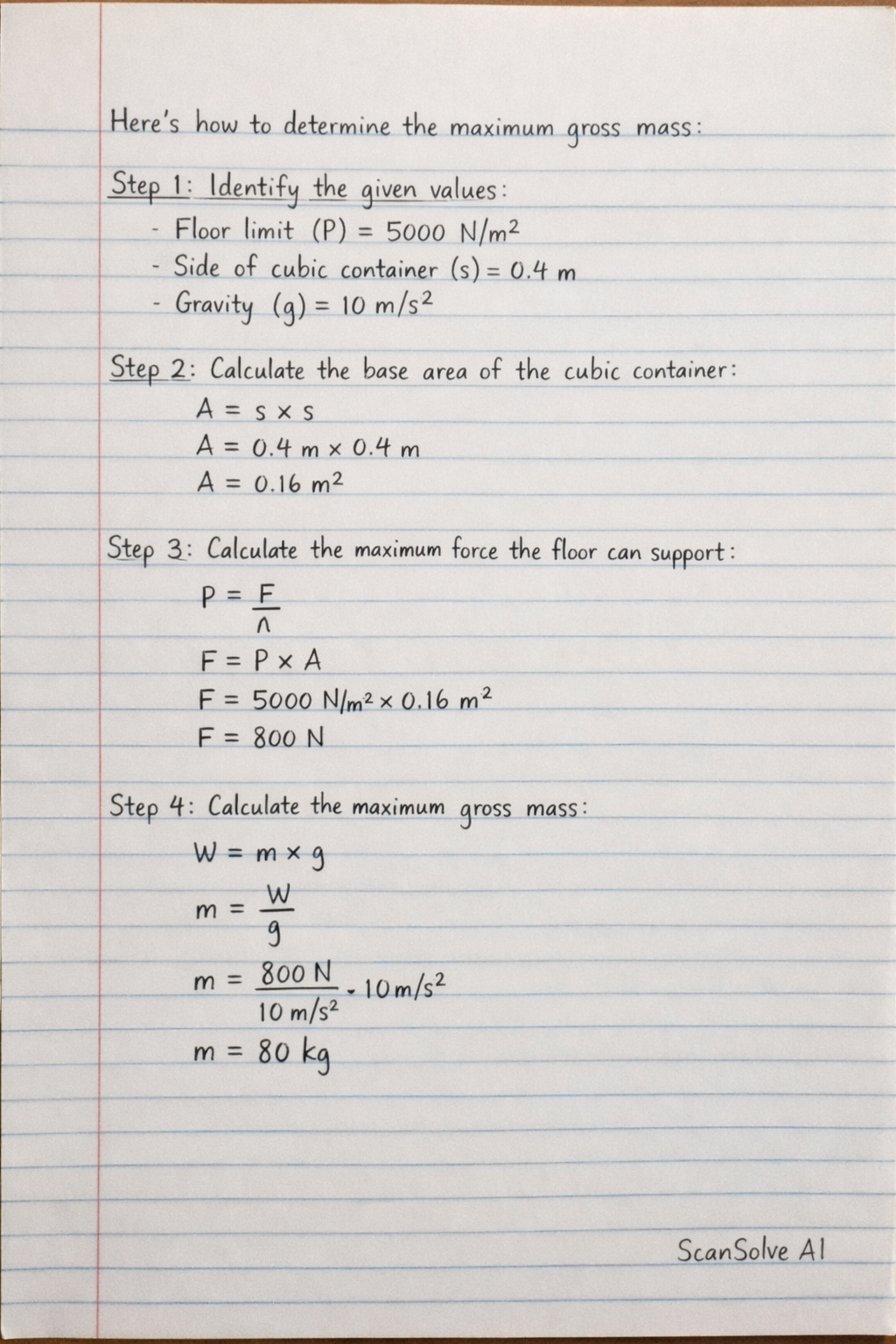
Handwritten Step-by-Step Solution
Get this as a handwritten image on WhatsApp — like a tutor wrote it for you.
Try on WhatsApp