
We read your photo as:
A cycle consists of two processes: (1) heating at constant pressure from state 1 to state 2, and (2) cooling at constant volume from state 2 to state 1. For air, assume R = 287 J/kg.K and k = 1.4. Sta
Physics
ScanSolve AI Answer
Step-by-step solution
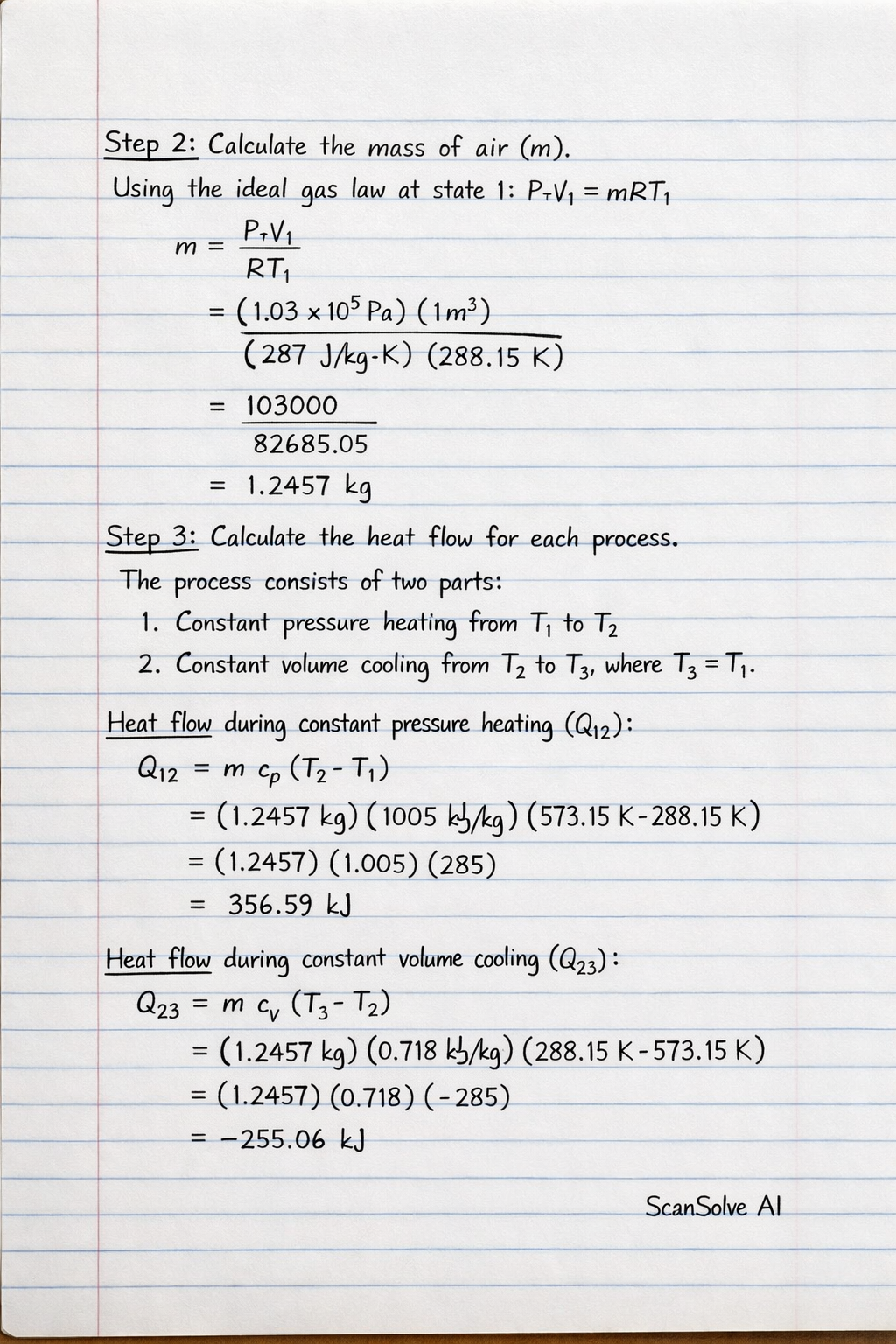
5 stepsCalculate the mass of air ().
Using the ideal gas law at state 1:
Calculate the heat flow for each process.
The process consists of two parts:
- Constant pressure heating from to .
- Constant volume cooling from to , where .
Heat flow during constant pressure heating ():
Heat flow during constant volume cooling ():
Calculate the net heat flow (i).
The net heat flow is the sum of heat flows for both processes.
The net heat flow is .
Calculate the change in entropy for each process.
Change in entropy during constant pressure heating ():
Change in entropy during constant volume cooling ():
Calculate the overall change in entropy (ii).
The overall change in entropy is the sum of entropy changes for both processes.
The overall change in entropy is .
Was this helpful?
Still stuck on this one?
Ask a follow-up, and the answer starts from this question.
Got a different question?Ask your own question
More Physics Questions
QA heat engine operates on a cycle with the following state points and given data. Calculate the work…QIn a Carnot cycle operating between 330°C and 35°C, the maximum and minimum pressures are 6 MPa and…QA thermodynamic system is taken from an original state A to an intermediate state B by a linear…QA gas undergoes a polytropic process (PV1.2 = constant) from an initial state of 3.4 bar and 0.283…QOne mole of a monatomic ideal gas undergoes the process A to B as shown in the given P-V diagram…
Handwritten Step-by-Step Solution
Get this as a handwritten image on WhatsApp — like a tutor wrote it for you.
Try on WhatsApp