
We read your photo as:
A. Define the following terms: i. Ground state, ii. Excited state, iii. The work function of certain metal is 3.6 x 10⁻¹⁹ J. If the metal is illuminated with light of wave length 3.5 x 10⁻⁷m, calculate: a. The stopping potential b. Cut off frequency
ScanSolve AI Answer
Step-by-step solution
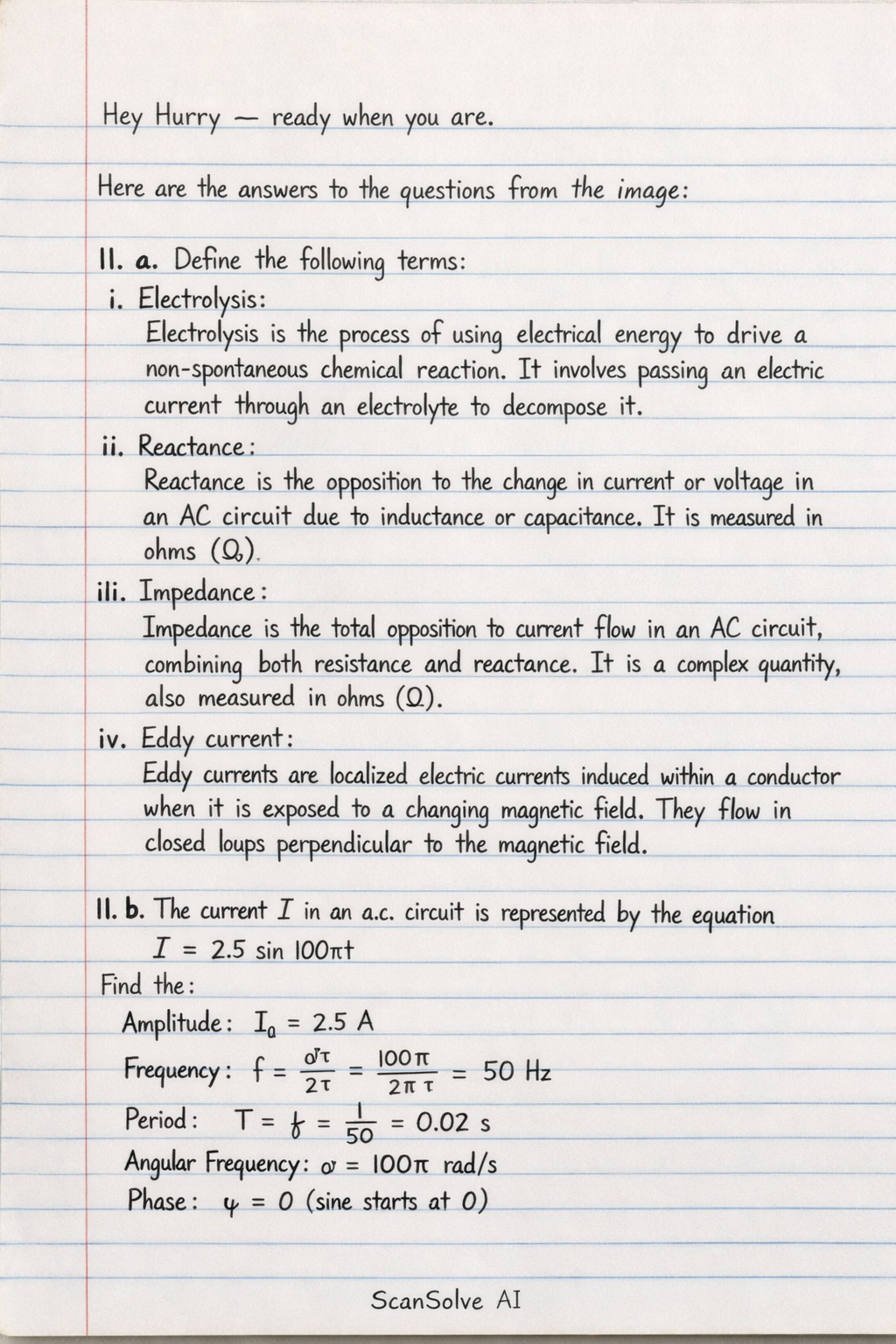
11 stepsHere are the answers to the questions from the image:
11. a. Define the following terms:
-
i. Electrolysis:
- Electrolysis is the process of using electrical energy to drive a non-spontaneous chemical reaction. It involves passing an electric current through an electrolyte to decompose it.
-
ii. Reactance:
- Reactance is the opposition to the change in current or voltage in an AC circuit due to inductance or capacitance. It is measured in ohms ().
-
iii. Impedance:
- Impedance is the total opposition to current flow in an AC circuit, combining both resistance and reactance. It is a complex quantity, also measured in ohms ().
-
iv. Eddy current:
- Eddy currents are localized electric currents induced within a conductor when it is exposed to a changing magnetic field. They flow in closed loops perpendicular to the magnetic field.
11. b. The current in an a.c. circuit is represented by the equation
-
. Sketch a variation of with .
- The graph of versus would be a sine wave.
- The amplitude of the current is 2.5 A.
- The period s.
- The current starts at 0, increases to a maximum of 2.5 A at s, returns to 0 at s, decreases to a minimum of A at s, and returns to 0 at s.
-
. Determine the frequency of the current.
Compare the given equation with the standard form of an AC current equation, .
From $I = 2.5 \sin 100\pi t$, we have $\omega = 100\pi$ rad/s.Use the relationship between angular frequency () and frequency ().
$$ \omega = 2\pi f $$ $$ 100\pi = 2\pi f $$Solve for .
$$ f = \frac{100\pi}{2\pi} $$ $$ f = 50 \text{ Hz} $$ The frequency of the current is $\boxed{\text{50 Hz}}$.- . Calculate the root mean square of the current.
Identify the peak current () from the equation.
From $I = 2.5 \sin 100\pi t$, the peak current $I_0 = 2.5$ A.Use the formula for RMS current () for a sinusoidal waveform.
$$ I_{rms} = \frac{I_0}{\sqrt{2}} $$Substitute the value of and calculate.
$$ I_{rms} = \frac{2.5}{\sqrt{2}} $$ $$ I_{rms} \approx \frac{2.5}{1.4142} $$ $$ I_{rms} \approx 1.7677 \text{ A} $$ The root mean square of the current is $\boxed{\text{1.77 A}}$ (to 3 significant figures).11. c. Write down the relationship between refracting angle A of a triangle glass prism, the minimum deviation Dm and refractive index.
The relationship for the refractive index () of a prism at minimum deviation is given by:where is the refracting angle of the prism and is the angle of minimum deviation.
11. d. Show that the pressure on a single molecule of a gas inside a box is given by , where and .
This formula represents the pressure exerted by an ideal gas, not a single molecule. Here's the derivation for the pressure of an ideal gas:Consider a single molecule of mass moving with velocity in a cubical box of side length .
When it collides elastically with a wall perpendicular to the x-axis, its momentum changes by .
The time taken for the molecule to travel to the opposite wall and back is .
The force exerted by this molecule on the wall is .For molecules in the box, the total force on one wall is .
The pressure on the wall is .
Since (volume of the box), .For a large number of molecules, the average of the square of the velocity components is equal in all directions
.
The mean square speed (or ) is given by .
So, .
Therefore, .Substitute this into the pressure equation.
Recognize that is the total mass of the gas, and is the density () of the gas.
This shows that the pressure exerted by an ideal gas is given by .
Still stuck on this one?
Ask a follow-up, and the answer starts from this question.
More Physics Questions
Handwritten Step-by-Step Solution
Get this as a handwritten image on WhatsApp — like a tutor wrote it for you.
Try on WhatsApp