
We read your photo as:
A. Define the following terms: i. Stationary state, ii. Ground state, iii. Excitation energy. b. The energy levels in a hydrogen atom are given by the equation: E_n = rac−13.6n2 eV. If the electron mo
ScanSolve AI Answer
This answer stops before the end.
It was cut off when it was first written. Ask ScanSolve this question again for the full working.
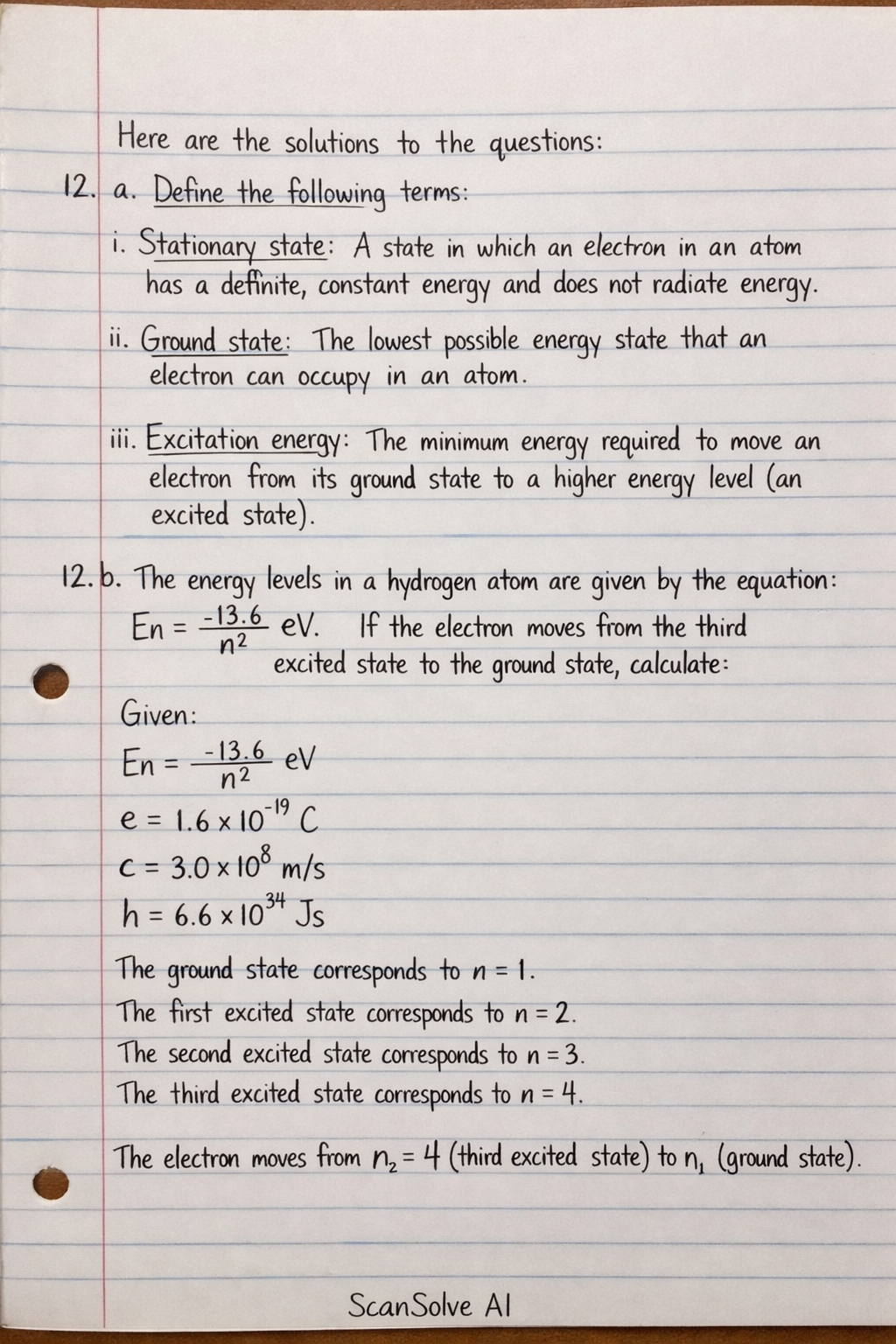
Here are the solutions to the questions:
12. a. Define the following terms:
- i. Stationary state: A state in which an electron in an atom has a definite, constant energy and does not radiate energy.
- ii. Ground state: The lowest possible energy state that an electron can occupy in an atom.
- iii. Excitation energy: The minimum energy required to move an electron from its ground state to a higher energy level (an excited state).
12. b. The energy levels in a hydrogen atom are given by the equation: eV. If the electron moves from the third excited state to the ground state, calculate:
Given:
eV
Electron charge, C
Speed of light, m/s
Planck's constant, Js
The ground state corresponds to .
The first excited state corresponds to .
The second excited state corresponds to .
The third excited state corresponds to .
The electron moves from (third excited state) to (ground state).
-
i. The energy of the radiation emitted ():
Step 1: Calculate the energy of the initial state ().
Step 2: Calculate the energy of the final state ().
Step 3: Calculate the energy of the emitted photon.
Step 4: Convert the energy from electron volts (eV) to Joules (J).
-
ii. The wavelength of the radiation ():
Step 1: Use the formula relating energy, Planck's constant, speed of light, and wavelength: .
Rearrange to solve for : .Step 2: Substitute the values.
Still stuck on this one?
Ask a follow-up, and the answer starts from this question.
More Physics Questions
Handwritten Step-by-Step Solution
Get this as a handwritten image on WhatsApp — like a tutor wrote it for you.
Try on WhatsApp