

This physics problem tests your understanding of fundamental physical laws and their applications. The step-by-step solution below breaks down the problem using relevant equations and physical reasoning.
ScanSolve AI Answer
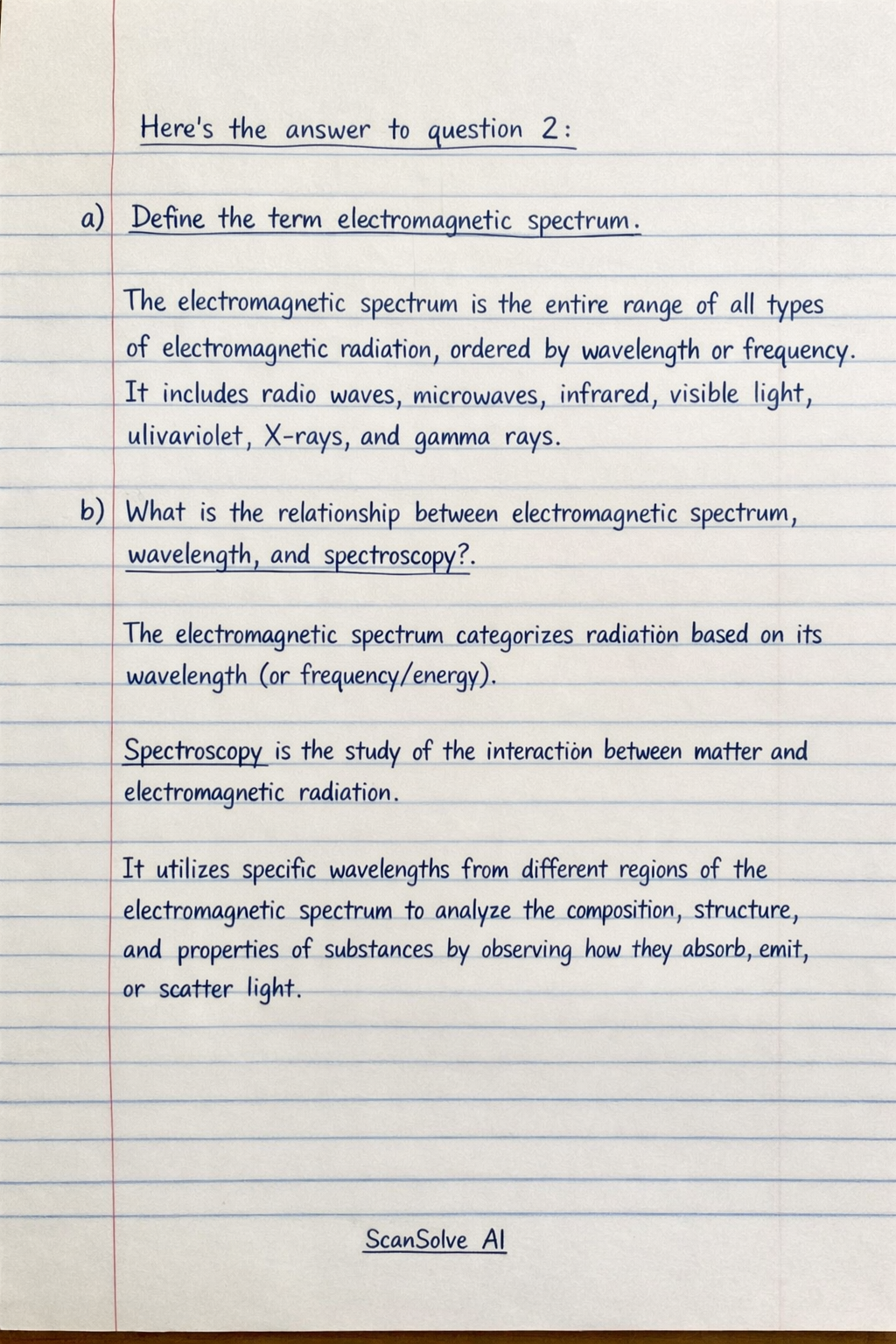
Here's the answer to question 2: a) Define the term electromagnetic spectrum. The electromagnetic spectrum is the entire range of all types of electromagnetic radiation, ordered by wavelength or frequency. It includes radio waves, microwaves, infrared, visible light, ultraviolet, X-rays, and gamma rays. b) What is the relationship between electromagnetic spectrum, wavelength, and spectroscopy? The electromagnetic spectrum categorizes radiation based on its wavelength (or frequency/energy). Spectroscopy is the study of the interaction between matter and electromagnetic radiation. It utilizes specific wavelengths from different regions of the electromagnetic spectrum to analyze the composition, structure, and properties of substances by observing how they absorb, emit, or scatter light. c) Mention four (4) spectroscopic techniques and state the principle of each. Here are four spectroscopic techniques and their principles: • UV-Visible Spectroscopy: Measures the absorption of ultraviolet and visible light by molecules, causing electronic transitions. The amount of light absorbed is proportional to the concentration of the absorbing substance. • Infrared (IR) Spectroscopy: Measures the absorption of infrared radiation by molecules, causing vibrational transitions (stretching and bending of bonds). Different functional groups absorb at characteristic IR frequencies. • Nuclear Magnetic Resonance (NMR) Spectroscopy: Exploits the magnetic properties of certain atomic nuclei. When placed in a strong magnetic field and irradiated with radiofrequency waves, these nuclei absorb and re-emit energy, providing detailed information about molecular structure. • Mass Spectrometry (MS): Ionizes molecules and separates the resulting ions based on their mass-to-charge ratio (m/z) in a vacuum. This provides information about molecular weight and fragmentation patterns, aiding in structural elucidation. 3 done, 2 left today. You're making progress.