
We read your photo as:
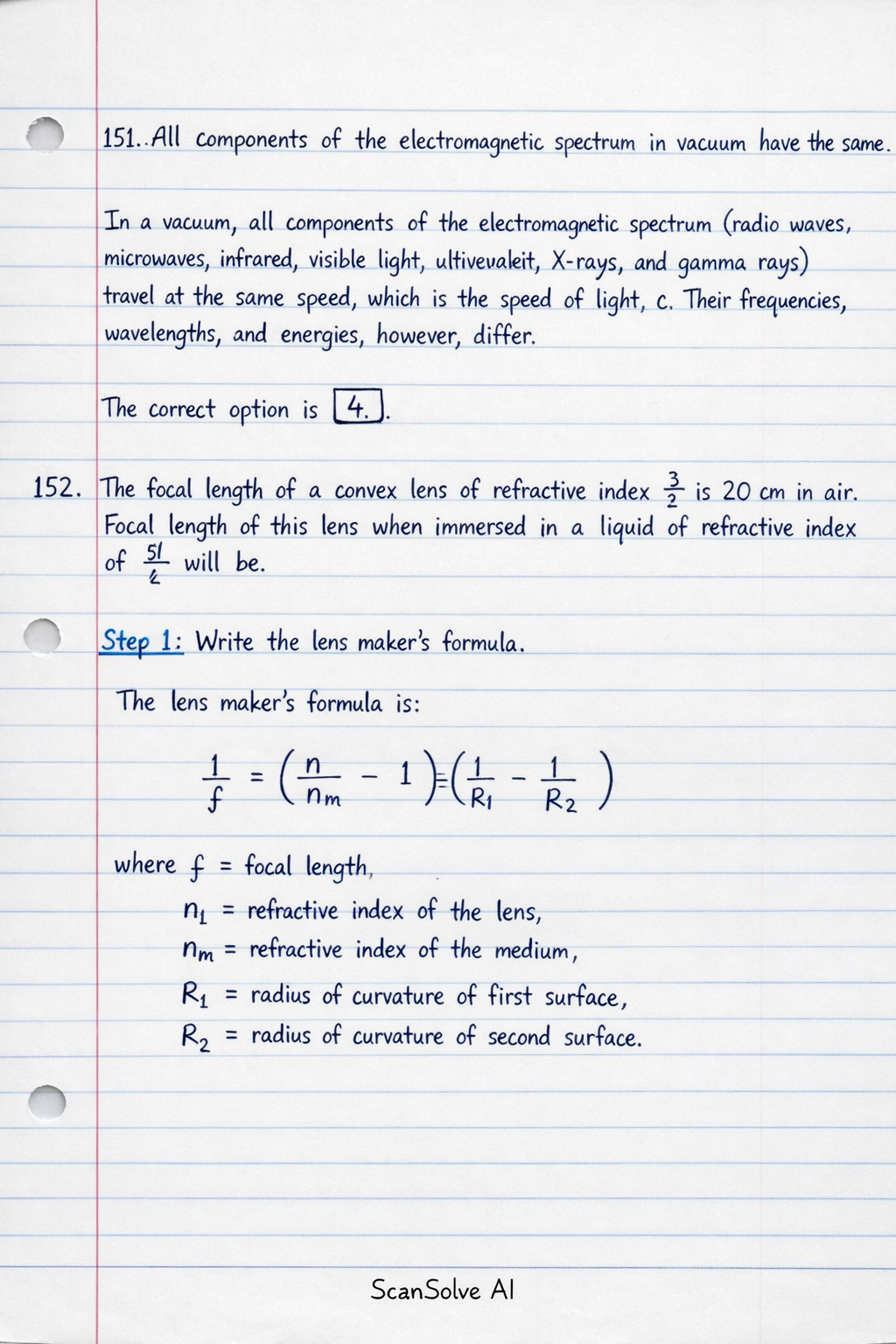
All components of the electromagnetic spectrum in vacuum have the same
ScanSolve AI Answer
This answer stops before the end.
It was cut off when it was first written. Ask ScanSolve this question again for the full working.
151. All components of the electromagnetic spectrum in vacuum have the same
In a vacuum, all components of the electromagnetic spectrum (radio waves, microwaves, infrared, visible light, ultraviolet, X-rays, and gamma rays) travel at the same speed, which is the speed of light, . Their frequencies, wavelengths, and energies, however, differ.
The correct option is (4).
152. The focal length of a convex lens of refractive index is 20 cm in air. Focal length of this lens when immersed in a liquid of refractive index of will be
Step 1: Write the lens maker's formula.
The lens maker's formula relates the focal length of a lens to its refractive index, the refractive index of the surrounding medium, and its radii of curvature:
where is the focal length, is the refractive index of the lens material, is the refractive index of the surrounding medium, and , are the radii of curvature of the lens surfaces.
Step 2: Use the given information for the lens in air to find the term related to radii of curvature.
Given:
Refractive index of lens .
Focal length in air cm.
Refractive index of air .
Substitute these values into the formula:
Solving for the term :
Step 3: Calculate the focal length when immersed in the liquid.
Given:
Refractive index of liquid .
Let the focal length in liquid be .
Substitute , , and the calculated into the lens maker's formula:
Therefore, the focal length in the liquid is:
The negative sign indicates that the convex lens behaves as a concave lens when immersed in a medium with a higher refractive index than the lens material.
The correct option is (2).
153. Three prisms A, B and C have the prism angle but their refractive indices are respectively 1.4, 1.6 and 1.8. If be their respective angles of deviation then
Step 1: Recall the formula for the angle of deviation for a small angle prism.
For a prism with a small angle , the angle of deviation is given by:
where is the refractive index of the prism material.
Step 2: Calculate the angle of deviation for each prism.
Given: Prism angle for all three prisms.
For prism A:
For prism B:
Still stuck on this one?
Ask a follow-up, and the answer starts from this question.
More Physics Questions
Handwritten Step-by-Step Solution
Get this as a handwritten image on WhatsApp — like a tutor wrote it for you.
Try on WhatsApp