
Tensile stress and strain
Physics
ScanSolve AI Answer
Here are the definitions for tensile stress and strain:
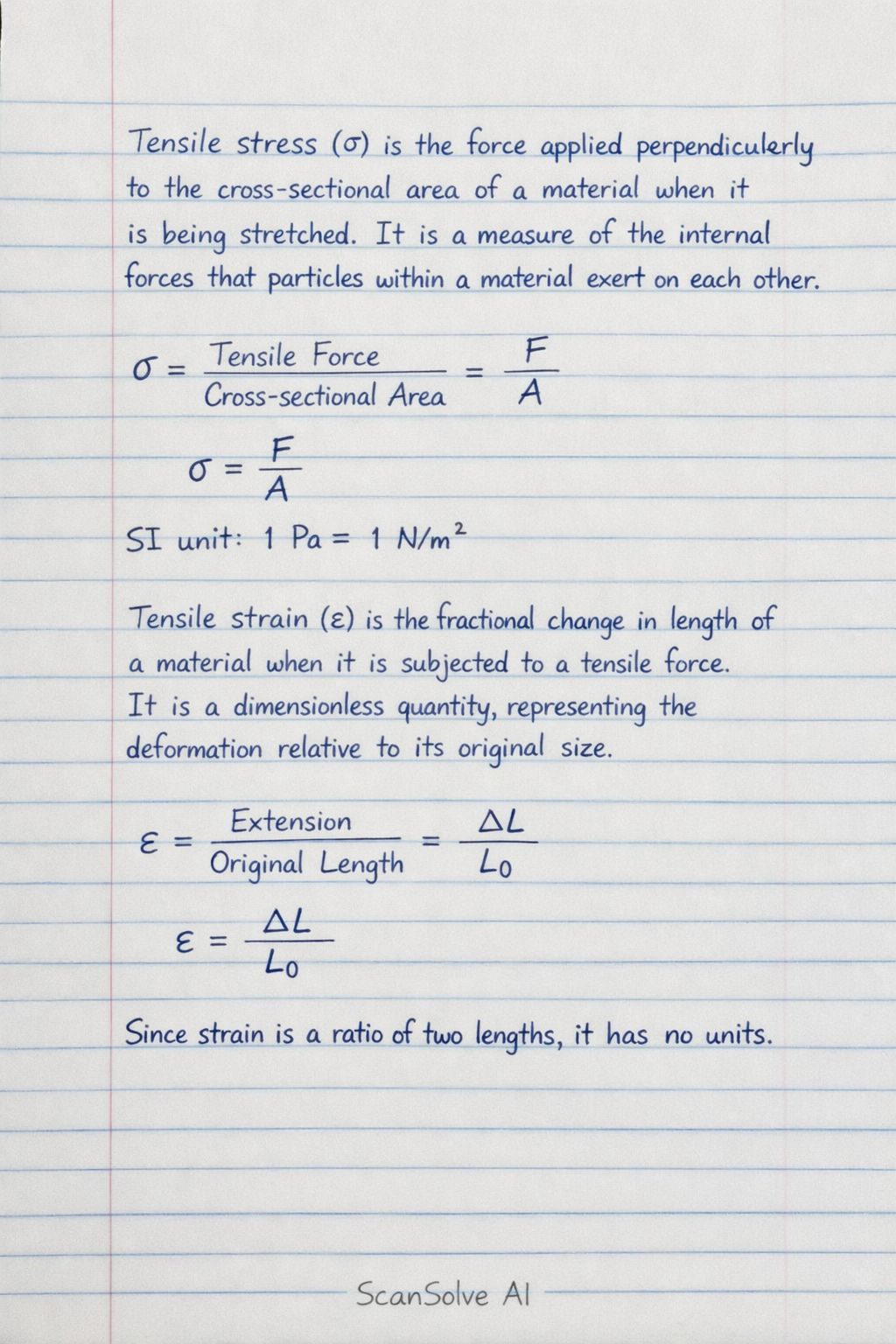
- Tensile stress () is the force applied perpendicularly to the cross-sectional area of a material when it is being stretched. It is a measure of the internal forces that particles within a continuous material exert on each other.
The SI unit for tensile stress is the pascal (), which is equivalent to newtons per square meter ().
- Tensile strain () is the fractional change in length of a material when it is subjected to a tensile force. It is a dimensionless quantity, representing the deformation of the material relative to its original size.
Since strain is a ratio of two lengths, it has no units.
Was this helpful?
Still stuck on this one?
Ask a follow-up, and the answer starts from this question.
Got a different question?Ask your own question
More Physics Questions
QDraw the stress-strain graph to the following scales: Stress 10 mm = 25 MPa; Strain 20 mm = 200…QCalculate the following: 6.1.1 The stress, 6.1.2 The final length of the bar. 6.2.1 The maximum…QCalculate the stress and strain in a metal wire given its dimensions, applied force, and elongation.QQUESTION 7: STRESS, STRAIN AND YOUNG'S MODULUS A copper rod that is 5,2 m long is subjected to a…QTrue/False: Deformation cannot be change size or shape but tensile deformation is changing of…
Handwritten Step-by-Step Solution
Get this as a handwritten image on WhatsApp — like a tutor wrote it for you.
Try on WhatsApp