

This physics problem tests your understanding of fundamental physical laws and their applications. The step-by-step solution below breaks down the problem using relevant equations and physical reasoning.
ScanSolve AI Answer
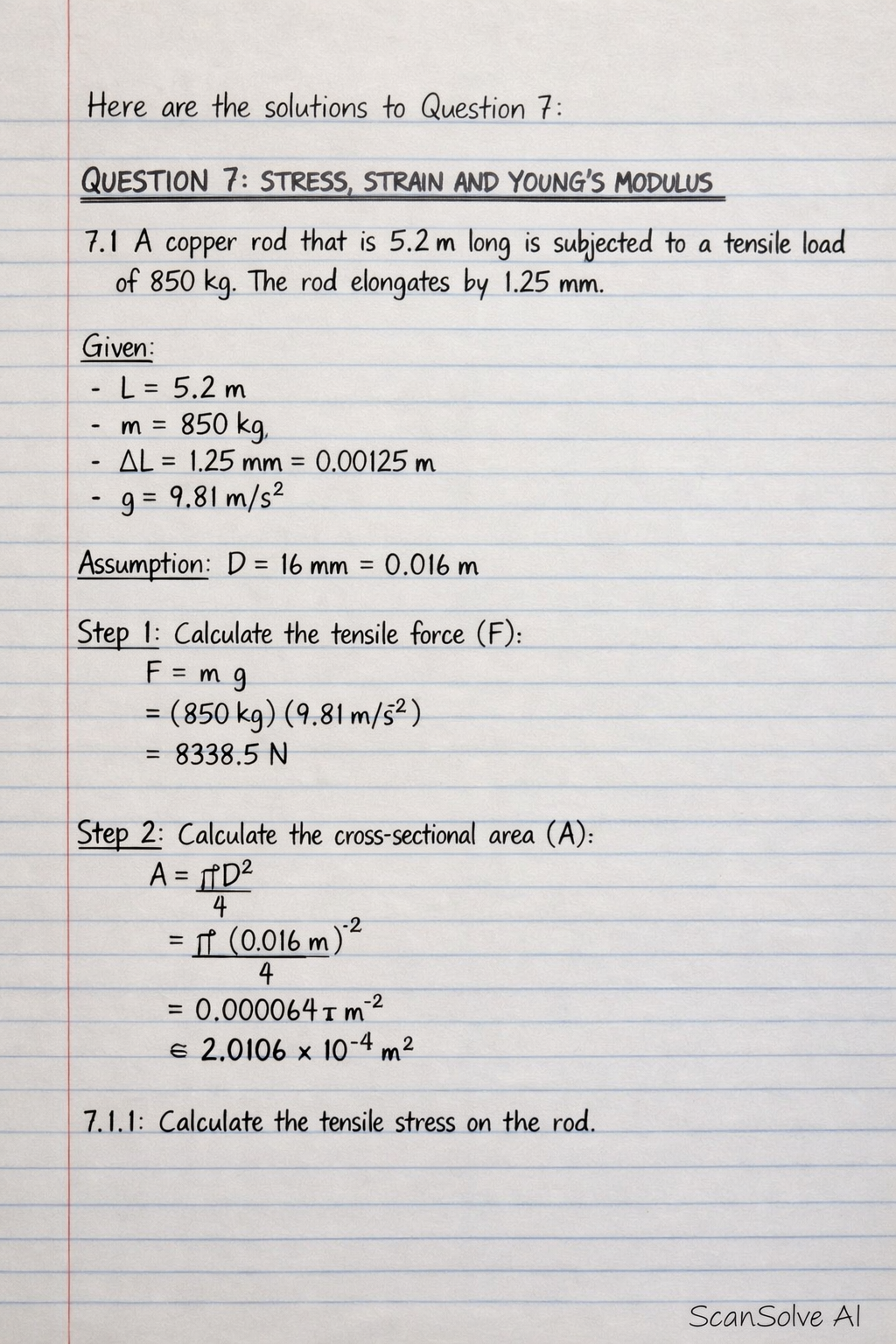
Here are the solutions to Question 7: QUESTION 7: STRESS, STRAIN AND YOUNG'S MODULUS 7.1 A copper rod that is 5,2 m long is subjected to a tensile load of 850 kg. The rod elongates by 1,25 mm. Given: Original length, L = 5.2 m Mass of load, m = 850 kg Elongation, L = 1.25 mm = 0.00125 m Acceleration due to gravity, g = 9.81 m/s^2 Assumption: The original diameter of the copper rod is 16 mm, as provided in the context of Question 7.2 for a gauge length section, and no other diameter is given for 7.1. Original diameter, D = 16 mm = 0.016 m Step 1: Calculate the tensile force (F). F = mg = (850 kg)(9.81 m/s^2) = 8338.5 N Step 2: Calculate the cross-sectional area (A). A = ( D^2)/(4) = (0.016 m)^24 = 0.000064 m^2 ≈ 2.0106 × 10^-4 m^2 7.1.1 Calculate the tensile stress on the rod. Step 3: Calculate the tensile stress (). = (F)/(A) = 8338.5 N2.0106 × 10^-4 m^2 ≈ 41472697 Pa ≈ 41.47 MPa The tensile stress on the rod is 41.47 MPa. 7.1.2 Calculate the strain on the rod. Step 4: Calculate the strain (). = ( L)/(L) = 0.00125 m5.2 m ≈ 0.00024038 The strain on the rod is 0.000240. 7.2 The following data were recorded during a tensile test on a steel specimen: Given: Original diameter, D_0 = 16 mm = 0.016 m Gauge length, L_0 = 80 mm = 0.080 m Gauge length at fracture, L_f = 92.16 mm Neck diameter at fracture, D_f = 11.52 mm Step 1: Calculate the original cross-sectional area (A_0). A_0 = ( D_0^2)/(4) = (0.016 m)^24 = 0.000064 m^2 ≈ 2.0106 × 10^-4 m^2 Step 2: Calculate Stress and Strain for each data point. Stress ( = LoadA_0) Strain ( = ExtensionL_0) | Load (kN) | Load (N) | Extension (mm) | Extension (m) | Stress () (MPa) | Strain () | | :-------- | :------- | :------------- | :------------ | :---------------------- | :------------------ | | 0 | 0 | 0 | 0 | 0 | 0 | | 15 | 15000 | 0.0182 | 0.0000182 | 74.60 | 0.0002275 | | 30 | 30000 | 0.0363 | 0.0000363 | 149.21 | 0.00045375 | | 45 | 45000 | 0.0547 | 0.0000547 | 223.82 | 0.00068375 | | 60 | 60000 | 0.0724 | 0.0000724 | 298.42 | 0.000905 | | 75 | 75000 | 0.0910 | 0.0000910 | 373.03 | 0.0011375 | 7.2.1 Draw a stress-strain graph for these values. (Due to the text-based format, I cannot draw the graph. However, the table above provides the calculated stress and strain values needed to plot the graph. The graph should have strain on the x-axis and stress on the y-axis. The points should be plotted and connected to form the stress-strain curve. The tip suggests a scale of 10 mm = 10 MPa for stress and 10 mm = 50 × 10^-6 for strain.) 7.2.2 Determine Young's modulus of elasticity with the aid of the graph. Step 3: Determine Young's Modulus (E) from the linear elastic region. Young's Modulus is the slope of the stress-strain graph in the elastic region. We can use any two points from the linear part of the table (e.g., from Load 15 kN to Load 60 kN). Let's use the points corresponding to 15 kN and 60 kN: Point 1: (_1, _1) = (0.0002275, 74.60 MPa) Point 2: (_2, _2) = (0.000905, 298.42 MPa) E = ( )/( ) = (_2 - _1)/(_2 - _1) E = (298.42 - 74.60) × 10^6 Pa(0.000905 - 0.0002275) E = 223.82 × 10^6 Pa0.0006775 ≈ 330361623 Pa E ≈ 330.36 GPa Young's modulus of elasticity is 330.36 GPa. 7.2.3 Determine the percentage reduction in area. Step 4: Calculate the final cross-sectional area (A_f). A_f = ( D_f^2)/(4) = (0.01152 m)^24 = 0.00010432896 m^2 ≈ 1.0433 × 10^-4 m^2 Step 5: Calculate the percentage reduction in area. Percentage reduction in area = (A_0 - A_f)/(A_0) × 100\% Percentage reduction in area = 2.0106 × 10^-4 m^2 - 1.0433 × 10^-4 m^22.0106 × 10^-4 m^2 × 100\% Percentage reduction in area = 0.9673 × 10^-42.0106 × 10^-4 × 100\% ≈ 48.11\% The percentage reduction in area is 48.11\%. 7.3 A hollow steel tube has an outside diameter of 50 mm and an inside diameter of 30 mm. The tube is 3,8 m long and is subjected to an axial tensile load of 60 kN. Given: Outside diameter, D_o = 50 mm = 0.050 m Inside diameter, D_i = 30 mm = 0.030 m Length, L = 3.8 m Axial tensile load, F = 60 kN = 60000 N Step 1: Calculate the cross-sectional area (A) of the hollow tube. A = ()/(4)(D_o^2 - D_i^2) = ()/(4)((0.050 m)^2 - (0.030 m)^2) A = ()/(4)(0.0025 - 0.0009) m^2 = ()/(4)(0.0016) m^2 = 0.0004 m^2 ≈ 1.2566 × 10^-3 m^2 7.3.1 Calculate the normal stress in the tube. Step 2: Calculate the normal stress (). = (F)/(A) = 60000 N0.0004 m^2 ≈ 47746482.9 Pa ≈ 47.75 MPa The normal stress in the tube is 47.75 MPa. 7.3.2 If the extension of the tube is 0,76 mm, calculate the strain. Given: Elongation, L = 0.76 mm = 0.00076 m Step 3: Calculate the strain (). = ( L)/(L) = 0.00076 m3.8 m = 0.0002 The strain is 0.0002. 7.3.3 Determine Young's modulus of the material. Step 4: Determine Young's Modulus (E). E = ()/() = 47.746 × 10^6 Pa0.0002 ≈ 238730000000 Pa E ≈ 238.73 GPa Young's modulus of the material is 238.73 GPa.