

This physics problem tests your understanding of fundamental physical laws and their applications. The step-by-step solution below breaks down the problem using relevant equations and physical reasoning.
ScanSolve AI Answer
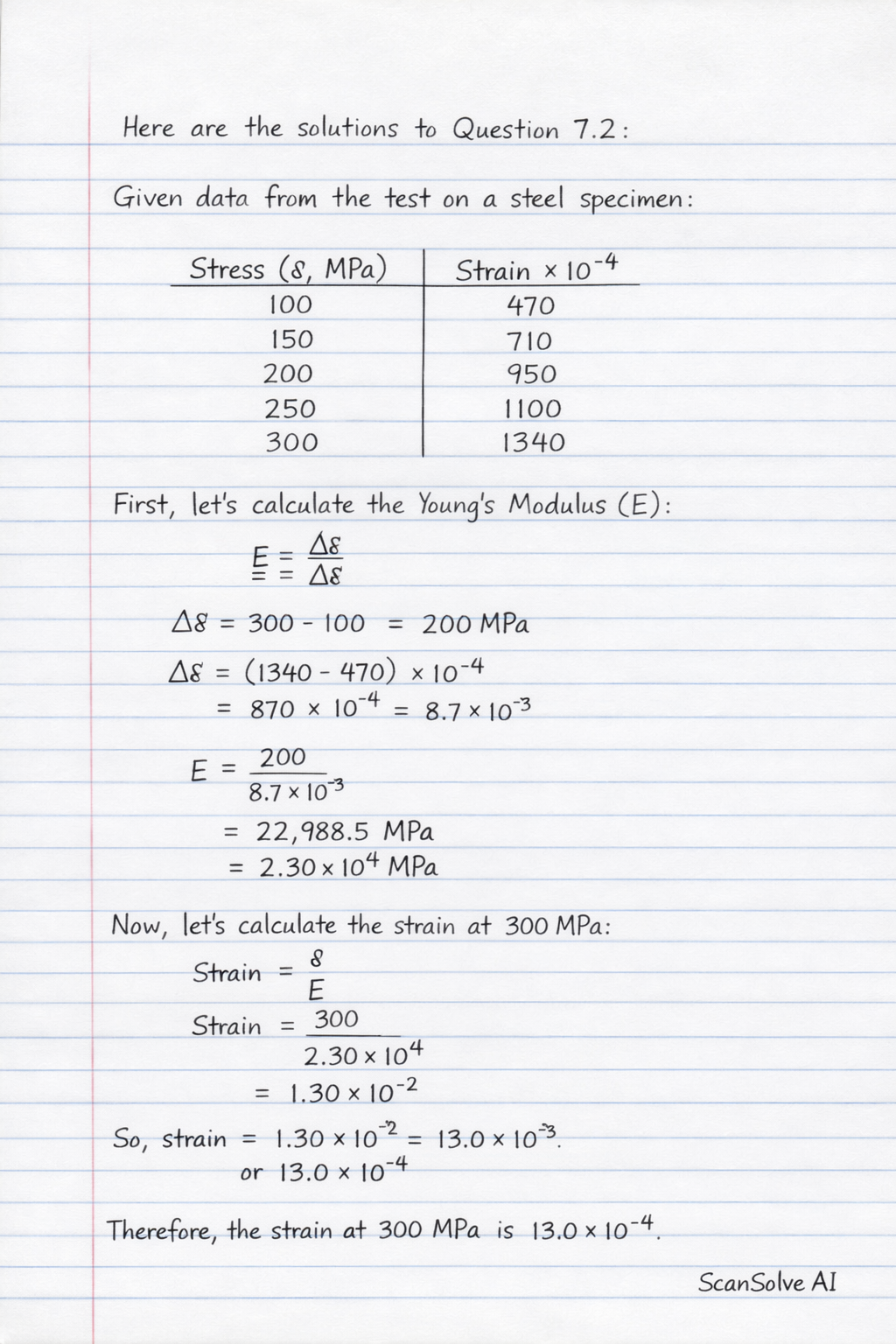
Here are the solutions to Question 7.2: Given data from the test on a steel specimen: | Stress (, MPa) | Strain × 10^-4 | | :--------------------- | :---------------------- | | 100 | 470 | | 150 | 710 | | 200 | 950 | | 250 | 1100 | | 300 | 1340 | Assumption for Strain Units: Based on typical values for Young's Modulus of steel (around 200 GPa) and the previous question (7.1), it is highly probable that the "Strain × 10^-4" in the table header is a typo and should be "Strain × 10^-6". We will proceed with this assumption to obtain a realistic modulus of elasticity for steel. Therefore, the actual strain values are: | Stress (, MPa) | Strain () | | :--------------------- | :------------------ | | 100 | 470 × 10^-6 = 0.000470 | | 150 | 710 × 10^-6 = 0.000710 | | 200 | 950 × 10^-6 = 0.000950 | | 250 | 1100 × 10^-6 = 0.001100 | | 300 | 1340 × 10^-6 = 0.001340 | 7.2.1 Draw the stress-strain graph to the following scales: Stress: 10 mm = 25 MPa Strain: 20 mm = 200 × 10^-4 (Using the corrected assumption, this becomes 20 mm = 200 × 10^-6) Step 1: Set up the graph axes and scales. Y-axis (Stress): Label the vertical axis "Stress (, MPa)". Scale: 10 mm represents 25 MPa. This means 1 mm represents 2.5 MPa. Mark points at 0, 25, 50, 75, 100, , 300 MPa. X-axis (Strain): Label the horizontal axis "Strain ()". Scale: 20 mm represents 200 × 10^-6 (or 0.0002). This means 1 mm represents 10 × 10^-6 (or 0.00001) strain. Mark points at 0, 200 × 10^-6, 400 × 10^-6, , 1400 × 10^-6. Step 2: Plot the data points. Plot the following points on your graph: (0.000470, 100) (0.000710, 150) (0.000950, 200) (0.001100, 250) (0.001340, 300) Step 3: Draw the best-fit line. Draw a straight line through the initial linear portion of the plotted points. For steel, the stress-strain curve is typically linear up to the yield point. 7.2.2 Determine the modulus of elasticity. Step 4: Calculate Young's modulus (E) from the linear portion of the data. Young's modulus is the slope of the stress-strain curve in the elastic region. We will use the first two data points, which typically represent the initial linear elastic behavior. E = ( )/( ) Using the first two points: _1 = 100 MPa = 100 × 10^6 Pa _1 = 470 × 10^-6 _2 = 150 MPa = 150 × 10^6 Pa _2 = 710 × 10^-6 E = (150 - 100) × 10^6 Pa(710 - 470) × 10^-6 E = 50 × 10^6 Pa240 × 10^-6 E = (50)/(240) × 10^12 Pa E ≈ 0.208333 × 10^12 Pa E ≈ 208.33 × 10^9 Pa E ≈ 208.33 GPa The modulus of elasticity is 208.33 GPa.