
Give note on , with calculations if there's any Stress/strain Tensile/compressive stress Modulus of elasticity Poisson ratio Composite materials
Economics
ScanSolve AI Answer
Step-by-step solution
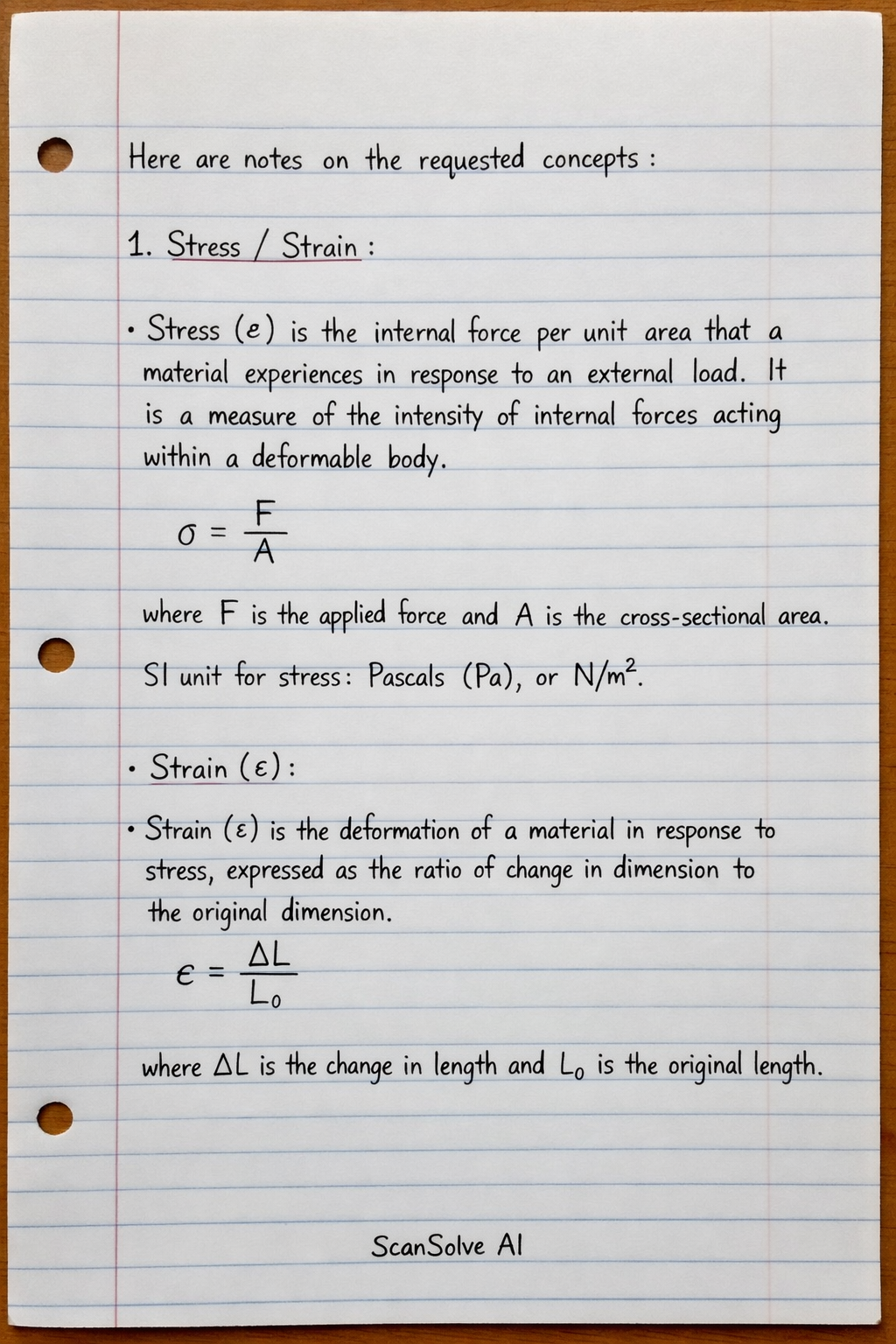
5 stepsHere are notes on the requested concepts:
Stress/Strain
- Stress () is the internal force per unit area that a material experiences in response to an external load. It is a measure of the intensity of internal forces acting within a deformable body. where is the applied force and is the cross-sectional area. The SI unit for stress is Pascals (), or .
- Strain () is the deformation of a material in response to stress, expressed as the ratio of change in dimension to the original dimension. It is a dimensionless quantity. where is the change in length and is the original length.
Tensile/Compressive Stress
- Tensile stress occurs when a material is subjected to forces that pull it apart, causing elongation. The stress acts perpendicular to the cross-section and points outwards.
- Compressive stress occurs when a material is subjected to forces that push it together, causing shortening. The stress acts perpendicular to the cross-section and points inwards. Both tensile and compressive stress are types of normal stress.
Modulus of Elasticity (Young's Modulus)
- The Modulus of Elasticity (), also known as Young's Modulus, is a measure of a material's stiffness or resistance to elastic deformation under load. It is defined as the ratio of stress to strain in the elastic region of a material's stress-strain curve. The SI unit for the Modulus of Elasticity is Pascals (), or . A higher modulus indicates a stiffer material.
Poisson's Ratio
- Poisson's ratio () is a material property that describes the ratio of transverse (lateral) strain to axial (longitudinal) strain when a material is stretched or compressed. When a material is stretched in one direction, it tends to contract in the perpendicular directions. The negative sign indicates that a positive axial strain (stretching) results in a negative lateral strain (contraction). Poisson's ratio is a dimensionless quantity, typically ranging from 0 to 0.5 for most engineering materials.
Composite Materials
- Composite materials are engineered materials made from two or more constituent materials with significantly different physical or chemical properties that remain separate and distinct at the macroscopic or microscopic level within the finished structure. They are designed to achieve properties superior to those of the individual components. Common examples include fiber-reinforced polymers (like fiberglass or carbon fiber composites) and concrete (cement, aggregate, and water). The overall properties of a composite, such as its modulus of elasticity, can often be estimated using rules of mixtures based on the properties and volume fractions of its constituent phases.
Was this helpful?
Still stuck on this one?
Ask a follow-up, and the answer starts from this question.
Got a different question?Ask your own question
More Economics Questions
QDraw the stress-strain graph to the following scales: Stress 10 mm = 25 MPa; Strain 20 mm = 200…QA concrete cylinder of diameter 150 mm and length 300 mm when subjected to an axial compressive load…QTensile stress and strainQ8.Thebulkmodulusofamaterialismostrelevantwhenanalyzing: 12.Intheequationforthermalstress,sigma=Y(alp…QCalculate the maximum load, tensile stress, shear stress, and crushing stress for the tie bar in the…
Browse by topic:Microeconomics
Handwritten Step-by-Step Solution
Get this as a handwritten image on WhatsApp — like a tutor wrote it for you.
Try on WhatsApp