We read your photo as:

Define stress and modulus of elasticity with SI units. Calculate changes in length and diameter of a bar under load. Determine hoop stress in a cylindrical pressure vessel.

Physics

ScanSolve AI Answer

Answers

3 parts
b(i)

−0.0393 mm-0.0393 \text{ mm}

b(ii)

+0.000825 mm+0.000825 \text{ mm}

c

128.57 MPa128.57 \text{ MPa}

Step-by-step solution

11 steps

Part a(i)

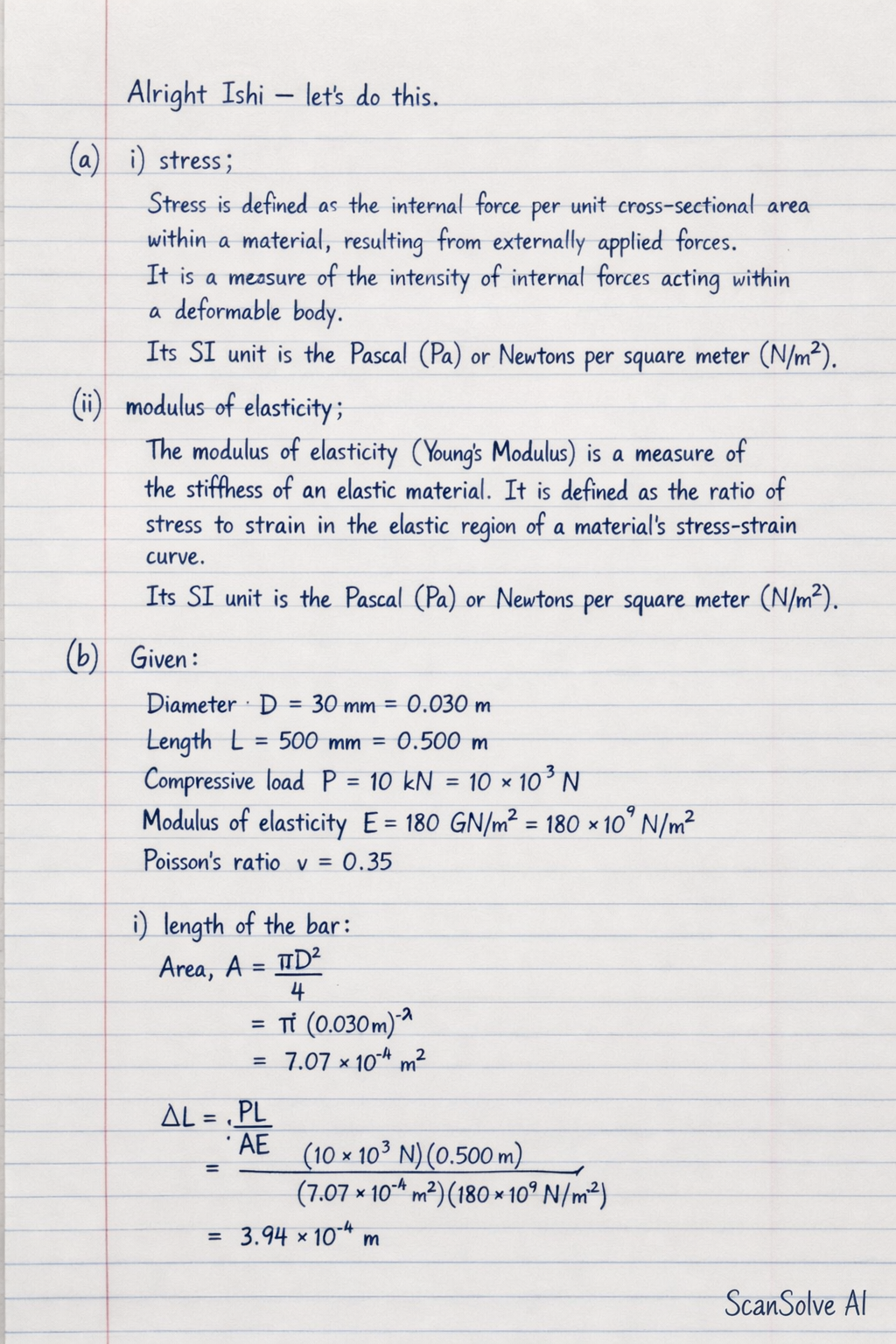
stress;

Stress is defined as the internal force per unit cross-sectional area within a material, resulting from externally applied forces. It is a measure of the intensity of internal forces acting within a deformable body.
Its SI unit is the Pascal (Pa) or Newtons per square meter (N/m2\text{N/m}^2).

Part a(ii)

modulus of elasticity.

The modulus of elasticity (Young's Modulus) is a measure of the stiffness of an elastic material. It is defined as the ratio of stress to strain in the elastic region of a material's stress-strain curve.
Its SI unit is the Pascal (Pa) or Newtons per square meter (N/m2\text{N/m}^2).

Part b(i)

−0.0393 mm-0.0393 \text{ mm}

length of the bar;

Given:
Diameter D=30 mm=0.030 mD = 30 \text{ mm} = 0.030 \text{ m}
Length L=500 mm=0.500 mL = 500 \text{ mm} = 0.500 \text{ m}
Compressive load P=10 kN=10×103 NP = 10 \text{ kN} = 10 \times 10^3 \text{ N}
Modulus of elasticity E=180 GN/m2=180×109 N/m2E = 180 \text{ GN/m}^2 = 180 \times 10^9 \text{ N/m}^2
Poisson's ratio ν=0.35\nu = 0.35

  1. Calculate the cross-sectional area (AA) of the bar.

    A=πD24A = \frac{\pi D^2}{4} A=π(0.030 m)24A = \frac{\pi (0.030 \text{ m})^2}{4} A=π×0.0009 m24A = \frac{\pi \times 0.0009 \text{ m}^2}{4} A=0.000706858 m2A = 0.000706858 \text{ m}^2
  2. Calculate the axial stress (σ\sigma) in the bar.

    σ=PA\sigma = \frac{P}{A} σ=10×103 N0.000706858 m2\sigma = \frac{10 \times 10^3 \text{ N}}{0.000706858 \text{ m}^2} σ≈14147123.5 N/m2≈14.147 MPa\sigma \approx 14147123.5 \text{ N/m}^2 \approx 14.147 \text{ MPa}
  3. Calculate the axial strain (ϵL\epsilon_L) using Hooke's Law.

    ϵL=σE\epsilon_L = \frac{\sigma}{E} ϵL=14.147×10⁶ N/m2180×109 N/m2\epsilon_L = \frac{14.147 \times 10^6 \text{ N/m}^2}{180 \times 10^9 \text{ N/m}^2} ϵL≈0.000078594\epsilon_L \approx 0.000078594
  4. Calculate the change in length (ΔL\Delta L).

    ΔL=ϵL×L\Delta L = \epsilon_L \times L ΔL=0.000078594×0.500 m\Delta L = 0.000078594 \times 0.500 \text{ m} ΔL≈0.000039297 m\Delta L \approx 0.000039297 \text{ m}

    Since the load is compressive, the length will decrease.

    ΔL≈0.0393 mm\Delta L \approx 0.0393 \text{ mm}

    The change in length of the bar is −0.0393 mm\boxed{-0.0393 \text{ mm}} (negative indicates decrease).

Part b(ii)

+0.000825 mm+0.000825 \text{ mm}

diameter of the bar.

  1. Calculate the lateral strain (ϵD\epsilon_D) using Poisson's ratio.

    Poisson's ratio ν=−lateral strainaxial strain=−ϵDϵL\nu = -\frac{\text{lateral strain}}{\text{axial strain}} = -\frac{\epsilon_D}{\epsilon_L}.

    ϵD=−ν×ϵL\epsilon_D = -\nu \times \epsilon_L ϵD=−0.35×0.000078594\epsilon_D = -0.35 \times 0.000078594 ϵD≈−0.000027508\epsilon_D \approx -0.000027508

    Since the axial strain is compressive (negative change in length), the lateral strain will be positive (increase in diameter).

  2. Calculate the change in diameter (ΔD\Delta D).

    ΔD=ϵD×D\Delta D = \epsilon_D \times D ΔD=0.000027508×0.030 m\Delta D = 0.000027508 \times 0.030 \text{ m} ΔD≈0.00000082524 m\Delta D \approx 0.00000082524 \text{ m} ΔD≈0.000825 mm\Delta D \approx 0.000825 \text{ mm}

    The change in diameter of the bar is +0.000825 mm\boxed{+0.000825 \text{ mm}} (positive indicates increase).

Part c

128.57 MPa128.57 \text{ MPa}

Given:
Cylinder diameter D=1.5 mD = 1.5 \text{ m}
Shell thickness t=3.5 mm=0.0035 mt = 3.5 \text{ mm} = 0.0035 \text{ m}
Internal fluid pressure p=600 kN/m2=600×103 N/m2p = 600 \text{ kN/m}^2 = 600 \times 10^3 \text{ N/m}^2

  1. Consider a longitudinal section of the cylindrical pressure vessel of length LL.

    The internal pressure pp acts radially outwards.

  2. Calculate the total force (FpF_p) exerted by the internal pressure on the projected area.

    The projected area over which the pressure acts is D×LD \times L.

    Fp=p×(D×L)F_p = p \times (D \times L) Fp=(600×103 N/m2)×(1.5 m×L)F_p = (600 \times 10^3 \text{ N/m}^2) \times (1.5 \text{ m} \times L) Fp=900×103×L NF_p = 900 \times 10^3 \times L \text{ N}
  3. Calculate the resisting force (FrF_r) due to the hoop stress (σh\sigma_h) in the shell.

    The hoop stress acts tangentially on the two cut surfaces of the shell, each with an area of t×Lt \times L.

    Fr=σh×(2×t×L)F_r = \sigma_h \times (2 \times t \times L) Fr=σh×(2×0.0035 m×L)F_r = \sigma_h \times (2 \times 0.0035 \text{ m} \times L) Fr=σh×(0.007×L) NF_r = \sigma_h \times (0.007 \times L) \text{ N}
  4. Equate the internal pressure force to the resisting force for equilibrium.

    Fp=FrF_p = F_r 900×103×L=σh×(0.007×L)900 \times 10^3 \times L = \sigma_h \times (0.007 \times L)
  5. Solve for the hoop stress (σh\sigma_h).

    σh=900×1030.007 N/m2\sigma_h = \frac{900 \times 10^3}{0.007} \text{ N/m}^2 σh=9000000.007 N/m2\sigma_h = \frac{900000}{0.007} \text{ N/m}^2 σh≈128571428.57 N/m2\sigma_h \approx 128571428.57 \text{ N/m}^2 σh≈128.57 MPa\sigma_h \approx 128.57 \text{ MPa}

    The hoop stress in the vessel is 128.57 MPa\boxed{128.57 \text{ MPa}}.

Was this helpful?

Try one yourself

A new problem that tests the same skill.

Still stuck on this one?

Ask a follow-up, and the answer starts from this question.

Got a different question?Ask your own question
Handwritten step-by-step solution preview

Handwritten Step-by-Step Solution

Get this as a handwritten image on WhatsApp — like a tutor wrote it for you.

Try on WhatsApp