
We read your photo as:
True/False: Deformation cannot be change size or shape but tensile deformation is changing of length. Plastic and elastic deformations are the same. Stress and strain are force over area. Work out: A
ScanSolve AI Answer
Step-by-step solution
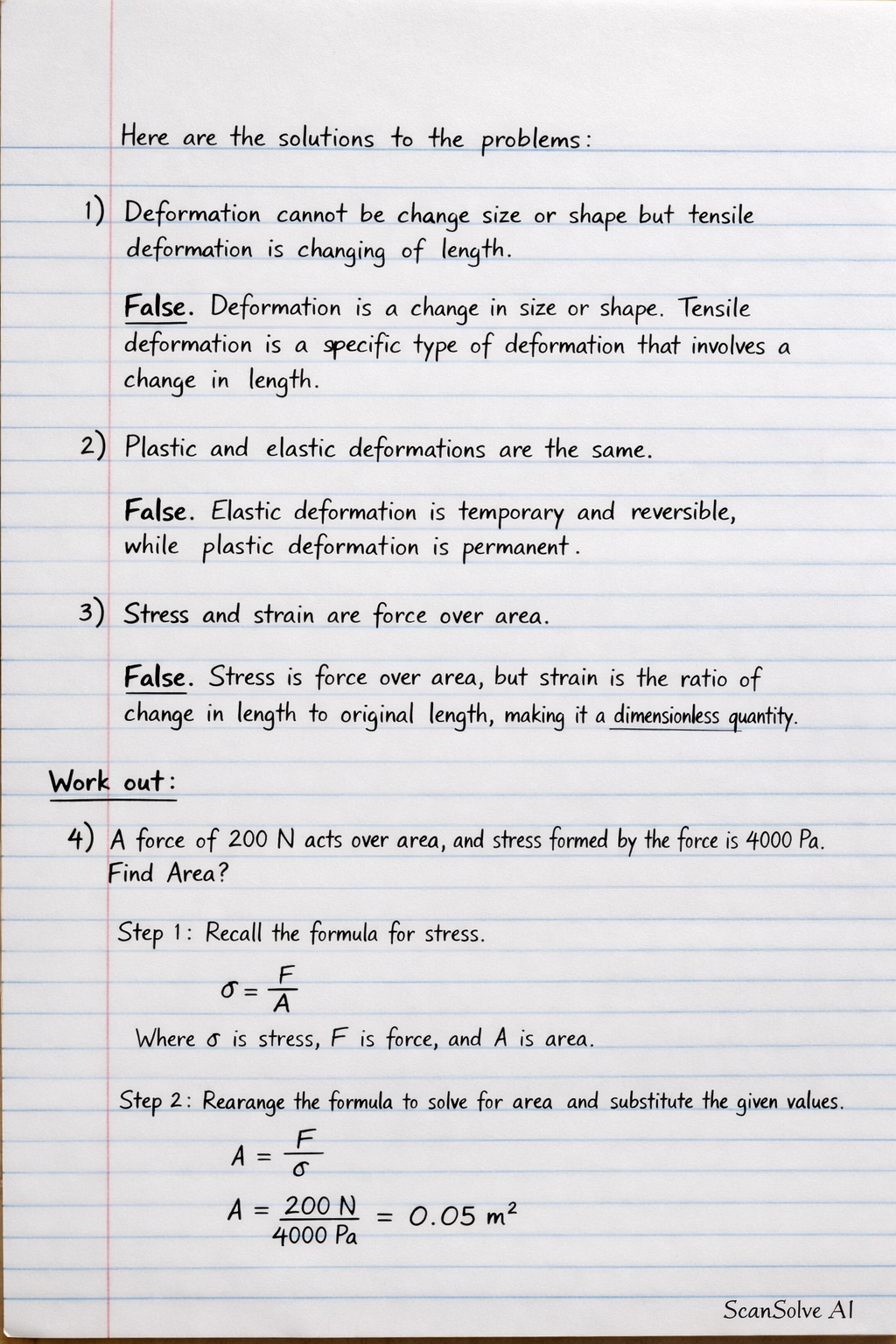
8 stepsHere are the solutions to the problems:
Group work: Write True or False if not
-
Deformation cannot be change size or shape but tensile deformation is changing of length.
- False. Deformation is a change in size or shape. Tensile deformation is a specific type of deformation that involves a change in length.
-
Plastic and elastic deformations are the same.
- False. Elastic deformation is temporary and reversible, while plastic deformation is permanent.
-
Stress and strain are force over area.
- False. Stress is force over area, but strain is the ratio of change in length to original length, making it a dimensionless quantity.
Work out
4. A force of acts over area, and stress formed by the force is . Find Area?
Recall the formula for stress.
Where is stress, is force, and is area.
Rearrange the formula to solve for area and substitute the given values.
Calculate the area.
The area is .
5. A force of acts over cross section area of a wire of length , if wire increase by . Find
(a) Stress
(b) Strain
a) Stress
Recall the formula for stress and substitute the given values.
Calculate the stress.
The stress is .
b) Strain
Convert the increase in length from centimeters to meters.
Recall the formula for strain and substitute the values.
Calculate the strain.
The strain is .
Still stuck on this one?
Ask a follow-up, and the answer starts from this question.
More Physics Questions
Handwritten Step-by-Step Solution
Get this as a handwritten image on WhatsApp — like a tutor wrote it for you.
Try on WhatsApp