a) The area under a stress-strain curve represents the energy stored per unit volume of the material. Up to the elastic limit, this is known as resilience, and up to the point of fracture, it re
This physics problem tests your understanding of fundamental physical laws and their applications. The step-by-step solution below breaks down the problem using relevant equations and physical reasoning.
ScanSolve AI Answer
4.
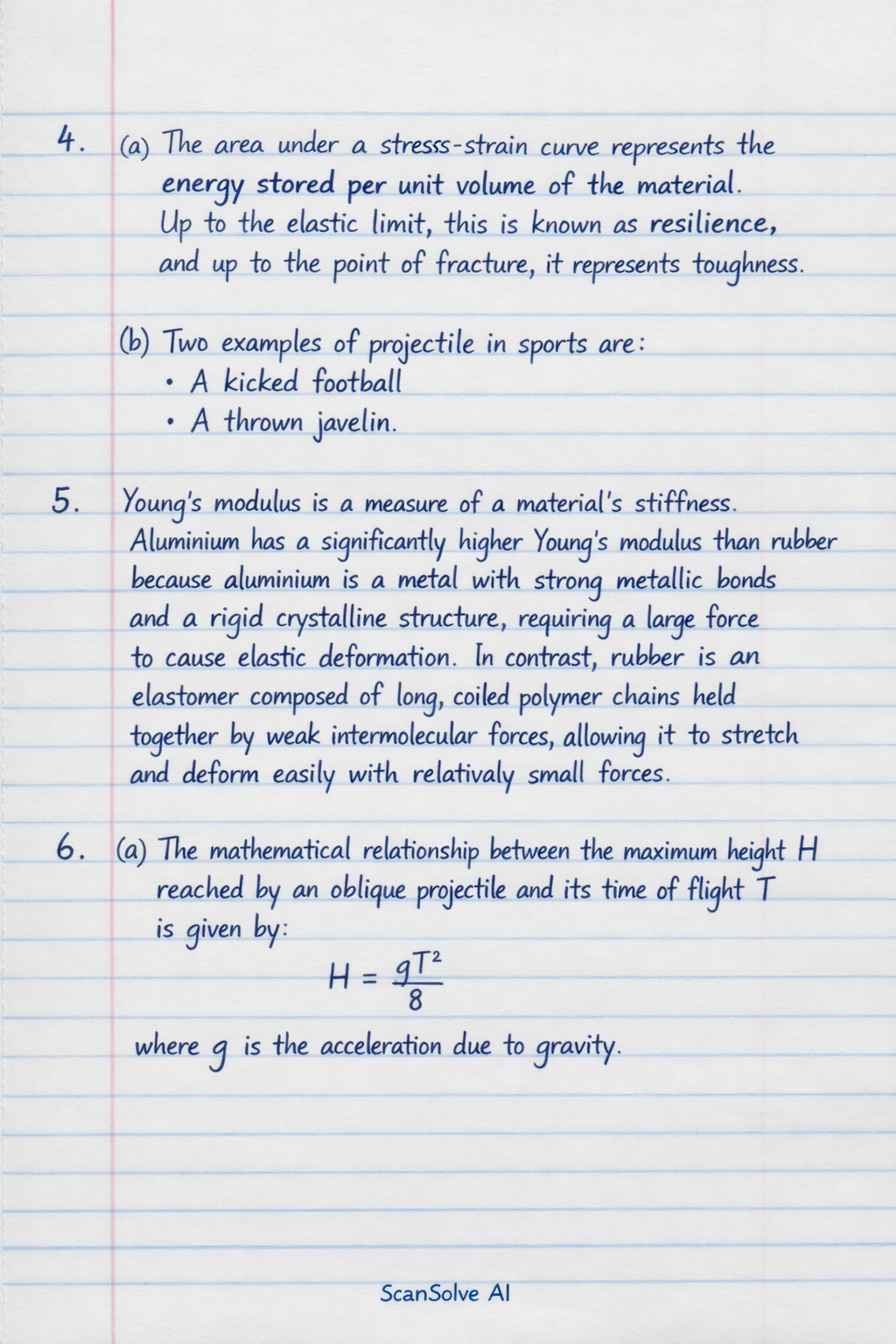
a) The area under a stress-strain curve represents the energy stored per unit volume of the material. Up to the elastic limit, this is known as resilience, and up to the point of fracture, it represents toughness.
b) Two examples of projectile in sports are:
• A kicked football
• A thrown javelin
5.
Young's modulus is a measure of a material's stiffness. Aluminium has a significantly higher Young's modulus than rubber because aluminium is a metal with strong metallic bonds and a rigid crystalline structure, requiring a large force to cause elastic deformation. In contrast, rubber is an elastomer composed of long, coiled polymer chains held together by weak intermolecular forces, allowing it to stretch and deform easily with relatively small forces.
6.
a) The mathematical relationship between the maximum height $H$ reached by an oblique projectile and its time of flight $T$ is given by:
$$ H = \frac{gT^2}{8} $$
where $g$ is the acceleration due to gravity.
b)
Given:
Initial speed, $u = 8 \text{ m s}^{-1}$
Acceleration due to gravity, $g = 10 \text{ m s}^{-2}$
Condition: to attain a maximum range.
Step 1: Determine the angle of projection for maximum range.
For maximum range, the angle of projection $\theta = 45^\circ$.
Step 2: Determine the velocity components at the highest point.
At the highest point of a projectile's trajectory, the vertical component of velocity ($v_y$) is zero. The horizontal component of velocity ($v_x$) remains constant throughout the flight (neglecting air resistance).
$$ v_x = u \cos\theta $$
Step 3: Calculate the horizontal velocity at the highest point.
$$ v_x = (8 \text{ m s}^{-1}) \times \cos(45^\circ) $$
$$ v_x = 8 \text{ m s}^{-1} \times \frac{\sqrt{2}}{2} $$
$$ v_x = 4\sqrt{2} \text{ m s}^{-1} $$
$$ v_x \approx 4 \times 1.4142 \text{ m s}^{-1} $$
$$ v_x \approx 5.6568 \text{ m s}^{-1} $$
Step 4: State the velocity at the highest point.
Since the vertical velocity is zero at the highest point, the velocity of the body at the highest point is equal to its horizontal velocity.
Velocity at the highest point $\approx \boxed{5.7 \text{ m s}^{-1}}$.
7.
a) The principle on which fibre optics is based is Total Internal Reflection.
b) The two main parts of an optical fibre are:
• Core
• Cladding
Last free one today — make it count tomorrow, or type /upgrade for unlimited.
a) The area under a stress-strain curve represents the energy stored per unit volume of the material. Up to the elastic limit, this is known as resilience, and up to the point of fracture, it re
|Physics
a) The area under a stress-strain curve represents the energy stored per unit volume of the material. Up to the elastic limit, this is known as resilience, and up to the point of fracture, it re
ScanSolve AI Answer
4.a) The area under a stress-strain curve represents the energy stored per unit volume of the material. Up to the elastic limit, this is known as resilience, and up to the point of fracture, it represents toughness.
b) Two examples of projectile in sports are:
• A kicked football
• A thrown javelin
5.
Young's modulus is a measure of a material's stiffness. Aluminium has a significantly higher Young's modulus than rubber because aluminium is a metal with strong metallic bonds and a rigid crystalline structure, requiring a large force to cause elastic deformation. In contrast, rubber is an elastomer composed of long, coiled polymer chains held together by weak intermolecular forces, allowing it to stretch and deform easily with relatively small forces.
6.a) The mathematical relationship between the maximum height H reached by an oblique projectile and its time of flight T is given by:
H=8gT2
where g is the acceleration due to gravity.
b)
Given:
Initial speed, u=8ms−1
Acceleration due to gravity, g=10ms−2
Condition: to attain a maximum range.
Step 1: Determine the angle of projection for maximum range.
For maximum range, the angle of projection θ=45∘.
Step 2: Determine the velocity components at the highest point.
At the highest point of a projectile's trajectory, the vertical component of velocity (vy) is zero. The horizontal component of velocity (vx) remains constant throughout the flight (neglecting air resistance).
vx=ucosθ
Step 3: Calculate the horizontal velocity at the highest point.
vx=(8ms−1)×cos(45∘)vx=8ms−1×22vx=42ms−1vx≈4×1.4142ms−1vx≈5.6568ms−1
Step 4: State the velocity at the highest point.
Since the vertical velocity is zero at the highest point, the velocity of the body at the highest point is equal to its horizontal velocity.
Velocity at the highest point \approx 5.7 \text{ m s^{-1}}.
7.a) The principle on which fibre optics is based is Total Internal Reflection.
b) The two main parts of an optical fibre are:
• Core
• Cladding
Last free one today — make it count tomorrow, or type /upgrade for unlimited.
Need help with your own homework?
Get instant step-by-step solutions to any question. Free to start.