
We read your photo as:
Describe the process of fracture in ductile and brittle materials using a stress-strain curve.
Physics
ScanSolve AI Answer
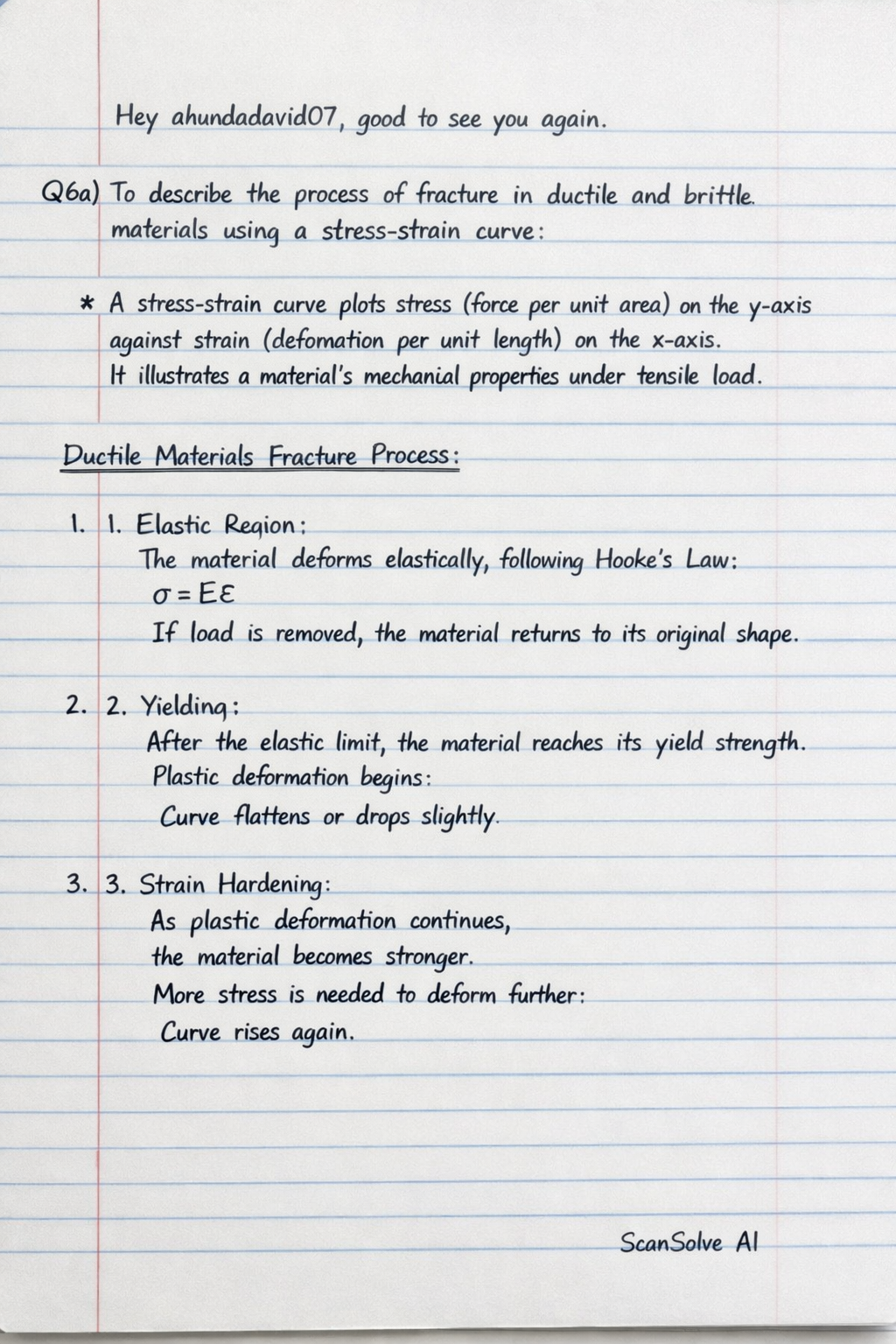
Q6a) To describe the process of fracture in ductile and brittle materials using a stress-strain curve:
- A stress-strain curve plots stress (force per unit area) on the y-axis against strain (deformation per unit length) on the x-axis. It illustrates a material's mechanical properties under tensile load.
Ductile Materials Fracture Process:
- Elastic Region: Initially, the material deforms elastically, following Hooke's Law, where stress is proportional to strain. If the load is removed, the material returns to its original shape.
- Yielding: Beyond the elastic limit, the material reaches its yield strength and begins to deform plastically. This permanent deformation occurs, and the curve may flatten or show a slight drop.
- Strain Hardening: As plastic deformation continues, the material becomes stronger and harder, requiring more stress to deform further. The curve rises again.
- Ultimate Tensile Strength (UTS): The stress reaches a maximum point, the ultimate tensile strength. Beyond this point, the material can no longer withstand increasing load.
- Necking: After UTS, a localized reduction in cross-sectional area, known as necking, begins. The engineering stress appears to decrease, but the true stress continues to rise.
- Fracture: The material finally fractures after significant plastic deformation and necking, typically resulting in a cup-and-cone fracture surface.
Brittle Materials Fracture Process:
- Elastic Region: Brittle materials also deform elastically in the initial stages, following Hooke's Law.
- Little to No Plastic Deformation: Unlike ductile materials, brittle materials exhibit very little or no plastic deformation before fracture. The elastic region extends almost up to the fracture point.
- Fracture: Fracture occurs suddenly and catastrophically at or very close to the ultimate tensile strength, with minimal prior warning or deformation. The fracture surface is typically flat and perpendicular to the applied stress.
A neat diagram of a stress-strain curve showing these regions and the distinct fracture points for both ductile and brittle materials is essential for a complete answer. The ductile curve will show a long plastic region and necking before fracture, while the brittle curve will be steeper, shorter, and end abruptly after the elastic region.
Was this helpful?
Still stuck on this one?
Ask a follow-up, and the answer starts from this question.
Got a different question?Ask your own question
More Physics Questions
QA) The area under a stress-strain curve represents the energy stored per unit volume of the…QDraw the stress-strain graph to the following scales: Stress 10 mm = 25 MPa; Strain 20 mm = 200…QTensile stress and strainQDefine structural geology, stress, and strain in rocks.QCalculate the stress and strain in the wire using the provided data and figures.
Handwritten Step-by-Step Solution
Get this as a handwritten image on WhatsApp — like a tutor wrote it for you.
Try on WhatsApp